
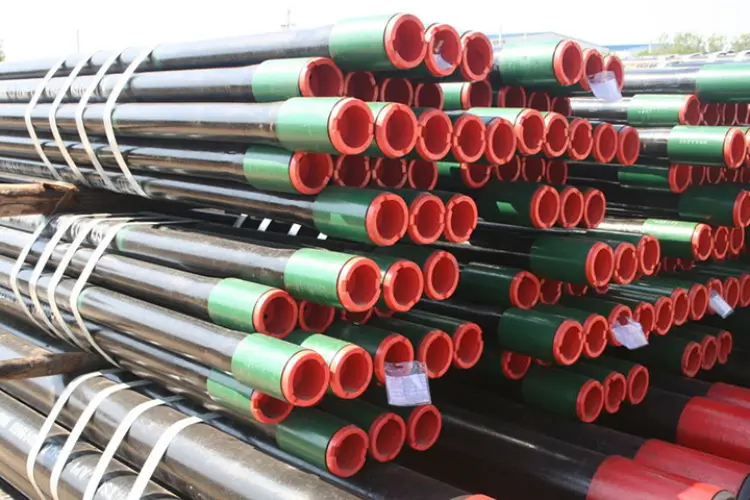
ASTM A572 Grade 42 SSAW Pipe
ASTM A572 Grade 42 SSAW Pipe - Complete Material Data and Equivalent Grades
In-depth technical reference for ASTM A572 Grade 42 steel used in spiral submerged arc welded (SSAW) pipes. Covers chemical composition, mechanical and thermal properties, international equivalents, and application guidelines.
Spiral submerged arc welding (SSAW), cold forming, hot bending, cutting, machining, and subsequent heat treatments such as stress relieving.
- Phone : +8618037372205
- Email : [email protected]
- WhatsApp: Contact via Whtsapp
- WeChat: +8618037372205
ASTM A572 Grade 42 SSAW Pipe Introduction
ASTM A572 Grade 42 is a high-strength low-alloy (HSLA) structural steel with a minimum yield strength of 42 ksi (290 MPa). It is widely utilized for spiral submerged arc welded (SSAW) pipes in structural and pressure applications. The steel offers an excellent balance of strength, weldability, and notch toughness while maintaining good formability. Typical delivery conditions include as-rolled, normalized, or thermo-mechanically controlled processed (TMCP). Its low carbon equivalent reduces susceptibility to cold cracking, making it suitable for field welding. Compared to conventional carbon steels like ASTM A36, Grade 42 provides higher strength-to-weight ratios, enabling lighter designs and cost savings. The fine grain practice, often involving niobium or vanadium microalloying, refines the microstructure and enhances toughness at sub-zero temperatures when specified.
ASTM A572 Grade 42 SSAW Pipe Chemical Composition
The chemical composition conforms to ASTM A572/A572M Grade 42. Grain refinement elements such as niobium, vanadium, or titanium may be added singly or in combination. Copper is specified when improved atmospheric corrosion resistance is required. Silicon is typically present for deoxidation. The low carbon equivalent ensures excellent weldability even without preheat in moderate thicknesses.
| Element | Typical Value (max unless noted) | Remarks |
|---|---|---|
| Carbon (C) | 0.21% | Max limit |
| Manganese (Mn) | 1.35% | Max limit; higher Mn may be used to achieve strength |
| Phosphorus (P) | 0.04% | Max limit |
| Sulfur (S) | 0.05% | Max limit |
| Silicon (Si) | 0.40% (max) | If required by specification; for deoxidation |
| Copper (Cu) | 0.20% min (when specified) | For enhanced atmospheric corrosion resistance |
| Niobium (Nb) | 0.005–0.05% (typical) | Optional grain refiner; minimum 0.01% for fine grain practice |
| Vanadium (V) | 0.01–0.15% (typical) | Optional grain refiner; may be used alone or with Nb |
| Titanium (Ti) | 0.005–0.02% (typical) | Optional for grain refinement or inclusion shape control |
| Nitrogen (N) | 0.012–0.015% (typical) | Residual; controlled when microalloyed |
ASTM A572 Grade 42 SSAW Pipe Thermal and Electrical Physical Properties
Physical properties are typical for low-carbon HSLA steels and are not part of the ASTM A572 specification. Values are provided to aid design calculations. The density, modulus of elasticity, and thermal expansion are similar to those of plain carbon steels. Electrical resistivity and thermal conductivity vary slightly with temperature; room-temperature values are given.
| Property | Typical Value | Unit | Test Condition |
|---|---|---|---|
| Density (ρ) | 7.85 | g/cm³ | At 20°C |
| Modulus of Elasticity (E) | 200 | GPa | At 20°C |
| Shear Modulus (G) | 80 | GPa | Calculated from E and Poisson's ratio |
| Poisson's Ratio (ν) | 0.3 | – | At 20°C |
| Coefficient of Thermal Expansion (α) | 11.7 × 10⁻⁶ | /K | 20–100°C range |
| Thermal Conductivity (λ) | 48 | W/(m·K) | At 20°C |
| Specific Heat Capacity (c_p) | 480 | J/(kg·K) | At 20°C |
| Electrical Resistivity (ρ_e) | 0.22 | µΩ·m | At 20°C |
ASTM A572 Grade 42 SSAW Pipe Mechanical Properties
Mechanical properties are based on ASTM A572 Grade 42 requirements for hot-rolled structural steel. Tensile testing is performed on the base metal in the longitudinal or transverse direction. For SSAW pipe, the pipe body properties may be slightly influenced by forming, but weld seam overmatching ensures integrity. Values are valid for thicknesses up to 150 mm (6 in.) unless limited by the standard. Impact toughness is not mandatory but can be specified with supplementary requirements (e.g., Charpy V-notch at specified temperature).
| Property | Standard Requirement (min unless stated) | Unit | Test Condition |
|---|---|---|---|
| Yield Strength (ReH) | 290 | MPa | 0.2% offset, transverse, ambient temperature |
| Yield Strength (ReH) | 42 | ksi | 0.2% offset, transverse, ambient temperature |
| Tensile Strength (Rm) | 415 | MPa | Transverse, ambient temperature |
| Tensile Strength (Rm) | 60 | ksi | Transverse, ambient temperature |
| Elongation (A) in 200 mm (8 in.) | 20% | % | Plate thickness ≤19 mm (0.75 in.) |
| Elongation (A) in 50 mm (2 in.) | 24% | % | Plate thickness ≤19 mm (0.75 in.) |
| Elongation (A) in 200 mm | 18% | % | Plate thickness >19 mm up to 38 mm |
| Elongation (A) in 50 mm | 22% | % | Plate thickness >19 mm up to 38 mm |
| Bend Test (180° cold bend) | d=1.5t | – | For thickness ≤19 mm, bend diameter = 1.5 times thickness |
| Charpy V-Notch Impact (KV) (optional) | 27 (typical) | J | At -20°C, if supplementary requirement S5 specified |
ASTM A572 Grade 42 SSAW Pipe Fully Equivalent Material Standards and Substitute Grades
| Country/Region | Standard | Grade | Remarks |
|---|---|---|---|
| European Union | EN 10025-2 | S275JR | Yield 275 MPa, tensile 410–560 MPa; closest match; verify CEV for weldability |
| International | ISO 630-2 | S275JR | Equivalent to EN 10025-2 S275JR |
| China | GB/T 700 | Q275B | Yield ≥275 MPa, tensile 410–560 MPa; similar strength level |
| Japan | JIS G3106 | SM400A | Yield ≥245 MPa, tensile 400–510 MPa; slightly lower yield, check design requirements |
| India | IS 2062 | E300 | Yield ≥300 MPa, tensile 440–580 MPa; alternative with slightly higher strength |
ASTM A572 Grade 42 SSAW Pipe Application Introduction
ASTM A572 Grade 42 in SSAW pipe form is primarily used in moderate-pressure fluid and structural applications. Its good strength and weldability make it a cost-effective choice for onshore and offshore infrastructure. The spiral welding process enables production of large-diameter pipes with consistent quality. Typical service environments include ambient and low-temperature conditions when impact-tested. The steel can be galvanized or coated for enhanced corrosion protection.
Product Applications: Spiral welded steel pipes (SSAW) up to OD 2540 mm (100 in.), Longitudinally welded pipes (for smaller diameters), Piling pipes and foundation tubes, Culverts and drainage pipes, Firefighting and process piping systems, Conveyor rollers and structural hollow sections
Processed into products: Mainline oil and gas transmission pipelines, Water transmission mains, Steel pipe piles for building foundations, Bridge pier and abutment pipes, Trestle and jetty support pipes, Tunnel liner segments after forming
Application industries: Oil & Gas Transportation (flowlines, gathering lines), Water Supply and Wastewater Management, Civil Engineering and Structural Piling, Port and Harbor Construction (dolphins, fender pipes), Bridge and Highway Construction, Mechanical and Industrial Tubing
ASTM A572 Grade 42 SSAW Pipe Closely Related or Similar Substitute Materials
| Country/Region | Standard | Grade | Remarks |
|---|---|---|---|
| United States | ASTM A572 | Grade 50 | Higher yield (345 MPa), often used in bridge and structural applications |
| United States | ASTM A529 | Grade 50 | Carbon-manganese steel, yield 345 MPa, tensile 485–690 MPa |
| European Union | EN 10025-2 | S355JR | Yield 355 MPa, tensile 470–630 MPa; widely available structural steel |
| Japan | JIS G3106 | SM490A | Yield ≥325 MPa, tensile 490–610 MPa; good weldability |
| China | GB/T 1591 | Q345B | Yield ≥345 MPa, tensile 470–630 MPa; commonly used in China |
Notes:
Weldability: Carbon equivalent (CEV) typically ≤0.38% based on ladle analysis, allowing welding without preheat for thicknesses up to 25 mm under normal conditions. Corrosion resistance: Copper-bearing variants (minimum 0.20% Cu) provide up to twice the atmospheric corrosion resistance of plain carbon steel. SSAW Pipe specifics: Pipe body properties may be influenced by the cold forming process; the yield strength may increase due to work hardening, which should be considered when designing to minimum values. Supplementary requirements per ASTM A572, such as tension test per heat, Charpy impact testing, and ultrasonic examination, can be specified for SSAW pipes to meet project specifications.
- Share



