
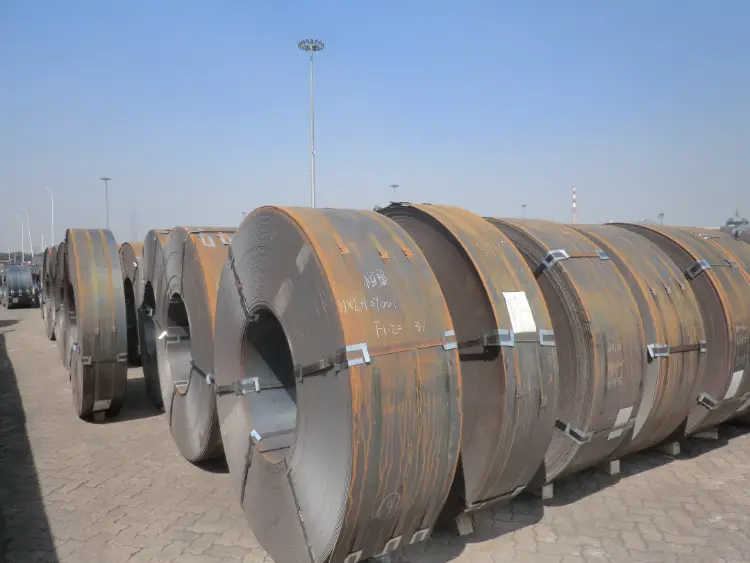
ASTM A572 Gr 42 Steel Coil
ASTM A572 Gr 42 Steel Coil: Composition, Properties & Equivalents
Comprehensive data on ASTM A572 Grade 42 carbon and low-alloy high-strength steel coil, including chemical composition, tensile and yield strength, thermal conductivity, density, and international equivalent grades like EN S275JR.
Hot-rolling, cold-rolling, pickling, slitting, cutting, welding, forming
- Phone : +8618037372205
- Email : [email protected]
- WhatsApp: Contact via Whtsapp
- WeChat: +8618037372205
ASTM A572 Gr 42 Steel Coil Introduction
ASTM A572/A572M Grade 42 is a high-strength low-alloy (HSLA) structural steel with a minimum yield strength of 42 ksi (290 MPa). It offers excellent weldability, good notch toughness, and is suitable for bolted, riveted, or welded construction. Key benefits:
- High strength-to-weight ratio
- Good formability and machinability
- Corrosion resistance similar to carbon steel but with enhanced mechanical properties due to microalloying elements
- Wide availability in coil, plate, and structural shapes
This grade is often used in bridges, buildings, truck frames, and machinery where weight savings and structural integrity are important.
ASTM A572 Gr 42 Steel Coil Chemical Composition
Chemical composition according to ASTM A572/A572M for Grade 42. Values are maximum unless a range or minimum is indicated. Notes:
- Copper content of 0.20% minimum is required only when copper steel is specified.
- For plates over 40 mm (1.5 in.) thick, silicon shall be 0.15–0.40%.
- Microalloying elements (vanadium, niobium) may be added to achieve strength when specified by the purchaser (Type 1 or Type 2).
| Chemical Element | Value (wt%) | Remarks |
|---|---|---|
| Carbon (C) | ≤0.21 | Max |
| Manganese (Mn) | ≤1.35 | Max for all thicknesses |
| Phosphorus (P) | ≤0.04 | Max |
| Sulfur (S) | ≤0.05 | Max |
| Silicon (Si) | ≤0.40 (plates ≤40 mm); 0.15–0.40 (plates >40 mm) | Range or max as per thickness |
| Copper (Cu) | ≥0.20 (if specified) | Min when copper steel is ordered |
| Iron (Fe) | Balance |
ASTM A572 Gr 42 Steel Coil Thermal and Electrical Physical Properties
Typical physical properties for ASTM A572 Grade 42 steel. These values are not specified in the material standard but are representative for low-alloy carbon steels. Note: Properties may vary slightly with temperature and exact composition.
- Density: 7.85 g/cm³
- Elastic modulus (E) at 20°C: 200 GPa
- Shear modulus (G): 80 GPa
- Poisson's ratio (ν): 0.3
Thermal expansion is linear from 20–600°C. Electrical resistivity increases with temperature.
| Property | Typical Value | Unit | Test Condition / Remarks |
|---|---|---|---|
| Density (ρ) | 7.85 | g/cm³ | At 20°C |
| Modulus of Elasticity (E) | 200 | GPa | At 20°C |
| Shear Modulus (G) | 80 | GPa | Calculated from E and ν |
| Poisson's Ratio (ν) | 0.3 | dimensionless | At 20°C |
| Thermal Expansion Coefficient (α) | 12.2 (20–100°C); 13.2 (20–300°C); 14.1 (20–600°C) | 10⁻⁶/K | Average linear expansion |
| Thermal Conductivity (λ) | 45 | W/(m·K) | At 20°C, typical for low-alloy steel |
| Specific Heat Capacity (cₚ) | 460 | J/(kg·K) | At 20°C–100°C |
| Electrical Resistivity (ρ_e) | 0.17 | µΩ·m | At 20°C |
ASTM A572 Gr 42 Steel Coil Mechanical Properties
Minimum mechanical properties for ASTM A572 Grade 42 as per standard requirements. Test conditions: Tensile testing performed at room temperature on full-section or machined specimens. Yield strength corresponds to ReH (upper yield) or Rp0.2 (0.2% offset). Elongation measured on 50 mm (2 in.) gauge length for plates up to 20 mm thickness. Note: For thicknesses greater than 20 mm, elongation requirements may differ slightly; consult standard for exact values. Typical tensile strength is 415–550 MPa.
| Property | Standard Requirement Value | Unit | Test Condition |
|---|---|---|---|
| Yield Strength (ReH / Rp0.2) | ≥290 | MPa | Room temperature; all thicknesses (≤100 mm) |
| Tensile Strength (Rm) | ≥415 | MPa | Room temperature; all thicknesses (≤100 mm) |
| Elongation (A) in 50 mm (2 in.) | ≥20 | % | Thickness ≤20 mm; gauge length 50 mm |
| Elongation (A) in 200 mm (8 in.) | ≥18 (typical) | % | Thickness ≤20 mm; gauge length 200 mm; for reference only |
ASTM A572 Gr 42 Steel Coil Complete Matches or Equivalent Grades from International Standards
| Region / Country | Standard | Grade / Designation | Remarks |
|---|---|---|---|
| USA | ASTM A572/A572M | Grade 42 [290] | Original specification. Minimum yield 42 ksi (290 MPa). |
| USA | AISI / SAE | — | Not directly designated; equivalent to structural low-alloy steels. |
| Europe / EN | EN 10025-2:2004 | S275JR, S275J0, S275J2 | Yield 275 MPa min; slightly lower strength but often used interchangeably with thickness adjustment. |
| Europe / EN | EN 10025-2:2004 | S355JR, S355J0 | Higher yield strength (355 MPa); can replace Grade 42 in stronger designs. |
| Japan / JIS | JIS G3106 | SM400A, SM400B, SM400C | Yield 245 MPa min; lower strength, may require redesign. |
| Japan / JIS | JIS G3101 | SS400 | General structural steel, not equivalent in strength; for non-critical substitution. |
| China / GB | GB/T 1591-2018 | Q275, Q275C, Q275D | Yield 275 MPa min; chemical composition differs; commonly suggested as alternative. |
| International / ISO | ISO 630-2:2021 | Fe 430B, Fe 430C | Yield 275–295 MPa depending on thickness; similar concept. |
ASTM A572 Gr 42 Steel Coil Application Introduction
ASTM A572 Grade 42 steel coil is ideally suited for structural components that require moderate strength, good weldability, and cost-effectiveness. Typical processing includes cutting to length, leveling, blanking, bending, and welding. The steel can be galvanized or coated for corrosion protection. Fabrication: It can be formed cold or hot and is easily machined. Welding: All common welding methods (SMAW, GMAW, SAW) can be used without preheat for thicknesses up to about 25 mm; preheat may be required for thicker sections. Note: Ensure compliance with design codes (AISC, Eurocode) when substituting equivalent grades.
Product Applications: Bridge beams and girders, Building columns and frames, Truck chassis and structural members, Trailer frames and kingpins, Storage tank shells and roofs, Railroad car underframes, Heavy equipment booms and arms
Processed into products: Welded H-beams and I-beams, Built-up box sections, Bolted connections and splice plates, Bracket supports and base plates, Gusset plates, Crane rail beams, Excavator buckets and blades, Mining truck bodies
Application industries: Construction and Infrastructure, Heavy Machinery Manufacturing, Truck and Trailer Manufacturing, Shipbuilding and Marine Structures, Railway Car Building, Storage Tank Manufacturing, Mining Equipment
ASTM A572 Gr 42 Steel Coil Similar or Alternative Materials for Comparison
| Region / Country | Standard | Grade / Designation | Remarks |
|---|---|---|---|
| USA | ASTM A36/A36M | A36 | Lower yield strength (250 MPa); widely available carbon structural steel; good weldability. |
| USA | ASTM A572/A572M | Grade 50 [345] | Higher strength variant (yield 345 MPa); often used when weight reduction is critical. |
| USA | ASTM A529/A529M | Grade 50, Grade 55 | Similar HSLA steel with higher manganese; yield 50–55 ksi (345–380 MPa). |
| USA | ASTM A709/A709M | Grade 36, Grade 50 | Structural steel for bridges; Grade 36 similar to A36; Grade 50 higher strength. |
| Europe / EN | EN 10025-3:2004 | S275N, S275NL | Normalized/normalized rolled fine-grain steels; impact toughness guaranteed; similar strength. |
| Europe / EN | EN 10025-4:2004 | S275M, S275ML | Thermomechanically rolled fine-grain steels; tough and weldable. |
| Japan / JIS | JIS G3106 | SM490A | Higher strength (yield 325 MPa); used in welded structures requiring higher strength. |
Notes:
Additional Information:
- When ordering ASTM A572 Grade 42 as coil, specify thickness tolerance, width, and edge condition (mill edge or trimmed).
- If Charpy impact tests are required, they must be specified as a supplementary requirement (e.g., ASTM A673 is a common impact testing standard). Grade 42 is not normally supplied with guaranteed impact properties, but can be ordered with specified temperature and energy levels.
- Corrosion protection through painting or galvanizing is recommended for outdoor exposure.
- The use of this steel must comply with applicable building codes and design specifications.
- Share



