
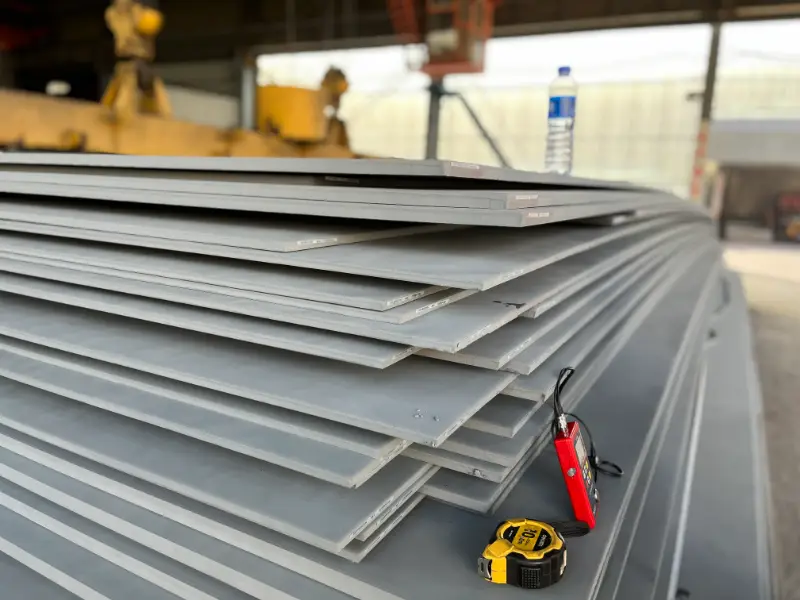
ASTM A387 Grade 11 Class 1 (A387Gr11Cl1) Pressure Vessel & Boiler Steel Plate
ASTM A387 Grade 11 Class 1 (A387Gr11Cl1) Pressure Vessel & Boiler Steel Plate -
Comprehensive material data for ASTM A387 Grade 11 Class 1 chromium-molybdenum alloy steel plate, including chemical composition, mechanical properties, thermal and electrical properties, global equivalents, and application guidance.
Hot rolling, normalizing, tempering, stress relieving, cutting, welding, forming
- Phone : +8618037372205
- Email : [email protected]
- WhatsApp: Contact via Whtsapp
- WeChat: +8618037372205
ASTM A387 Grade 11 Class 1 Pressure Vessel & Boiler Steel Plate Introduction
ASTM A387 Grade 11 Class 1 is a chromium-molybdenum alloy steel plate intended for welded boilers and pressure vessels. It belongs to the 1.25Cr-0.5Mo family and is supplied in the annealed (normalized and tempered) condition. Key characteristics include:
- Good elevated temperature strength and oxidation resistance
- Excellent weldability with appropriate preheat and post-weld heat treatment
- Resistance to hydrogen attack and sulfide stress cracking in hydrogen service
- Uniform mechanical properties across a wide thickness range
Typical applications are in refining, petrochemical, and power generation equipment where service temperatures can reach up to 500°C (930°F). Class 1 delivers a minimum yield strength of 310 MPa with a tensile strength of 515–690 MPa.
ASTM A387 Grade 11 Class 1 Pressure Vessel & Boiler Steel Plate Chemical Composition
Chemical requirements according to ASTM A387/A387M for Grade 11 Class 1. Ladle analysis is shown; product analysis tolerances apply per ASTM A20/A20M. All elements are controlled to ensure creep strength and weldability.
| Element | Specified Value | Remarks |
|---|---|---|
| Carbon (C) | 0.05 – 0.17 | Ladle analysis; lower carbon improves weldability |
| Manganese (Mn) | 0.40 – 0.65 | Reflected in ladle analysis |
| Phosphorus (P) | ≤ 0.025 | Maximum limit |
| Sulfur (S) | ≤ 0.025 | Maximum limit |
| Silicon (Si) | 0.50 – 0.80 | Silicon aids deoxidation |
| Chromium (Cr) | 1.00 – 1.50 | Primary alloying element for oxidation resistance |
| Molybdenum (Mo) | 0.45 – 0.65 | Enhances high-temperature strength |
ASTM A387 Grade 11 Class 1 Pressure Vessel & Boiler Steel Plate Thermal and Electrical Physical Properties
Physical properties for 1.25Cr-0.5Mo steel in the normalized and tempered condition. These are typical values for engineering calculations; actual values may vary slightly depending on heat treatment and temperature.
| Property | Typical Value | Unit | Test Condition / Temperature |
|---|---|---|---|
| Density (ρ) | 7.85 | g/cm³ | Room temperature |
| Modulus of Elasticity (E) | 190 – 210 | GPa | Room temperature |
| Shear Modulus (G) | 79 | GPa | Room temperature (typical) |
| Poisson's Ratio (ν) | 0.27 – 0.30 | – | Room temperature |
| Thermal Expansion Coeff. (α) | 11.2 | µm/(m·°C) | 20–100°C |
| Thermal Expansion Coeff. (α) | 12.5 | µm/(m·°C) | 20–200°C |
| Thermal Expansion Coeff. (α) | 13.1 | µm/(m·°C) | 20–300°C |
| Thermal Expansion Coeff. (α) | 13.5 | µm/(m·°C) | 20–400°C |
| Thermal Conductivity (λ) | 37 | W/(m·K) | at 100°C |
| Thermal Conductivity (λ) | 35 | W/(m·K) | at 200°C |
| Thermal Conductivity (λ) | 33 | W/(m·K) | at 300°C |
| Thermal Conductivity (λ) | 31 | W/(m·K) | at 400°C |
| Specific Heat Capacity (c) | 460 | J/(kg·K) | Room temperature |
| Electrical Resistivity (ρe) | 0.23 | µΩ·m | Room temperature |
ASTM A387 Grade 11 Class 1 Pressure Vessel & Boiler Steel Plate Mechanical Properties
Room temperature tensile properties as required by ASTM A387/A387M. Tests are conducted in accordance with ASTM A370. Values apply to plates in the normalized and tempered condition. No additional impact test is mandatory unless specified in the purchase order.
| Property | Specified Requirement | Unit | Test Condition |
|---|---|---|---|
| Yield Strength (ReH) | ≥ 310 | MPa | Room temperature, 0.2% offset |
| Tensile Strength (Rm) | 515 – 690 | MPa | Room temperature |
| Elongation (A) in 50 mm | ≥ 22 | % | Gauge length 50 mm (2 in.) |
ASTM A387 Grade 11 Class 1 Pressure Vessel & Boiler Steel Plate Fully Equivalent Material Standards & Substitute Grades
| Country / Region | Standard | Grade | Remarks |
|---|---|---|---|
| USA | ASTM A387/A387M | Grade 11 Class 1 (A387Gr11Cl1) | Base specification |
| European Union | EN 10028-2 | 13CrMo4-5 (1.7335) | Same chemical and mechanical requirements |
| Japan | JIS G4109 | SCMV 2-1 | Equivalent for boiler and pressure vessel plates |
| China | GB/T 713 | 14Cr1MoR | Domestic equivalent often used in petrochemical equipment |
| International | ISO 9328-2 | 13CrMo4-5 | Identical nominal composition to EN grade |
ASTM A387 Grade 11 Class 1 Pressure Vessel & Boiler Steel Plate Application Introduction
ASTM A387 Grade 11 Class 1 plates are primarily used in welded pressure vessels and boilers that operate at elevated temperatures and moderate hydrogen partial pressures. The material is well suited for fabrication by hot forming, welding, and machining. Post-weld heat treatment (PWHT) is mandatory in most service conditions to restore ductility and reduce residual stresses. Field welding requires preheat and strict interpass temperature control.
Product Applications: Pressure vessels for hydrogen service (API RP 941 Nelson curves), High-temperature steam boilers and drums, Process reactors and columns, Shell-and-tube heat exchangers and waste heat recovery units, Spheres and storage tanks for hot hydrocarbons
Processed into products: Vessel shells and dished heads, Tube sheets and floating head flanges, Nozzle forgings and reinforcing pads, Skirt support rings and anchor bolt chairs, Baffle plates and support grids in heat exchangers, Piping transition pieces when combined with matching piping steel
Application industries: Oil & Gas (refinery HF alkylation, hydrotreaters, hydrocrackers), Chemical & Petrochemical (ammonia converters, methanol reactors), Power Generation (boiler drums, steam separators, superheater headers), Heat Exchanger Manufacturing (shell-and-tube exchangers, waste heat boilers)
ASTM A387 Grade 11 Class 1 Pressure Vessel & Boiler Steel Plate Similar / Nearby Alternative Materials
| Country / Region | Standard | Grade | Remarks |
|---|---|---|---|
| USA | ASTM A387/A387M | Grade 12 Class 1 | 1Cr-0.5Mo steel; slightly lower Cr, lower elevated temperature strength |
| USA | ASTM A387/A387M | Grade 22 Class 1 | 2.25Cr-1Mo steel; higher Cr for better oxidation/corrosion resistance, higher creep strength, but more difficult to weld |
| European Union | EN 10028-2 | 10CrMo9-10 (1.7380) | 2.25Cr-1Mo grade, suitable for higher temperature service |
| China | GB/T 713 | 12Cr1MoVR | Cr-Mo-V steel with improved creep strength compared to 1.25Cr-0.5Mo |
Notes:
Welding recommendations: Use matching filler metals (e.g., AWS A5.28 ER90S-B3 or E9018-B3 electrodes). Preheat to 200–300°C (dependent on thickness) and apply post-weld heat treatment at 670–700°C. Service limits: In hydrogen service, follow API RP 941 (Nelson curves) for 1.25Cr-0.5Mo steel. The material is resistant to temper embrittlement when trace elements (P, Sn, Sb, As) are controlled. For sour service, refer to NACE MR0175/ISO 15156 for suitable hardness and heat treatment conditions. Plates are normally UT tested per ASTM A435 or A578 as required.
- Share



