
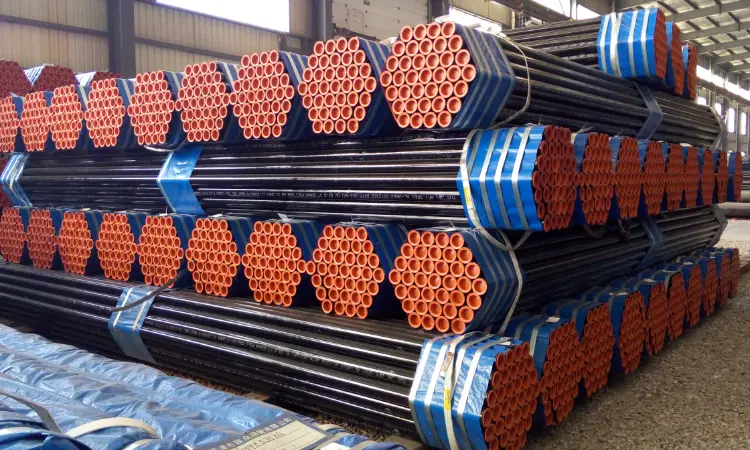
ASTM A139 Grade D SSAW Pipe Material
DNV Grade D SSAW Pipe – Spiral Submerged Arc Welded Structural Steel Pipe for Marine & Offshore
Material data for Grade D spiral submerged arc welded (SSAW) pipe according to DNV rules for normal-strength hull structural steel. Typical chemistry, mechanical properties, and thermal properties are provided.
Suitable for cold forming, spiral forming, submerged-arc welding, welding by all common methods, flame cutting, and normalising rolling (as-supplied condition usually hot-rolled or normalised)
- Phone : +8618037372205
- Email : [email protected]
- WhatsApp: Contact via Whtsapp
- WeChat: +8618037372205
ASTM A139 Grade D SSAW Pipe Introduction
The material designated as Grade D SSAW pipe refers to spiral submerged arc welded (SSAW) steel pipe manufactured from normal-strength shipbuilding steel plates conforming to DNV Grade D requirements. This steel is widely used in marine, offshore, and structural applications where good weldability, moderate strength, and reliable low-temperature toughness are required. DNV Grade D belongs to the family of normal-strength hull structural steels defined by classification societies such as DNV, and it is characterised by a minimum yield strength of 235 MPa and minimum impact toughness of 27 J at -20 °C. The SSAW process allows efficient production of large-diameter pipe from coiled or discrete plates, making it suitable for piling, conductor pipes, water transmission, and structural members. This grade offers a balanced combination of formability, weldability, and cost-effectiveness, and is fully equivalent to other IACS Grade D steels.
ASTM A139 Grade D SSAW Pipe Chemical Composition – Typical DNV Grade D Requirements
The chemical composition of DNV Grade D is controlled to ensure good weldability and notch toughness at sub-zero temperatures. Carbon equivalent (CEV) is typically limited to 0.38–0.40% to avoid cold cracking. Fine-grain practice is usually applied, and total aluminium or other grain-refining elements are specified. The limits shown below are the standard ladle analysis values according to DNV-OS-B101.
- Values are in weight percent.
- For product thicknesses ≤50 mm; slightly relaxed limits may apply for higher thicknesses in some standards.
- Optional addition of Nb, V, Ti may be used for strength and grain refinement; if present, total Nb+V+Ti ≤0.12%.
| Chemical Element | Standard Requirement (max, unless range given) | Remarks |
|---|---|---|
| Carbon (C) | 0.21 | Max. |
| Manganese (Mn) | 0.60 – 1.50 | Range; minimum 2.5×C for some product forms |
| Silicon (Si) | 0.10 – 0.50 | Range |
| Phosphorus (P) | 0.035 | Max. |
| Sulfur (S) | 0.035 | Max. |
| Chromium (Cr) | 0.20 | Max. |
| Nickel (Ni) | 0.40 | Max. |
| Copper (Cu) | 0.35 | Max. |
| Aluminium (Al, total) | ≥ 0.015 | Min.; acid-soluble Al ≥0.015 when fine-grain practice is required |
| Nitrogen (N) | 0.012 | Max. (for normalised steel, if not fixed by strong nitride formers) |
| CEV (Carbon Equivalent) | ≤ 0.38 | CEV = C + Mn/6 + (Cr+Mo+V)/5 + (Ni+Cu)/15 |
ASTM A139 Grade D SSAW Pipe Thermal and Electrical Physical Properties
The physical properties listed below are typical for normal-strength carbon-manganese steels similar to DNV Grade D. They are provided as engineering reference for design and simulation and are not part of the mandatory standard requirements.
- Density and thermal expansion are measured at room temperature unless specified otherwise.
- Thermal conductivity and specific heat capacity vary slightly with temperature; values at 20 °C and 100 °C are given.
- Electrical resistivity is given at 20 °C for non-magnetised condition.
| Property | Standard Typical Value | Unit | Test Condition |
|---|---|---|---|
| Density (ρ) | 7850 | kg/m³ | 20 °C |
| Elastic modulus (E) | 205 | GPa | Room temperature |
| Shear modulus (G) | 80 | GPa | Room temperature; approximated as E/[2(1+ν)] |
| Poisson's ratio (ν) | 0.30 | — | Elastic domain, room temperature |
| Thermal expansion coefficient (α) | 11.5 | 10⁻⁶/K | 20 – 100 °C |
| Thermal expansion coefficient (α) | 12.5 | 10⁻⁶/K | 20 – 200 °C |
| Thermal expansion coefficient (α) | 13.5 | 10⁻⁶/K | 20 – 300 °C |
| Thermal conductivity (λ) | 52 | W/(m·K) | 20 °C |
| Thermal conductivity (λ) | 49 | W/(m·K) | 100 °C |
| Specific heat capacity (cp) | 486 | J/(kg·K) | 20 °C |
| Specific heat capacity (cp) | 515 | J/(kg·K) | 100 °C |
| Electrical resistivity (ρ_e) | 0.22 | µΩ·m | 20 °C |
ASTM A139 Grade D SSAW Pipe Mechanical Properties – DNV Grade D Steel for SSAW Pipe
The mechanical properties are determined on base material (hot-rolled or normalised plate) from which the spiral pipe is manufactured. For SSAW pipe, properties in the weld zone shall meet additional requirements. The tensile and impact values below correspond to thickness ≤50 mm. Actual pipe body and weld properties are subject to project specifications.
- Tensile testing is performed transversely.
- Impact test temperature is -20 °C; minimum average energy for full-size specimen 27 J.
- Guaranteed values may be adjusted by the pipe manufacturer for wall thickness and location.
| Property | Standard Required Value | Unit | Test Condition / Remarks |
|---|---|---|---|
| Yield strength (ReH) | ≥ 235 | MPa | Ambient temperature, transverse; applies for t ≤ 50 mm (lower limit) |
| Tensile strength (Rm) | 400 – 520 | MPa | Ambient temperature, transverse |
| Elongation after fracture (A5) | ≥ 22 | % | Gauge length 5.65√So; transverse; for t ≤ 50 mm |
| Elongation after fracture (A50) | ≥ 18 | % | Alternative gauge length 50 mm, if applicable |
| Bend test (mandrel diameter) | No cracks or defects | — | 180° bend, mandrel diameter = 3t (t = specimen thickness) up to 25 mm thickness |
| Impact energy (KV2) | ≥ 27 (average) | J | Longitudinal or transverse at -20 °C; minimum single 20 J, full-size 10×10×55 mm specimen |
| Impact energy (KV2) – subsize | proportionally reduced | J | For thickness < 10 mm, charpy width 7.5 mm or 5 mm; conversion factors apply |
ASTM A139 Grade D SSAW Pipe Identical/Equivalent Material Standards & Grade Replacements
| Country / Region | Standard / Rule | Grade | Remarks |
|---|---|---|---|
| Norway / Global | DNV-OS-B101 / DNV Rules Pt.2 Ch.2 | Grade D | Base reference for this SSAW pipe material; normal-strength hull structural steel |
| USA | ABS Rules for Materials and Welding | Grade D | American Bureau of Shipping – identical requirements under IACS |
| UK | Lloyd's Register (LR) Rules | Grade D | Lloyd's Register – identical chemical and mechanical requirements |
| France | Bureau Veritas (BV) Rules | Grade D | Bureau Veritas – identical IACS normal-strength steel |
| China | CCS Rules for Materials and Welding | CCS D | China Classification Society – equivalent to Grade D |
| Japan | NK Rules (ClassNK) | Grade D | Nippon Kaiji Kyokai – identical requirements |
| Korea | KR Rules | Grade D | Korean Register – identical IACS Grade D |
| Italy | RINA Rules | Grade D | Registro Italiano Navale – equivalent normal-strength grade |
| Russia | RS Rules | Grade D | Russian Maritime Register of Shipping – equivalent grade |
ASTM A139 Grade D SSAW Pipe Application Introduction
DNV Grade D SSAW pipe combines the proven properties of normal-strength shipbuilding steel with the manufacturing efficiency of spiral welding, delivering a cost-effective tubular solution for structural and transport applications in marine and civil engineering. Typical users include EPC contractors, shipyards, offshore foundation fabricators, and water transmission developers. The pipe is primarily specified where good impact toughness at -20 °C, consistent yield strength above 235 MPa, and excellent weldability are required. Because it meets IACS unified requirements, it can be interchangeably used with equivalent Grade D material from different classification societies, simplifying procurement for global projects.
Product Applications: Spiral submerged arc welded (SSAW) pipes, Long-length piling pipes, Conductor casing for oil and gas wells, Marine riser pipes (low-pressure structural applications), Steel pipe piles (open-ended or closed-ended), Penstocks and water mains, Structural columns for marine terminals and platforms
Processed into products: Spiral-welded pipe piles (diameter up to 3000 mm or larger, wall thickness 6–25 mm typical for Grade D), Connector pieces (flanges, stiffening rings) made from the same steel grade, Pile shoes and drive shoes, Lifting trunnions and pipe handling attachments, Cross-bracing members fabricated from cut pipe sections, End rings and transition pieces for monopiles, Corrosion protection coatings are often applied (FBE, 3LPE, coal tar enamel)
Application industries: Marine & shipbuilding, Offshore oil & gas (conductor pipes, jacket legs), Port & harbour engineering (fender piles, dolphins), Bridge & heavy civil construction (pile foundations, structural columns), Water transmission & penstock pipelines, Renewable energy (wind turbine monopile foundations, transition pieces), Mining & dredging (slurry pipes, tailings pipelines)
ASTM A139 Grade D SSAW Pipe Similar / Alternative Materials
| Country / Region | Standard / Rule | Grade | Remarks |
|---|---|---|---|
| Norway / Global | DNV-OS-B101 | Grade A | Same min. yield 235 MPa; no impact test required; used where low-temperature toughness is not needed |
| Norway / Global | DNV-OS-B101 | Grade B | Same strength; impact tested at 0 °C (27 J); less stringent than Grade D (-20 °C) |
| Norway / Global | DNV-OS-B101 | Grade E | Same strength; impact tested at -40 °C; used for deeper cold service; may need normalised delivery |
| Europe | EN 10025-2 | S235J0 / S235J2 | Structural steel with yield 235 MPa; J0 and J2 have impact at 0 °C and -20 °C; non-marine grades |
| USA | ASTM A572 / A709 | Grade 42 (290) or similar | Slightly higher strength (290 MPa yield); good weldability; used for structural plates |
| International | API 5L | Grade X42 / X46 | Pipeline steel with higher strength; SSAW pipes often produced in these grades for oil & gas; require compliance with different toughness regimes |
Notes:
The data provided are based on DNV-OS-B101 latest published edition for normal-strength hull structural steel Grade D and typical values for carbon-manganese steel. For specific pipe orders, supplementary requirements may apply, such as tighter chemical limits, mandatory normalising, ultrasonic testing of welds, and dimensional tolerances according to API 5L, ASTM A252, EN 10219, or project-specific specifications. The SSAW pipe manufacturing process introduces a helical weld seam; mechanical testing of the pipe, including weld tensile and bend tests, as well as weld impact toughness, shall be in accordance with the governing fabrication standard. All values in this datasheet are for general information and should not replace certified material certificates for design and procurement.
- For wall thickness above 50 mm, please refer to the specific classification society rules for possible de-rating of mechanical properties.
- Contact your material supplier for precise melt-specific and product-specific test certificates.
- Share



