
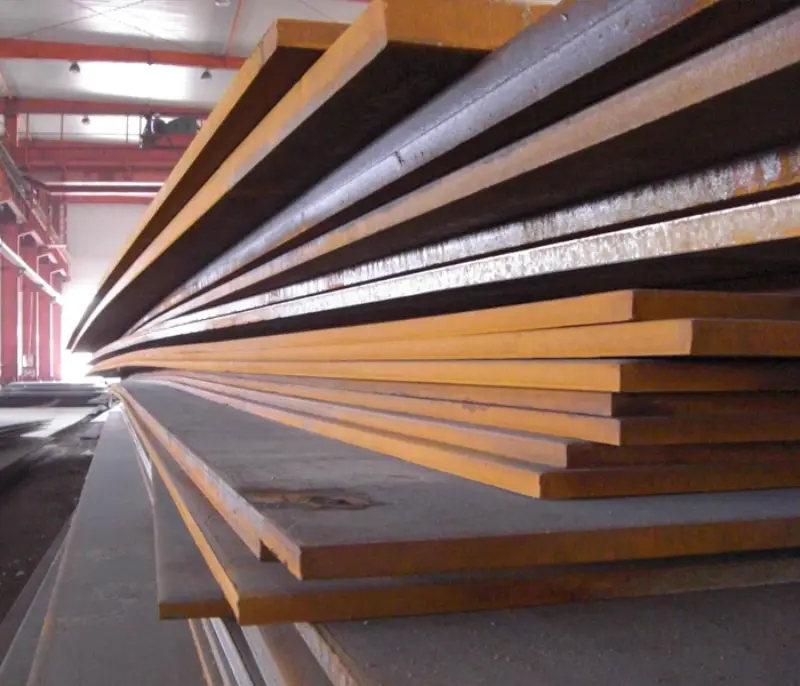
ASTM A131 FH36 Shipbuilding Steel
ASTM A131 FH36 Shipbuilding Steel Coil: High-Strength Low-Temp Toughness for Critical Marine Structures
Comprehensive technical profile of ASTM A131 FH36 steel coil, including chemical composition, mechanical properties at -60°C, thermal and electrical data, equivalent grades, and application guidance for shipbuilding and offshore engineering.
Welding, bending, flame cutting, cold forming, machining
- Phone : +8618037372205
- Email : [email protected]
- WhatsApp: Contact via Whtsapp
- WeChat: +8618037372205
ASTM A131 FH36 Shipbuilding Steel Introduction
ASTM A131 FH36 is a high-strength, normalized or thermo-mechanically controlled rolled (TMCP) structural steel primarily used in shipbuilding and offshore structures. It offers a minimum yield strength of 355 MPa (51 ksi) and excellent notch toughness at -60°C, making it suitable for critical applications in Arctic and low-temperature environments. The steel is alloyed with grain-refining elements such as niobium, vanadium and titanium, and provides good weldability and formability. Typical delivery condition includes TMCP, normalized, or quenched and tempered, with thicknesses up to 150 mm commonly available in coil/plate form.
ASTM A131 FH36 Shipbuilding Steel Chemical Composition
The chemical analysis conforms to ASTM A131/A131M for FH36 (F condition). Elements like Nb, V, Ti, Al are added to refine grain and improve toughness. Carbon equivalent (CEV) is restricted for weldability. All values are maximum unless specified otherwise.
| Element | Standard Value | Remarks |
|---|---|---|
| Carbon (C) | ≤0.16% | Ladle analysis |
| Manganese (Mn) | 0.90–1.60% | Depending on thickness |
| Silicon (Si) | ≤0.50% | Typically 0.10–0.50% |
| Phosphorus (P) | ≤0.025% | |
| Sulfur (S) | ≤0.020% | |
| Aluminum (Al, total) | ≥0.020% | Minimum soluble; grain refining |
| Niobium (Nb) | 0.02–0.05% | Optional microalloy |
| Vanadium (V) | 0.05–0.10% | Optional microalloy |
| Titanium (Ti) | ≤0.02% | Optional; max for grain refinement |
| Copper (Cu) | ≤0.35% | |
| Chromium (Cr) | ≤0.20% | |
| Nickel (Ni) | ≤0.40% | Sometimes up to 0.80% for thickness |
| Molybdenum (Mo) | ≤0.08% | |
| Nitrogen (N) | ≤0.012% | Often controlled to ensure Al/N ratio |
ASTM A131 FH36 Shipbuilding Steel Thermal and Electrical Properties
These values are not mandated by ASTM A131 but are typical for low-carbon microalloyed steels and are suitable for engineering calculations. They can vary slightly with heat treatment condition.
| Property | Typical Value | Unit | Test Condition / Remarks |
|---|---|---|---|
| Density (ρ) | 7.85 | g/cm³ | Room temperature |
| Elastic Modulus (E) | 205–210 | GPa | Tension, ambient |
| Shear Modulus (G) | 79–81 | GPa | Calculated from E and ν ≈ 0.3 |
| Poisson's Ratio (ν) | 0.29–0.30 | - | Ambient |
| Thermal Expansion Coefficient (α) | 11.5–12.5 (10⁻⁶/K) | K⁻¹ | Range 20–100°C |
| Thermal Conductivity (λ) | 45–52 | W/(m·K) | At 20°C |
| Specific Heat Capacity (cp) | 460–480 | J/(kg·K) | At 20°C |
| Electrical Resistivity (ρ_e) | 0.20–0.25 | µΩ·m | At 20°C |
ASTM A131 FH36 Shipbuilding Steel Mechanical Properties
Properties are per ASTM A131/A131M for thickness ≤ 100 mm. For thicker sections, values may be slightly reduced by agreement. The FH36 designation requires Charpy V-notch impact test at -60°C with a minimum average absorbed energy of 34 J (longitudinal) and 24 J (transverse).
| Property | Standard Requirement Value | Unit | Test Condition |
|---|---|---|---|
| Yield Strength (ReH) | ≥355 | MPa | t ≤ 100 mm, transverse or longitudinal as agreed |
| Tensile Strength (Rm) | 490–620 | MPa | Flat specimen, transverse |
| Elongation (A5) | ≥21 | % | Gauge length 5.65√S₀; thickness t ≤ 40 mm |
| Elongation (A5) | ≥19 | % | Gauge length 5.65√S₀; 40 < t ≤ 100 mm |
| Charpy V-notch (KV2) longitudinal | ≥34 (average) | J | -60°C, minimum single value 24 J |
| Charpy V-notch (KV2) transverse | ≥24 (average) | J | -60°C, minimum single value 17 J |
| Bend test (D = 3a) | No cracks | - | 180° bend, mandrel diameter 3 times specimen thickness (t ≤ 25 mm) |
ASTM A131 FH36 Shipbuilding Steel Identical/Equivalent Material Standards and Replaceable Grades
| Country/Region | Standard | Grade | Remarks |
|---|---|---|---|
| USA | ASTM A131/A131M | FH36 | Original specification |
| International | ABS Rules | FH36 | American Bureau of Shipping equivalent |
| International | LR Rules | FH36 | Lloyd's Register |
| International | DNV Rules | FH36 | DNV GL (now DNV) |
| International | BV Rules | FH36 | Bureau Veritas |
| International | CCS Rules | FH36 | China Classification Society |
| Europe | EN 10025-4 | S355ML (EN 10025-4:2019) | Low temp toughness at -50°C; similar strength; comparable for -60°C when ordered as S355MLO or special |
| Japan | JIS G 3106 | SM490B (modified) | With Charpy test at -60°C as a supplementary requirement; original SM490B requires 0°C |
ASTM A131 FH36 Shipbuilding Steel Application Introduction
ASTM A131 FH36 coils are employed where high strength combined with superior low-temperature toughness is mandatory. The steel is suited for thick welded sections exposed to dynamic loads and harsh environments. Typical applications include:
Product Applications: Hull plates and shell plating for ice-strengthened ships, Deck plating, bottom plating, and internals of LNG carriers, Jack-up rig legs, spud cans, and cantilever beams, Offshore platform modular structures and flare booms, Pressure vessel shells operating at low temperatures (supplementary requirements)
Processed into products: Welded stiffeners, brackets, and girders, Structural nodes and tubular joints, Ice belt strakes and rubbing strips, Crane booms, pedestals, and heavy lifting attachments, Piling and transition pieces for wind turbines, Ship rudder horns and propeller nozzle parts
Application industries: Shipbuilding (commercial and naval vessels), Offshore oil & gas exploration and production structures, Arctic and ice-class vessels (icebreakers, LNG carriers), Offshore wind turbine foundations (transition pieces, monopiles), Heavy civil engineering in cold climates (bridges, mooring components)
ASTM A131 FH36 Shipbuilding Steel Similar/Alternative Material Recommendations
| Country/Region | Standard | Grade | Characteristics and Notes |
|---|---|---|---|
| USA | ASTM A131/ A131M | EH36 | Similar strength but Charpy test at -40°C; lower toughness than FH36; less costly for non-Arctic service |
| Europe | EN 10025-4 | S355ML | Min. ReH 355 MPa, Charpy at -50°C; close to FH36, widely used in offshore structures |
| Europe | EN 10025-3 | S355N/S355NL | Normalized rolling; NL grade Charpy at -50°C; suitable but not identical to FH36 |
| International | API 2W Grade 50 | Gr. 50 CT | Thermo-mechanically rolled for offshore platforms; requires -40°C or -60°C optional; comparable strength |
| China | GB 712 | DH36/EH36/FH36 | Chinese shipbuilding steel; FH36 has -60°C toughness, equivalent to ASTM FH36 |
Notes:
- Welding: Low carbon equivalent (typically <0.43) permits good cold cracking resistance; preheat may be required for thick sections. Welding consumables should match the -60°C toughness requirement.
- Corrosion protection: As with all structural steels, coating/painting or cathodic protection is needed for seawater immersion.
- Certification: Material must be supplied with ship classification society survey and certification, if required.
- Thickness tolerance: According to ASTM A6/A6M or as agreed.
- Share



