
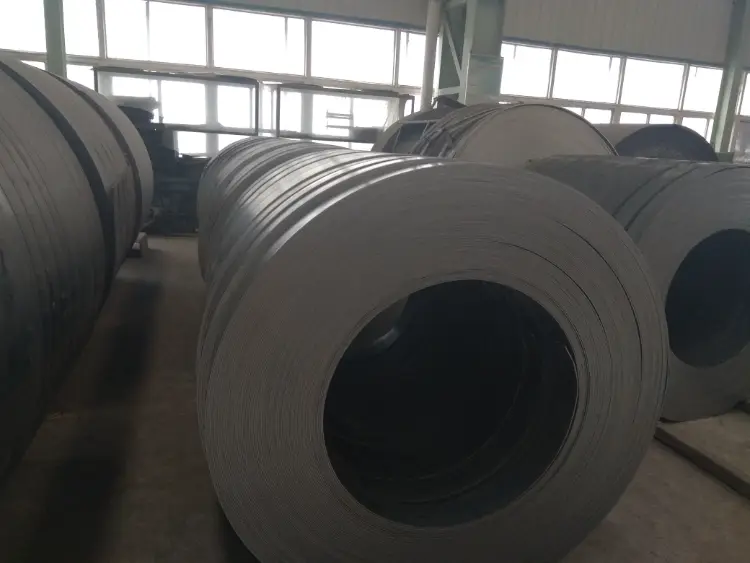
ASTM A131 AH32 Shipbuilding Steel Coil
ASTM A131 AH32 Shipbuilding Steel Coil: High-Strength Structural Steel for Marine Applications
Detailed material properties, chemical composition, mechanical and physical data for ASTM A131 AH32 shipbuilding steel coil, a high-strength hull structural steel used in marine and offshore constructions.
Hot rolling, controlled rolling, normalizing, thermo-mechanical control processing (TMCP), quenching and tempering (optional for thicker sections), welding, cutting, forming
- Phone : +8618037372205
- Email : [email protected]
- WhatsApp: Contact via Whtsapp
- WeChat: +8618037372205
ASTM A131 AH32 Shipbuilding Steel Coil Introduction
ASTM A131 AH32 is a high-strength, low-alloy structural steel grade specifically designed for shipbuilding and marine applications under the ASTM A131/A131M standard. This normalized or thermo-mechanically rolled steel offers a minimum yield strength of 315 MPa (45.7 ksi) and tensile strength in the range of 440–590 MPa, providing excellent weldability, toughness at 0°C, and good corrosion resistance in marine environments. The 'A' designation indicates impact testing at 0°C, ensuring reliable performance in temperate waters. AH32 is widely used for constructing hulls, decks, and offshore structures. Compared to ordinary-strength grades (e.g., Grade A, B, D, E), AH32 allows for reduced plate thickness and lighter structures while maintaining equal or superior mechanical integrity. It is supplied as coil, plate, or sections in a range of thicknesses, typically up to 100 mm, and can be delivered in as-rolled, normalized, or thermo-mechanical control processed (TMCP) conditions. Its balanced chemistry—controlled carbon equivalent—guarantees good weldability without preheating under normal conditions, making it a cost-effective choice for shipyards worldwide.
ASTM A131 AH32 Shipbuilding Steel Coil Chemical Composition
The chemical composition of ASTM A131 AH32 is strictly controlled to ensure good weldability, high strength, and low-temperature toughness. Carbon equivalent (CE) is typically below 0.38% to minimize hardening in the heat-affected zone. Microalloying elements such as niobium, vanadium, and titanium may be added singly or in combination for grain refinement. All values comply with ASTM A131/A131M standard for grade AH32.
| Element | Standard Value (max, unless range) | Remarks |
|---|---|---|
| Carbon (C) | ≤ 0.18% | Melting shop analysis |
| Manganese (Mn) | 0.90 – 1.60% | Higher Mn improves strength/toughness balance |
| Silicon (Si) | 0.10 – 0.50% | Deoxidation element |
| Phosphorus (P) | ≤ 0.035% | Residual element, controlled for toughness |
| Sulfur (S) | ≤ 0.035% | Controls inclusion morphology |
| Aluminum (Al) | ≥ 0.015% (total) | Used for grain refinement and deoxidation |
| Niobium (Nb) | ≤ 0.05% | Optional microalloy, grain refinement |
| Vanadium (V) | ≤ 0.10% | Optional microalloy, precipitation hardening |
| Titanium (Ti) | ≤ 0.02% | Optional, grain refinement and inclusion control |
| Copper (Cu) | ≤ 0.35% | May be present as residual |
| Chromium (Cr) | ≤ 0.20% | Residual element |
| Nickel (Ni) | ≤ 0.40% | Residual, can be intentionally added |
| Molybdenum (Mo) | ≤ 0.08% | Residual |
| Nitrogen (N) | ≤ 0.012% | Controlled to avoid ageing effects |
| Carbon Equivalent (CE) formula | CE = C + Mn/6 + (Cr+Mo+V)/5 + (Ni+Cu)/15 ≤ 0.38% | Typically supplied with CE ≤ 0.38% for guaranteed weldability |
ASTM A131 AH32 Shipbuilding Steel Coil Physical Properties
Physical properties listed are typical for low-alloy shipbuilding steel at room temperature unless otherwise noted. These values are not mandatory per ASTM A131 but are representative for C-Mn structural steels. Variations may occur depending on final mill production and microalloying additions.
| Property | Typical Value | Unit | Test Condition |
|---|---|---|---|
| Density (ρ) | 7.85 | g/cm³ | At 20°C |
| Modulus of Elasticity (E) | 200 – 210 | GPa | At 20°C, tension |
| Shear Modulus (G) | 80 – 81 | GPa | At 20°C, torsion |
| Poisson's Ratio (ν) | 0.27 – 0.30 | — | At 20°C, elastic range |
| Thermal Expansion Coefficient (α) | 11.5 – 12.5 × 10⁻⁶ | 1/K | Between 20°C and 100°C |
| Thermal Expansion Coefficient (α) | 12.5 – 13.5 × 10⁻⁶ | 1/K | Between 20°C and 200°C |
| Thermal Expansion Coefficient (α) | 13.5 – 14.5 × 10⁻⁶ | 1/K | Between 20°C and 400°C |
| Thermal Conductivity (λ) | 45 – 55 | W/(m·K) | At 20°C |
| Thermal Conductivity (λ) | 42 – 50 | W/(m·K) | At 100°C |
| Thermal Conductivity (λ) | 38 – 45 | W/(m·K) | At 200°C |
| Specific Heat Capacity (cp) | 460 – 500 | J/(kg·K) | At 20°C – 100°C |
| Electrical Resistivity (ρ_e) | 0.20 – 0.25 | μΩ·m | At 20°C |
ASTM A131 AH32 Shipbuilding Steel Coil Mechanical Properties
Mechanical properties are determined on longitudinal test specimens. Values adhere to ASTM A131/A131M. For AH32, impact tests are carried out at 0°C. Minimum longitudinal Charpy V-notch energy is 34 J (average of 3 specimens). Properties for thicker sections (>50 mm) may be agreed upon at the time of order.
| Property | Standard Value | Unit | Test Condition |
|---|---|---|---|
| Yield Strength (ReH) | ≥ 315 | MPa | Tensile test, at room temperature |
| Tensile Strength (Rm) | 440 – 590 | MPa | Tensile test, at room temperature |
| Elongation (A), 200 mm gauge length | ≥ 22 | % | For thickness ≤ 50 mm, longitudinal specimen |
| Elongation (A), 50 mm gauge length | ≥ 24 | % | For thickness ≤ 50 mm, transverse specimen |
| Charpy V-Notch Impact Energy (KV2) | ≥ 34 (average), ≥ 24 (single) | J | Longitudinal, at 0°C (AH condition) |
| Charpy V-Notch Impact Energy (KV2) | ≥ 34 (average), ≥ 24 (single) | J | Transverse, at 0°C (optional) |
| Bend Test (bend angle 180°) | d = 3a (thickness ≤ 25 mm), d = 4a (25 < t ≤ 50 mm) | — | No cracks on outside of bent portion; d = mandrel diameter, a = specimen thickness |
ASTM A131 AH32 Shipbuilding Steel Coil Complete Equivalent Material Standards and Substitute Grades
| Country/Region | Standard | Grade | Remarks |
|---|---|---|---|
| International (IACS) | Classification Society Rule Requirements | AH32 | Recognized by all International Association of Classification Societies (IACS) members |
| USA | ABS (American Bureau of Shipping) | ABS AH32 | Identical mechanical and chemical requirements; charpy at 0°C |
| France | BV (Bureau Veritas) | BV AH32 | Equivalent grade for marine structures |
| Norway/Germany | DNV (Det Norske Veritas) | DNV A32 | DNV designates the 0°C impact grade as A32 (no 'H') |
| Germany | GL (Germanischer Lloyd) | GL A32 | Equivalent to AH32; GL merged into DNV GL, now DNV |
| UK | LR (Lloyd's Register) | LR AH32 | Fully equivalent for marine applications |
| Japan | NK (Nippon Kaiji Kyokai/ClassNK) | NK KA32 | ClassNK uses KA32 for 0°C notch toughness grade |
| Italy | RINA (Registro Italiano Navale) | RINA AH32 | Equivalent with same impact requirements |
| Russia | RS (Russian Maritime Register of Shipping) | RS A32 | A32 corresponds to 0°C impact test |
| China | CCS (China Classification Society) | CCS AH32 | Identical to ASTM A131 AH32 |
| South Korea | KR (Korean Register) | KR RA32 | RA32 is the Korean Register designation for 0°C impact grade |
ASTM A131 AH32 Shipbuilding Steel Coil Application Introduction
ASTM A131 AH32 steel coil is the material of choice for structural components in ships and offshore structures where high strength, good weldability, and adequate toughness at 0°C are required. It reduces deadweight and fabrication costs compared to ordinary-strength grades. Typical applications include:
Product Applications: Hull plates, deck plates, and side shell plates, Stiffeners, webs, and stringers in longitudinal framing systems, Bulkhead panels and transverse webs, Superstructure modules and deckhouse components, Offshore platform topside modules, helidecks, and flare booms, Cut-to-length parts for shipyards (using coil processing lines)
Processed into products: Ship hull shells (outer bottom, bilge strake, sheer strake), Longitudinal girders, floor plates, and brackets, Deck plating with rolled stiffeners (bulb flats or angle profiles from coil), Watertight doors and hatch coaming assemblies, Pipe supports, equipment foundations, and crane pedestal panels, Pontoon components for floating docks and gangways
Application industries: Commercial shipbuilding (bulk carriers, tankers, container ships, Ro-Ro vessels), Naval and defense shipbuilding (amphibious vessels, patrol boats), Offshore oil & gas platforms (jackets, decks, living quarters), Marine renewable energy (offshore wind turbine foundations, transition pieces), Barge and inland waterway vessel construction, Port and harbor infrastructure (fender panels, caissons)
ASTM A131 AH32 Shipbuilding Steel Coil Similar/Comparable Substitute Material Recommendations
| Country/Region | Standard | Grade | Remarks |
|---|---|---|---|
| USA | ASTM A131/A131M | AH36 | Higher strength (≥355 MPa yield, 490–620 MPa tensile), still with 0°C impact; may be used with thickness reduction if allowable by design. |
| USA | ASTM A131/A131M | DH32 | Same strength as AH32 but with -20°C impact test requirement; better low-temperature toughness, slightly higher cost. |
| Europe | EN 10025-4 | S355ML | Thermomechanically rolled structural steel with min 355 MPa yield, -50°C impact; not specifically for shipbuilding but close in strength and weldability, often used in offshore where not certified by class. |
| Europe | EN 10025-3 | S355N/NL | Normalized fine-grain steel; NL grade tested at -50°C; higher impact toughness; acceptable for some marine structures pending class approval. |
| Japan/Korea | JIS G 3106 | SM490A/B/C | Japanese standard for welded structures; SM490B with 0°C impact similar to AH32 but slightly higher tensile strength (490-610 MPa); check class society equivalence. |
| China | GB/T 712-2011 | AH32 | Identical to ASTM AH32 in domestic Chinese shipbuilding practice; also available as B32 for 0°C impact grade. |
Notes:
- AH32 coils are typically supplied with mill test certificates (EN 10204 type 3.1 or 3.2) confirming compliance with ASTM A131 and relevant class society rules.
- Carbon equivalent is commonly restricted to maximum 0.38% to ensure preheat-free welding under normal conditions; often the actual CE is below 0.36% for modern TMCP grades.
- For rolled coil, the maximum thickness is usually 25.4 mm (1 inch), but some mills offer up to 50 mm. Plate products from coil processing may have slight strength variation due to coiling/uncoiling; flattening and leveling are recommended.
- Traceability markings (heat number, grade, dimensions, manufacturer) are printed on the coil top and side surfaces.
- Surface condition: oiled or dry; pickled and oiled available for critical applications to improve paint adhesion.
- Ultrasonic testing (UT) to ASTM A578/A578M or class society requirements can be applied when specified.
- Share



