
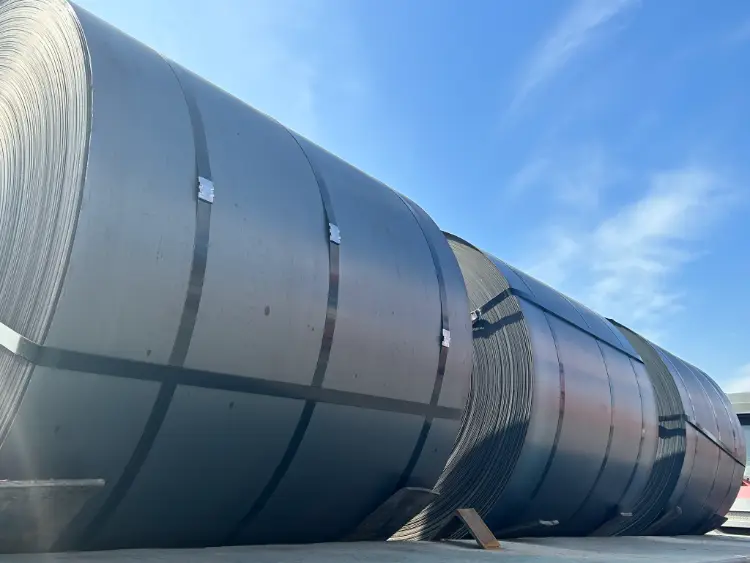
ASME SA709/SA709M Grade HPS70W Carbon Steel Coil
ASME SA709/SA709M Grade HPS70W Carbon & Low-alloy High-strength Steel Coil
Complete material data for ASME SA709/SA709M Grade HPS70W high-performance weathering steel coil, including chemical composition, mechanical properties, thermal and electrical physical properties, international equivalents, similar materials, and application guide.
Hot rolling, controlled rolling, thermo-mechanical controlled processing (TMCP), welding, cutting, forming
- Phone : +8618037372205
- Email : [email protected]
- WhatsApp: Contact via Whtsapp
- WeChat: +8618037372205
ASME SA709/SA709M Grade HPS70W Carbon Steel Coil Introduction
ASME SA709/SA709M Grade HPS70W is a high-performance, low-alloy, weathering structural steel primarily used in bridge construction. It belongs to the HPS (High Performance Steel) family, offering excellent weldability, superior toughness, and atmospheric corrosion resistance without painting. Designed to meet stringent fracture-critical and non-fracture-critical requirements, this grade provides minimum yield strength of 70 ksi (485 MPa) and tensile strength of 90–110 ksi (620–760 MPa). Its typical delivery condition is as-rolled, normalised, or thermo-mechanically rolled, supplied as coils, plates, and shapes. The steel is characterised by low carbon content, micro-alloying with vanadium, titanium, and copper, ensuring enhanced weathering properties and strength suitable for long-span bridges and heavy structural applications in aggressive environments.
ASME SA709/SA709M Grade HPS70W Carbon Steel Coil Chemical Composition
The chemical composition of HPS70W is tightly controlled to achieve high strength, excellent weldability, and weather resistance. Key elements such as copper, chromium, and nickel provide atmospheric corrosion resistance, while vanadium and titanium refine grain size for improved toughness. Maximum sulfur and phosphorus levels ensure cleanliness for critical structural applications.
| Element | Value (max, %) | Remarks |
|---|---|---|
| Carbon (C) | 0.12 | Heat analysis |
| Manganese (Mn) | 1.10 – 1.50 | Product analysis tolerance applies |
| Phosphorus (P) | 0.020 | Must be low for toughness |
| Sulfur (S) | 0.015 | For improved formability and weldability |
| Silicon (Si) | 0.30 – 0.50 | Deoxidation and strength |
| Copper (Cu) | 0.25 – 0.40 | Weathering element |
| Nickel (Ni) | 0.25 – 0.40 | Enhances toughness and corrosion resistance |
| Chromium (Cr) | 0.45 – 0.70 | Weathering and strength |
| Vanadium (V) | 0.04 – 0.08 | Grain refinement and precipitation strengthening |
| Titanium (Ti) | 0.01 – 0.05 | Micro-alloy for grain control |
| Aluminum (Al) | 0.010 – 0.040 | Killed steel for fine grain |
| Nitrogen (N) | 0.015 | Controlled for toughness |
| Carbon Equivalent (CE) | ≤ 0.43 | Based on product thickness and welding requirements |
ASME SA709/SA709M Grade HPS70W Carbon Steel Coil Thermal and Electrical Physical Properties
These physical properties are typical for HPS70W grade and are not part of the ASME SA709 specification requirements. They are provided for engineering calculations and design. Values may vary slightly depending on actual product processing and thickness.
| Property | Typical Value | Unit | Condition / Remarks |
|---|---|---|---|
| Density (ρ) | 7.85 | g/cm³ (kg/m³: 7850) | At room temperature (20°C) |
| Elastic Modulus (E) | 200 (29000) | GPa (ksi) | Typical for structural steel |
| Shear Modulus (G) | 80 (11600) | GPa (ksi) | Calculated, typical |
| Poisson's Ratio (ν) | 0.3 | — | In elastic range |
| Thermal Expansion (α) | 11.7 × 10⁻⁶ | /°C | Mean coefficient, 20°C to 100°C (also 6.5 × 10⁻⁶/°F from 70°F to 200°F) |
| Thermal Conductivity (λ) | 42 | W/(m·K) | At 20°C |
| Specific Heat Capacity (cp) | 480 | J/(kg·K) | At 20°C |
| Electrical Resistivity (ρₑ) | 0.15 × 10⁻⁶ | Ω·m | Typical for low-alloy steel at 20°C |
ASME SA709/SA709M Grade HPS70W Carbon Steel Coil Mechanical Properties
Mechanical tests are performed in accordance with specification requirements. Tensile properties are determined on test specimens taken from coil/plate in the as-delivered condition. Charpy V-notch impact tests apply for fracture-critical applications at prescribed temperatures. Bending tests confirm adequate ductility. Values are minimum unless otherwise indicated.
| Property | Specified Value | Unit | Test Condition |
|---|---|---|---|
| Yield Strength (ReH) | 70 [485] | ksi [MPa] | Minimum, 0.2% offset, for product thickness ≤ 4 in. (100 mm) |
| Tensile Strength (Rm) | 90 – 110 [620 – 760] | ksi [MPa] | For thickness ≤ 4 in. (100 mm) |
| Elongation (A) | 18 | % | In 8 in. (200 mm) gauge length |
| Elongation (A) | 21 | % | In 2 in. (50 mm) gauge length |
| Bend Test | 180° bend around pin without cracking | — | Bend diameter = 3T (T = specimen thickness), for thickness ≤ 0.75 in. (19 mm) |
| Bend Test | 180° bend around pin without cracking | — | Bend diameter = 4T, for thickness > 0.75 in. to 2 in. (50 mm) |
| Charpy V-notch Impact (KV) | 20 ft-lb [27 J] at 10 °F (-12 °C) | ft-lb [J] | For fracture-critical members, average minimum |
| Charpy V-notch Impact (KV) | 15 ft-lb [20 J] at 10 °F (-12 °C) | ft-lb [J] | For fracture-critical members, single minimum |
| Charpy V-notch Impact (KV) | 20 ft-lb [27 J] at 40 °F (4 °C) | ft-lb [J] | Non-fracture-critical members, alternative temperature |
ASME SA709/SA709M Grade HPS70W Carbon Steel Coil Fully Equivalent Material Standards and Substitutable Grades
| Country/Region | Standard | Grade | Remarks |
|---|---|---|---|
| United States | ASTM A709/A709M | Grade HPS70W | Identical composition and property requirements; widely used in U.S. bridge specifications |
| United States | AASHTO M 270M/M 270 | Grade HPS70W | Direct equivalent; AASHTO standard for bridge materials, harmonized with ASTM A709 |
| International | CSA G40.21 | Gr. 350W + tempering (with additional processing) | Close match in strength and weathering characteristics but may require supplementary requirements. Not a direct equivalent; verify with designer. |
| European Union | EN 10025-5 | S355J2W+N (strength lower) | Only approximate; HPS70W has higher strength and toughness. S355 is a 50 ksi grade; use only after design review. |
ASME SA709/SA709M Grade HPS70W Carbon Steel Coil Application Introduction
HPS70W is engineered for critical structural applications where high strength, excellent notch toughness, and atmospheric corrosion resistance are mandatory. Typical uses include welded bridge girders, box beams, and other load-bearing members in highway and railway bridges. It can be processed into plates, coiled strips, and structural shapes, and is suitable for various fabrication methods including thermal cutting, cold forming, and all conventional welding techniques with low-hydrogen practices. Because of its weathering nature, unpainted applications in suitable environments are common, reducing maintenance costs.
Product Applications: Bridge girders and trusses, Steel box beams, Structural columns and beams, Welded plate girders, Crane rails and runway beams, Heavy equipment chassis
Processed into products: Welded bridge splice plates, Stiffeners and diaphragms, Cross frames and lateral bracing, Anchor bolts and bearing plates (with suitable rolling), Fatigue-loaded connections (with appropriate detailing), Shear connectors
Application industries: Bridge and highway infrastructure, Heavy civil construction, Offshore and marine structures (with qualification), Industrial building frames, Mining and material handling equipment
ASME SA709/SA709M Grade HPS70W Carbon Steel Coil Similar or Comparable Materials for Reference
| Country/Region | Standard | Grade | Remarks |
|---|---|---|---|
| United States | ASTM A709/A709M | Grade 70W (non-HPS) | Conventional weathering steel with same strength level but lower toughness and limited weldability. Not suitable for fracture-critical applications. |
| United States | ASTM A588/A588M | Grade A / B | Weathering steel with 50 ksi yield. Used in structural shapes and plates. Significantly lower strength; cannot substitute directly. |
| United States | ASTM A572/A572M | Grade 65 | High-strength low-alloy structural steel (65 ksi yield) without weathering capability. Can be used indoors or with protective coatings. |
| European Union | EN 10025-6 | S690QL | Quenched and tempered high-strength steel (690 MPa yield) but not weathering. Excellent strength but requires corrosion protection. |
Notes:
- HPS70W was developed under a cooperative program between AASHTO, FHWA, and U.S. steel producers to enhance weldability and toughness compared to conventional 70W grades.
- For fracture-critical members, supplementary impact testing at specified temperatures is mandatory; consult ASME SA709/SA709M for exact requirements based on thickness and service condition.
- Product analysis tolerances are per ASME SA6/SA6M. The steel is typically fully killed and fine grain practice is required.
- When used in unpainted weathering applications, the steel develops a stable patina that protects against further corrosion, but exposure conditions must be evaluated to avoid excessive salt or humidity that can prevent proper patina formation.
- Weldability: Preheating and interpass temperature control may be necessary for thick sections; low-hydrogen electrodes and processes are recommended.
- Share



