
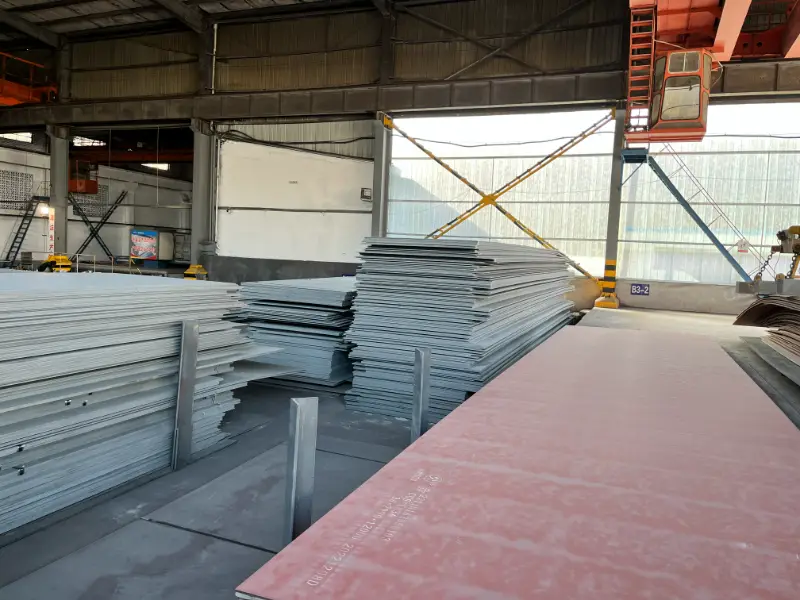
ASME SA709 Grade 100 High‑Strength Steel
ASME SA709 Grade 100 High‑Strength Steel | Structural Bridge & Heavy Engineering Plate / Coil
Comprehensive material data for ASME SA709/SA709M Grade 100 carbon and low-alloy high-strength structural steel coil. Includes chemical composition, mechanical properties, thermal/physical properties, international equivalents, and application guidance.
Hot rolling, cold forming, welding, machining (after appropriate thermal treatment), plasma/laser cutting
- Phone : +8618037372205
- Email : [email protected]
- WhatsApp: Contact via Whtsapp
- WeChat: +8618037372205
ASME SA709 Grade 100 High‑Strength Steel Introduction
ASME SA709/SA709M Grade 100 is a quenched and tempered (Q&T) carbon and low‑alloy high‑strength structural steel primarily used in bridge construction and other heavy‑fabricated structures. Key attributes:
- Minimum yield strength of 100 ksi (690 MPa) in thickness up to 2.5 in. (65 mm), ensuring excellent load‑bearing capacity.
- Good weldability and formability for its strength class when appropriate procedures are followed.
- Available in two atmospheric corrosion-resistant variations: standard Grade 100 [690] Type Q, and HPS 100W [690W] with enhanced weathering resistance (Cu‑Cr‑Ni alloying).
- Supplied in coil, plate, and bar form, enabling efficient fabrication of welded bridge girders, heavy equipment, and offshore structures.
ASME SA709 Grade 100 High‑Strength Steel Chemical Composition
The following table shows the typical heat analysis limits for ASME SA709/SA709M Grade 100 [690] Type Q (non‑weathering). HPS 100W [690W] has a different composition (lower carbon, addition of Cu, Cr, Ni, Mo) for improved atmospheric corrosion resistance. If HPS 100W is required, the purchase order must specify the supplementary requirement.
| Element | Grade 100 [690] (Type Q) | Remarks |
|---|---|---|
| Carbon (C) | 0.20 max | Heat analysis |
| Manganese (Mn) | 0.90 – 1.50 | |
| Phosphorus (P) | 0.035 max | |
| Sulfur (S) | 0.040 max | |
| Silicon (Si) | 0.15 – 0.50 | |
| Nickel (Ni) | 0.50 max | Including Cu + Ni + Cr + Mo + V ≤ 0.80 |
| Chromium (Cr) | 0.50 max | |
| Copper (Cu) | 0.35 max (when copper steel is specified: 0.20 – 0.40) | Cu may be specified for improved weather resistance |
| Molybdenum (Mo) | 0.15 max | |
| Vanadium (V) | 0.06 max | V + Nb ≤ 0.08 |
| Columbium / Niobium (Nb) | 0.05 max | May be added singly or in combination |
| Aluminum (Al) | 0.02 – 0.05 (if grain refining) | Optional for fine grain practice |
ASME SA709 Grade 100 High‑Strength Steel Physical & Thermal Properties
The physical properties below are typical for quenched and tempered low‑alloy steels of this strength level and are not specified in ASME SA709. They are provided for engineering design and material comparison.
| Property | Typical Value | Unit | Conditions / Remarks |
|---|---|---|---|
| Density (ρ) | 7.85 | g/cm³ | At room temperature |
| Modulus of Elasticity (E) | 205 | GPa | At room temperature |
| Shear Modulus (G) | 80 | GPa | Calculated from E and ν |
| Poisson's Ratio (ν) | 0.30 | – | Elastic region |
| Coefficient of Thermal Expansion (α) | 11.7 | 10⁻⁶/K | 20 °C to 100 °C (68–212 °F) |
| Thermal Conductivity (λ) | 42 | W/(m·K) | At 100 °C (approx.) |
| Specific Heat Capacity (cp) | 480 | J/(kg·K) | Room temperature to 100 °C |
| Electrical Resistivity (ρ_e) | 0.20 | 10⁻⁶ Ω·m | At 20 °C |
ASME SA709 Grade 100 High‑Strength Steel Mechanical Properties
Tensile and bend test requirements for ASME SA709/SA709M Grade 100 are given below. All values are minimum unless a range is stated. Impact tests (Charpy V‑notch) are supplementary and are performed only when specified on the order. For HPS 100W up to 4 in. (100 mm) thickness, the same yield and tensile apply, with slightly modified elongation.
| Property | Standard Requirement | Unit | Test Condition / Thickness |
|---|---|---|---|
| Yield Strength (ReH) | 100 min | ksi | t ≤ 2.5 in. (65 mm) – Grade 100 [690] |
| Yield Strength (ReH) | 690 min | MPa | t ≤ 65 mm – Grade 100 [690] |
| Tensile Strength (Rm) | 110 – 130 | ksi | t ≤ 2.5 in. (65 mm) – Grade 100 [690] |
| Tensile Strength (Rm) | 760 – 895 | MPa | t ≤ 65 mm – Grade 100 [690] |
| Elongation (A) in 2 in. (50 mm) | 18 min | % | t ≤ 0.75 in. (20 mm) – longitudinal |
| Elongation (A) in 2 in. (50 mm) | 16 min | % | 0.75 in. < t ≤ 2.5 in. (20 mm < t ≤ 65 mm) |
| Bend Test (180° bend) | d = 2 × t | – | t ≤ 0.75 in. (20 mm) |
| Bend Test (180° bend) | d = 3 × t | – | 0.75 in. < t ≤ 2.5 in. (20 mm < t ≤ 65 mm) |
| Charpy V‑Notch Impact (KV) – optional | 15 min | ft·lbf | At 0 °F (–18 °C), Zone 1; longitudinal (if specified) |
| Charpy V‑Notch Impact (KV) – optional | 20 min | J | At –18 °C, Zone 1; longitudinal (if specified) |
ASME SA709 Grade 100 High‑Strength Steel International Equivalent Standards & Substitution Grades
The following grades exhibit closely matching minimum yield strength and weldability but may differ in precise chemistries. Always verify full compliance with the designated standard for critical applications.
| Country / Region | Standard | Grade | Remarks |
|---|---|---|---|
| Europe | EN 10025-6 | S690Q / S690QL | Quenched and tempered, 690 MPa min YS. Verify CEV and toughness if impact specified. |
| International | ISO 4950-2 | S690Q | High yield strength flat products. Similar strength and welding requirements. |
| Japan | JIS G 3128 | SHY 685 | Low alloy high strength steel for welded structures. 685 MPa min YS; confirm thickness range. |
| China | GB/T 16270 | Q690D / Q690E | High strength structural steel plates. D/E suffix indicates different minimum service temperature. |
| United States | ASTM A514 / A517 | Grade Q | Quenched and tempered alloy steel plate (A514) or pressure vessel (A517). Strength matches Grade 100, but chemistry differs. |
ASME SA709 Grade 100 High‑Strength Steel Application Introduction
ASME SA709 Grade 100 is engineered for critical load‑bearing welded structures where a high strength‑to‑weight ratio is essential. Its balance of strength, toughness, and fabricability makes it suitable for the following industries and products:
Product Applications: Bridge plate girders, box girders, and rolled beams, Welded I‑beams and built‑up column sections, Structural steel coils cut‑to‑length for heavy plate parts, High‑strength heavy plate for crane and lifting applications, Offshore platform braces and node cans, Wind turbine tower flange plates and shell courses
Processed into products: Main bridge girders and stringers, Truss chords and diagonals, Crane boom sections and outrigger boxes, Excavator booms and arms, Jack‑up rig spud cans and legs, Welded tubular connections and transition pieces, Heavy‑duty base plates and splice plates
Application industries: Bridge & highway construction (primary girders, truss members, orthotropic deck plates), Heavy equipment manufacturing (crane booms, chassis, lifting frames), Offshore & marine engineering (jack‑up rig legs, platform substructures), Wind energy (tower sections, transition pieces), Mining & earthmoving machinery (bucket components, excavator arms), Pressure vessel and storage tank fabrication (when impact tested)
ASME SA709 Grade 100 High‑Strength Steel Similar High‑Strength Structural Steels
These grades provide comparable yield strength (≥ 100 ksi / 690 MPa) and are used in similar heavy structural applications. They may be considered when ASME SA709 Grade 100 availability is limited.
| Country / Region | Standard | Grade | Remarks |
|---|---|---|---|
| USA | ASTM A514 | Grade B, H, F, Q | Quenched and tempered alloy plates. Yield 100 ksi min, each grade has distinct chemistry. |
| USA | ASTM A517 | Grade B, H, F, Q | Pressure vessel grade counterpart, similar mechanicals. |
| Germany | DIN EN 10025-6 | S690QL1 / S690QL2 | Extra fine grain structural steel with improved toughness at low temperatures. |
| Sweden | SSAB (proprietary) | Strenx 700 / Weldox 700 | Commercial high‑strength structural steel, often exceeds SA709 Grade 100 minima. |
| South Korea | KS D 3610 | SHY 685 | Korean standard for high‑strength welded structural steel, similar to JIS SHY 685. |
Notes:
Important:
- When order specifies supplementary impact requirements, the test temperature and minimum absorbed energy must be clearly stated per ASME SA709 Table 3 or as agreed.
- HPS 100W (Grade 100W) is a weathering steel variant providing atmospheric corrosion resistance; it is supplied with a different heat analysis and mechanical properties per the same standard's supplementary requirements.
- Weldability: low‑carbon content and microalloying provide a carbon equivalent (Ceq) typically below 0.50%, enabling conventional welding with low‑hydrogen electrodes and appropriate preheat/interpass temperatures.
- For hot‑dip galvanizing, the high silicon content in standard Grade 100 may affect coating thickness; consult the galvanizer.
- Share



