
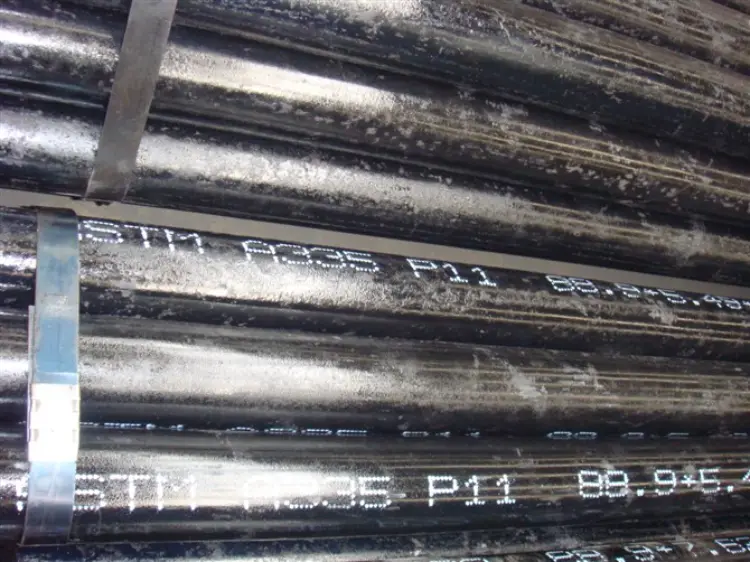
ASME SA335 P11 Boiler Steel Pipe
ASME SA335 P11 Boiler Steel Pipe: Composition, Properties & Applications Guide
Complete technical data for ASME SA335 P11 seamless ferritic alloy steel pipe used in high-temperature boiler service. Includes chemical composition, mechanical and physical properties, international equivalents, and application guidance.
Hot-finished or cold-drawn; suitable for welding, bending, and hot forming
- Phone : +8618037372205
- Email : [email protected]
- WhatsApp: Contact via Whtsapp
- WeChat: +8618037372205
ASME SA335 P11 Boiler Steel Pipe Introduction
ASME SA335 P11 is a seamless ferritic alloy steel pipe specifically designed for high-temperature service in boilers, superheaters, and heat exchangers. This chromium-molybdenum (1.25Cr-0.5Mo) grade offers an excellent combination of elevated temperature strength, creep resistance, oxidation resistance, and corrosion resistance, making it a preferred choice for power generation and petrochemical industries. The steel is typically supplied in the normalized and tempered condition, ensuring optimal microstructure stability. With a tensile strength requirement of at least 415 MPa and yield strength of 205 MPa, P11 provides reliable performance up to approximately 550°C. It also exhibits good weldability when proper preheating and post-weld heat treatment are followed. Its balanced composition and robust mechanical properties allow it to withstand the demanding conditions of high-pressure steam pipelines and refinery services.
ASME SA335 P11 Boiler Steel Pipe Chemical Composition
Chemical composition limits according to ASME SA335/SA335M. The steel contains controlled amounts of chromium and molybdenum for high-temperature strength and oxidation resistance. Phosphorus and sulfur are strictly limited to ensure cleanliness and weldability. Residual elements may be present but are not specifically required by the standard.
| Element | Composition (%) | Notes |
|---|---|---|
| Carbon (C) | 0.05 – 0.15 | Heat analysis per standard |
| Manganese (Mn) | 0.30 – 0.60 | Heat analysis per standard |
| Phosphorus (P) | ≤ 0.025 | Maximum |
| Sulfur (S) | ≤ 0.025 | Maximum |
| Silicon (Si) | 0.50 – 1.00 | Heat analysis per standard |
| Chromium (Cr) | 1.00 – 1.50 | Heat analysis per standard |
| Molybdenum (Mo) | 0.44 – 0.65 | Heat analysis per standard |
| Nickel (Ni) | ≤ 0.30 | Residual, if applicable (not mandated in base spec) |
| Copper (Cu) | ≤ 0.30 | Residual, if applicable (not mandated in base spec) |
ASME SA335 P11 Boiler Steel Pipe Thermal and Electrical Physical Properties
Typical physical properties for 1.25Cr-0.5Mo steel (UNS K11597) as referenced in ASME BPVC Section II Part D and published literature. These values are not specification requirements but are representative for engineering design. Data are provided for the normalized and tempered condition. Elastic modulus, thermal expansion, and thermal conductivity vary with temperature.
| Property | Typical Value | Unit | Test Condition / Temperature |
|---|---|---|---|
| Density (ρ) | 7830 | kg/m³ | Room temperature (20 °C) |
| Elastic Modulus (E) | 215 | GPa | 20 °C |
| Elastic Modulus (E) | 210 | GPa | 100 °C |
| Elastic Modulus (E) | 204 | GPa | 200 °C |
| Elastic Modulus (E) | 197 | GPa | 300 °C |
| Elastic Modulus (E) | 190 | GPa | 400 °C |
| Elastic Modulus (E) | 181 | GPa | 500 °C |
| Shear Modulus (G) | 83 | GPa | Estimated based on E and Poisson |
| Poisson's Ratio (ν) | 0.30 | — | Typical for ferritic steel |
| Thermal Expansion Coefficient (α) | 11.2 | 10⁻⁶/°C | Mean coef. 20–100 °C |
| Thermal Expansion Coefficient (α) | 12.0 | 10⁻⁶/°C | Mean coef. 20–200 °C |
| Thermal Expansion Coefficient (α) | 12.6 | 10⁻⁶/°C | Mean coef. 20–300 °C |
| Thermal Expansion Coefficient (α) | 13.1 | 10⁻⁶/°C | Mean coef. 20–400 °C |
| Thermal Expansion Coefficient (α) | 13.5 | 10⁻⁶/°C | Mean coef. 20–500 °C |
| Thermal Conductivity (λ) | 39.5 | W/(m·K) | At 100 °C |
| Thermal Conductivity (λ) | 39.0 | W/(m·K) | At 200 °C |
| Thermal Conductivity (λ) | 37.5 | W/(m·K) | At 300 °C |
| Thermal Conductivity (λ) | 35.2 | W/(m·K) | At 400 °C |
| Thermal Conductivity (λ) | 32.5 | W/(m·K) | At 500 °C |
| Specific Heat Capacity | 460 | J/(kg·K) | At 20 °C |
| Specific Heat Capacity | 500 | J/(kg·K) | At 200 °C |
| Specific Heat Capacity | 550 | J/(kg·K) | At 400 °C |
| Electrical Resistivity (ρ_e) | 0.22 | µΩ·m | At 20 °C, typical |
ASME SA335 P11 Boiler Steel Pipe Mechanical Properties
Tensile requirements for ASME SA335 P11 seamless pipe at room temperature per ASME SA335/SA335M. Elongation values vary with specimen orientation and wall thickness. Hardness values are not mandatory per the base specification but are often specified in supplementary requirements. The yield strength corresponds to 0.2% offset (ReH). All results are based on the product after final heat treatment.
| Property | Required Value | Unit | Test Condition / Remarks |
|---|---|---|---|
| Tensile Strength (Rm) | 415 – 585 | MPa | Transverse or longitudinal strip; full-section for thin-wall |
| Tensile Strength (Rm) | 60 – 85 | ksi | Transverse or longitudinal strip; full-section for thin-wall |
| Yield Strength (ReH) | ≥ 205 | MPa | 0.2% offset, all orientations |
| Yield Strength (ReH) | ≥ 30 | ksi | 0.2% offset |
| Elongation (A), longitudinal | ≥ 30 | % | Wall ≤ 5/16 in. (7.94 mm), 2 in. or 50 mm gage |
| Elongation (A), longitudinal | ≥ 22 | % | Wall > 5/16 in. (7.94 mm), 2 in. or 50 mm gage |
| Elongation (A), transverse | ≥ 20 | % | Wall ≤ 5/16 in. (7.94 mm), strip test |
| Elongation (A), transverse | ≥ 14 | % | Wall > 5/16 in. (7.94 mm), strip test |
| Hardness (Brinell) | ≤ 163 HBW | — | Typical as-supplied (not mandatory per base spec) |
| Hardness (Rockwell B) | ≤ 85 HRB | — | Typical as-supplied (not mandatory per base spec) |
ASME SA335 P11 Boiler Steel Pipe Exact Equivalent Materials and Substitution Options
| Country/Region | Standard | Grade/Designation | Remarks |
|---|---|---|---|
| Europe / EU | EN 10216-2 | 13CrMo4-5 (1.7335) | Seamless steel tubes for pressure purposes; identical 1.25Cr-0.5Mo chemistry |
| China | GB/T 5310 | 15CrMoG | Seamless steel tubes and pipes for high-pressure boiler; matching composition and properties |
| Japan | JIS G3458 | STPA22 | Alloy steel pipes for high-temperature service; equivalent to P11 |
| United Kingdom | BS 3059-2 | 620-440 | Steel boiler and superheater tubes; formerly 13CrMo4-4, now aligned with EN |
| International | ISO 9329-2 | 11CrMo4-5 (TS9) | Seamless steel tubes for pressure purposes – Part 2: Alloy steels; close equivalent |
ASME SA335 P11 Boiler Steel Pipe Application Introduction
ASME SA335 P11 pipes are extensively utilized in environments where repeated heating and cooling cycles demand stable microstructures and resistance to thermal fatigue. The material is suitable for steam temperatures up to approximately 550°C and is commonly employed in both fossil fuel and nuclear power generating stations, as well as in refinery heater tubes. Its good weldability and availability in multiple dimensions support a wide range of fabrication and installation scenarios. Proper preheating and post-weld heat treatment (PWHT) are recommended to avoid cold cracking and ensure joint integrity.
Product Applications: High-pressure main steam pipelines, Superheater and reheater tube banks, Boiler water wall tubes and headers, Heat exchanger tubes and shells, Process furnace tubes, High-temperature steam and gas piping
Processed into products: Boiler superheater and reheater U-bends, Stub ends, airfoil sections, and nozzle connections, Integrally finned tubes for heat recovery, Welded tube-to-header joints, Pipe spools and expansion loops, Transition pieces between dissimilar grades (e.g., P11 to P91)
Application industries: Power generation (coal, oil, gas, nuclear), Petrochemical and chemical processing, Oil refining (hydrocracker, coker, reformer units), Industrial boiler manufacturing, Heat recovery steam generators (HRSG), Combined cycle and cogeneration plants
ASME SA335 P11 Boiler Steel Pipe Similar or Alternative Materials for Consideration
| Country/Region | Standard | Grade/Designation | Remarks / Comparison |
|---|---|---|---|
| USA | ASME SA335 | P12 | 1Cr-0.5Mo steel; slightly lower chromium, lower creep strength; usable for less demanding temperature (<500°C). |
| USA | ASME SA335 | P22 | 2.25Cr-1Mo steel; higher chromium and molybdenum for superior creep resistance up to ~600°C; substitutes when higher strength needed. |
| Europe | EN 10216-2 | 10CrMo5-5 (1.7338) | Similar to P12 but with higher chromium; intermediate strength level. |
| Europe | EN 10216-2 | 10CrMo9-10 (1.7380) | Similar to P22; offers better high-temperature performance than P11, suitable for thicker-walled components. |
| Japan | JIS G3458 | STPA23 | Equivalent to 1.25Cr-0.5Mo-Si, slightly different silicon range but close mechanical properties. |
Notes:
Weldability: P11 exhibits good weldability using common arc welding processes (GTAW, SMAW, SAW). Preheating (200–300°C) and post-weld heat treatment (675–700°C tempering) are strongly recommended to avoid hydrogen-induced cracking and restore toughness. Maximum service temperature: Typically limited to ~550°C for continuous use; above 550°C scaling and oxidation rates increase significantly. For higher temperatures, consider grades such as SA335 P22 or P91. Dimensions: Available in outer diameters from 1/2 in. to over 30 in. and wall thicknesses up to Schedule XXS. Testing: Hydrostatic or nondestructive testing is often required per purchase specification. Hardness testing is commonly added as a supplementary requirement for sour service or high-temperature applications. International classification: UNS K11597, ASTM A335 P11 (identical standard for normal service), ASME Section II Part A designation.
- Share



