
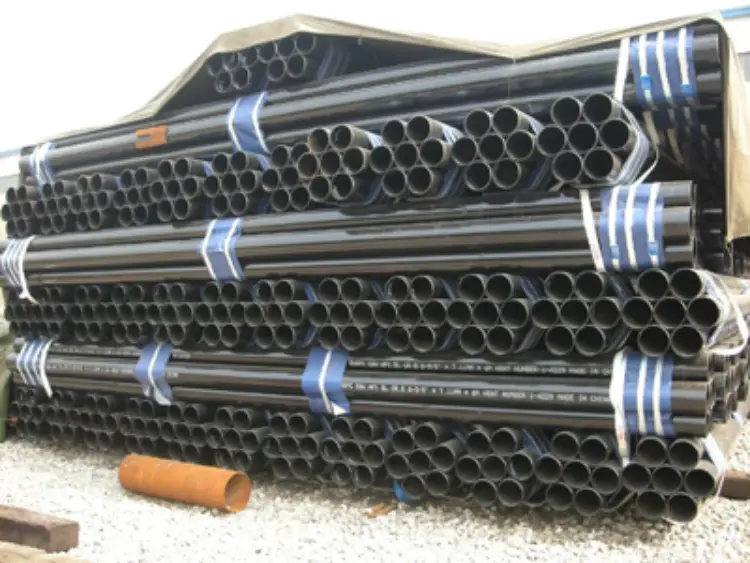
ASME SA312 TP310S Stainless Steel Pipe
ASME SA312 TP310S Stainless Steel Pipe: High-Temperature Oxidation Resistance & Austenitic Grade
Detailed data sheet for ASME SA312 TP310S stainless steel pipe covering chemical composition, mechanical and physical properties, international equivalents, and applications.
Hot rolling, cold drawing, welding, bending, flaring, expanding, machining
- Phone : +8618037372205
- Email : [email protected]
- WhatsApp: Contact via Whtsapp
- WeChat: +8618037372205
ASME SA312 TP310S Stainless Steel Pipe Introduction
ASME SA312 TP310S is an austenitic chromium-nickel stainless steel pipe grade specifically designed for high-temperature service. It is the low-carbon version of TP310 (UNS S31008), offering enhanced resistance to sensitization and intergranular corrosion. The alloy exhibits excellent oxidation resistance up to 1100°C (2012°F) in continuous service and possesses good strength at elevated temperatures. Its austenitic microstructure remains stable and non-magnetic even after cold working. Typical applications include furnace components, heat exchangers, and thermal processing equipment. The material is supplied in solution-annealed condition and is widely used in the chemical, petrochemical, and power generation industries.
ASME SA312 TP310S Stainless Steel Pipe Chemical Composition
The chemical composition complies with ASME SA312/SA312M for grade TP310S. The low carbon content (max 0.08%) minimizes carbide precipitation during welding or high-temperature exposure, improving resistance to intergranular attack. Chromium and nickel provide high-temperature strength and oxidation resistance. Maximum limits for sulfur and phosphorus ensure good weldability and corrosion resistance. Iron constitutes the balance.
| Element | Standard Value (%) | Remarks |
|---|---|---|
| Carbon (C) | ≤ 0.08 | Low carbon content for high-temperature stability |
| Manganese (Mn) | ≤ 2.00 | Typical range involves deoxidation |
| Silicon (Si) | ≤ 1.00 | Maximum limit for control of high-temperature scaling |
| Phosphorus (P) | ≤ 0.045 | Controlled for optimum weldability |
| Sulfur (S) | ≤ 0.030 | Enhances machinability limits, typical low value |
| Chromium (Cr) | 24.0 – 26.0 | Primary element for oxidation resistance |
| Nickel (Ni) | 19.0 – 22.0 | Stabilizes austenitic microstructure |
| Iron (Fe) | Balance | Remainder |
ASME SA312 TP310S Stainless Steel Pipe Thermal and Electrical Physical Properties
The data below are typical values for 310S stainless steel in the solution-annealed condition, compiled from recognized technical references. These properties are not specified in the ASME SA312 standard but serve as design guidelines. Variations may occur depending on exact composition, product form, and temperature. The thermal expansion coefficient is relatively high, and the thermal conductivity is low compared to carbon steels, which are characteristics of austenitic stainless steels.
| Property | Typical Value | Unit | Test Condition / Temperature |
|---|---|---|---|
| Density (ρ) | 8.00 | g/cm³ | At 20°C |
| Elastic Modulus (E) | 200 | GPa | At 20°C |
| Shear Modulus (G) | 77 | GPa | At 20°C, calculated from E and ν |
| Poisson's Ratio (ν) | 0.30 | - | At 20°C, typical for austenitic stainless steel |
| Thermal Expansion Coefficient (α) | 15.9 | 10⁻⁶/°C | 20–100°C |
| Thermal Expansion Coefficient (α) | 17.3 | 10⁻⁶/°C | 20–500°C |
| Thermal Expansion Coefficient (α) | 18.3 | 10⁻⁶/°C | 20–1000°C |
| Thermal Conductivity (λ) | 14.2 | W/(m·K) | At 100°C |
| Thermal Conductivity (λ) | 18.7 | W/(m·K) | At 500°C |
| Specific Heat Capacity (cp) | 500 | J/(kg·K) | At 20°C |
| Electrical Resistivity (ρe) | 0.78 | μΩ·m | At 20°C |
ASME SA312 TP310S Stainless Steel Pipe Mechanical Properties
Mechanical property values comply with ASME SA312/SA312M for solution-annealed TP310S. The properties are measured on longitudinal test specimens. The tensile requirements are mandatory; hardness testing is an optional supplementary requirement (e.g., S1). The specified elongation corresponds to a gauge length of 50 mm (or 2 in.) for full-section specimens or proportional strip specimens. Impact toughness is not normally required for this standard.
| Property | Standard Required Value | Unit | Test Condition |
|---|---|---|---|
| Tensile Strength (Rm) | ≥ 515 | MPa | Room temperature, longitudinal specimen |
| Yield Strength (ReH, 0.2% offset) | ≥ 205 | MPa | Room temperature, longitudinal specimen |
| Elongation (A) | ≥ 35 | % | Gauge length 50 mm (2 in.) |
| Brinell Hardness (HBW) (optional) | ≤ 217 | - | Optional supplementary requirement, typical maximum |
ASME SA312 TP310S Stainless Steel Pipe Completely Equivalent Standards and Substitute Grades
| Country / Region | Standard | Grade / Designation | Remarks |
|---|---|---|---|
| USA | ASTM A312/A312M | TP310S, UNS S31008 | Identical to ASME SA312 TP310S; same chemical and mechanical requirements |
| USA | ASME SA312 (this standard) | TP310S | Base specification |
| European Union | EN 10216-5 | X8CrNi25-21, 1.4845 | Seamless tubes for pressure purposes; minor compositional limits may differ; often considered direct substitute |
| ISO | ISO 9328-7 | X8CrNi25-21 | Equivalent under international standard for pressure purposes |
| Japan | JIS G3459 | SUS310S TP | Stainless steel pipes for corrosion resistant and high-temperature service |
| China | GB/T 14976 | S31008 (022Cr25Ni20) | Seamless stainless steel pipes for fluid transport; matches UNS S31008 |
ASME SA312 TP310S Stainless Steel Pipe Application Introduction
ASME SA312 TP310S pipes are engineered for demanding high-temperature environments where oxidation and creep resistance are critical. The material can be used in both oxidizing and reducing sulfur-containing atmospheres up to certain limits. It is not recommended for highly carburizing atmospheres because of the chromium content, but it performs excellently in air, combustion gases, and steam. Typical applications span across numerous industries, from power generation to food processing.
Product Applications: Process piping and headers in oil refineries and gas plants, Steam piping in conventional and nuclear power plants, Furnace roller hearths and radiant tubes in continuous annealing lines, Flare tips and incinerator parts, Heat exchanger tubes for corrosive high-temperature fluids, Condenser and evaporator tubes in desalination plants, Sanitary tubing and fittings in dairy and beverage industries
Processed into products: Straight lengths of seamless or welded pipe for field fabrication, Butt-weld pipe fittings (elbows, tees, reducers, caps), Flanges, blind flanges, and lap joint stub ends, Tube sheets for heat exchangers, Annular baffles and support plates for steam generators, Thermowell protection tubes, Custom fabricated spools and manifolds
Application industries: Petrochemical and chemical processing (furnace tubes, cracking tubes), Power generation (boilers, superheaters, steam lines), Heat treatment equipment (muffles, retorts, baskets), Aerospace (exhaust components, afterburner rings), Food and beverage (high-purity tubing for process lines), Waste incineration (combustion chambers, thermocouple protection tubes), Pharmaceutical (hygienic pipe systems)
ASME SA312 TP310S Stainless Steel Pipe Similar / Alternative Materials
| Country / Region | Standard | Grade / Designation | Remarks |
|---|---|---|---|
| USA | ASTM A312 | TP310, UNS S31000 | Higher carbon content (max 0.25%) – lower resistance to intergranular corrosion but similar high-temperature strength; not always interchangeable for welded assemblies |
| USA | ASTM A312 | TP309S, UNS S30908 | Lower chromium and nickel (Cr 22-24%, Ni 12-15%) – less oxidation resistance at extreme temperatures; suitable for lower-temperature oxidizing environments |
| European Union | EN 10028-7 / EN 10088-2 | 1.4841 (X15CrNiSi25-21) | Contains higher silicon for improved oxidation resistance; used for furnace parts |
| European Union | EN 10095 | 1.4828 (X15CrNiSi20-12) | Heat-resisting grade with lower nickel; adequate for temperatures up to ~1000°C |
| China | GB/T 14976 | S30908 (022Cr23Ni13) | Lower alloy content; can be considered where full 310S corrosion resistance is unnecessary |
Notes:
Welding considerations: TP310S is readily weldable by common arc welding processes (GTAW, SMAW, GMAW) using filler metals matching the composition (e.g., ER310). Preheat and post-weld heat treatment are generally not required. Low interpass temperatures (<150°C) are recommended to minimize distortion and sensitization.
Forming: The material can be hot or cold formed, though high strength and work hardening may necessitate intermediate annealing for severe cold working. Hot working should be performed in the range 1150–900°C, followed by rapid cooling to retain the solution-annealed structure.
Corrosion resistance: In addition to high-temperature oxidation resistance, TP310S exhibits good resistance to nitric acid and many organic chemicals at ambient temperatures but may be susceptible to chloride stress corrosion cracking above 60°C.
- Share



