
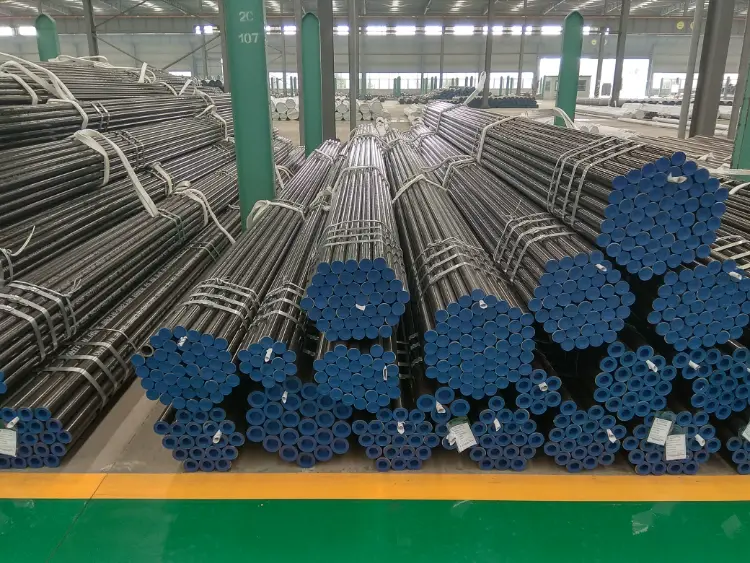
ASME SA210 Grade A (SA210GrA) Boiler Steel Pipe
ASME SA210 Grade A (SA210GrA) Boiler Steel Pipe - Chemical, Mechanical & Physical Properties
Detailed material data for ASME SA210 Grade A (SA210GrA) boiler steel pipe, including chemical composition, mechanical properties, physical properties, international equivalents, and application guide.
Hot‑finishing or cold‑drawing, followed by normalizing or normalizing + tempering
- Phone : +8618037372205
- Email : [email protected]
- WhatsApp: Contact via Whtsapp
- WeChat: +8618037372205
ASME SA210 Grade A Boiler Steel Pipe Introduction
ASME SA210 Grade A (SA210GrA) is a medium‑carbon steel seamless tube specifically designed for high‑temperature service in boilers, superheaters, and heat exchangers. It is manufactured to the ASME SA‑210/SA‑210M specification and is widely used in power generation and industrial boiler systems. The steel exhibits good weldability and moderate strength, with excellent resistance to scaling at elevated temperatures.
Typical delivery condition is either hot‑finished or cold‑drawn, followed by a normalizing or normalizing‑plus‑tempering heat treatment to ensure uniform microstructure and desired mechanical properties. The material is characterized by:
- Tensile strength ≥415 MPa (60 ksi)
- Yield strength ≥255 MPa (37 ksi)
- Elongation ≥30% in 50 mm (2 in.)
- Maximum hardness 79 HRB or 143 HBW
ASME SA210 Grade A Boiler Steel Pipe Chemical Composition
Chemical requirements according to ASME SA‑210/SA‑210M for Grade A‑1. Values are ladle analysis maximums unless stated otherwise. The silicon content is specified as a minimum to ensure deoxidation. All other elements are considered residual and are not intentionally added.
| Chemical Element | Standard Value | Remarks |
|---|---|---|
| Carbon (C) | ≤ 0.27 | |
| Manganese (Mn) | ≤ 0.93 | |
| Phosphorus (P) | ≤ 0.035 | |
| Sulfur (S) | ≤ 0.035 | |
| Silicon (Si) | ≥ 0.10 | Minimum requirement; typical 0.10–0.35% |
ASME SA210 Grade A Boiler Steel Pipe Thermal and Electrical Physical Properties
Typical physical properties for medium‑carbon boiler steel at room temperature unless otherwise noted. These values are representative for SA210 Grade A material and are not mandatory requirements but may be used for design calculations.
| Property | Standard Value | Unit | Test Condition |
|---|---|---|---|
| Density (ρ) | 7.85 | g/cm³ | Room temperature |
| Modulus of Elasticity (E) | 200–210 | GPa | Room temperature |
| Shear Modulus (G) | 80 | GPa | Room temperature (estimated) |
| Poisson's Ratio (ν) | 0.27–0.30 | – | Room temperature |
| Thermal Expansion Coefficient (α) | 11.5–12.5 (20–100°C); 13.0–14.0 (20–300°C); 14.5–15.5 (20–500°C) | ×10⁻⁶/K | Temperature ranges |
| Thermal Conductivity (λ) | 45–50 (at 20°C); 40–45 (at 300°C); 35–40 (at 500°C) | W/(m·K) | Temperature ranges |
| Specific Heat Capacity | 460–480 (at 20°C); 500–520 (at 300°C); 540–570 (at 500°C) | J/(kg·K) | Temperature ranges |
| Electrical Resistivity (ρe) | 0.18–0.22 | μΩ·m | Room temperature |
ASME SA210 Grade A Boiler Steel Pipe Mechanical Properties
Room‑temperature tensile properties and hardness as required by ASME SA‑210/SA‑210M for Grade A‑1. Tensile testing is performed on longitudinal specimens in accordance with ASTM A450/A450M. Hardness values apply unless otherwise agreed between purchaser and manufacturer.
| Property | Required Value | Unit | Test Condition |
|---|---|---|---|
| Tensile Strength (Rm) | ≥ 415 | MPa (ksi) | Room temperature, longitudinal specimen |
| Yield Strength (ReH) | ≥ 255 | MPa (ksi) | 0.2% offset, room temperature |
| Elongation (A) | ≥ 30 | % | Gauge length 50 mm (2 in.) |
| Hardness, Rockwell B | ≤ 79 | HRB | As‑delivered condition |
| Hardness, Brinell | ≤ 143 | HBW | As‑delivered condition |
ASME SA210 Grade A Boiler Steel Pipe Identical Equivalent Material Standards and Replaceable Grades
| Country/Region | Standard | Grade | Remarks |
|---|---|---|---|
| USA | ASME SA-210/SA-210M | SA210 Grade A (A-1) | Original specification |
| China | GB 5310 | 20G | Comparable chemical and mechanical properties |
| Europe | EN 10216-2 | P235GH | Equivalent for boilers and pressure purposes |
| Japan | JIS G3461 | STB340 | Corresponding boiler tube grade |
ASME SA210 Grade A Boiler Steel Pipe Application Introduction
ASME SA210 Grade A is primarily used in elevated‑temperature service within power plants and industrial boilers. Its combination of moderate strength, good weldability, and resistance to thermal fatigue makes it suitable for heat‑transfer components. Below are typical application areas, products, and specific components.
Product Applications: Water‑wall panels, Superheater and reheater tube bundles, Economizer banks, Steam and water piping, Heat exchanger tube bundles
Processed into products: Boiler water wall tubes, Superheater serpentine tubes, Economizer straight and bent tubes, Steam line headers and connectors, Furnace wall panels, Heat exchanger U‑tube bundles
Application industries: Fossil‑fuel power plants, Industrial boilers and heat recovery steam generators (HRSG), Petrochemical and refining (furnace tubes), District heating systems, Waste‑to‑energy plants
ASME SA210 Grade A Boiler Steel Pipe Similar/Alternative Material Recommendations
| Country/Region | Standard | Grade | Remarks |
|---|---|---|---|
| USA | ASTM A192/A192M | A192 | Carbon steel boiler tube; slightly lower strength, similar applications |
| China | GB 5310 | 15MoG | Low‑alloy option with improved elevated‑temperature strength |
| Europe | EN 10216-2 | P265GH | Higher strength carbon steel, suitable for thicker walls or higher pressure |
| International | ISO 9329-2 | PH 26 | Pressure‑purpose seamless tube with similar carbon‑manganese composition |
Notes:
Material shall be fully killed and fine‑grain practice is recommended but not mandatory. For cold‑drawn tubes, stress‑relieving at a minimum temperature of 650 °C (1200 °F) is required after the final cold‑drawing pass. Hydrostatic or non‑destructive electric testing is usually specified as per ASTM A450/A450M. The maximum hardness limit applies unless specifically waived by the purchaser. No specific chemical requirements exist for chromium, nickel, molybdenum, or copper; their residual contents are typically below 0.30% each and do not influence base properties.
- Share



