
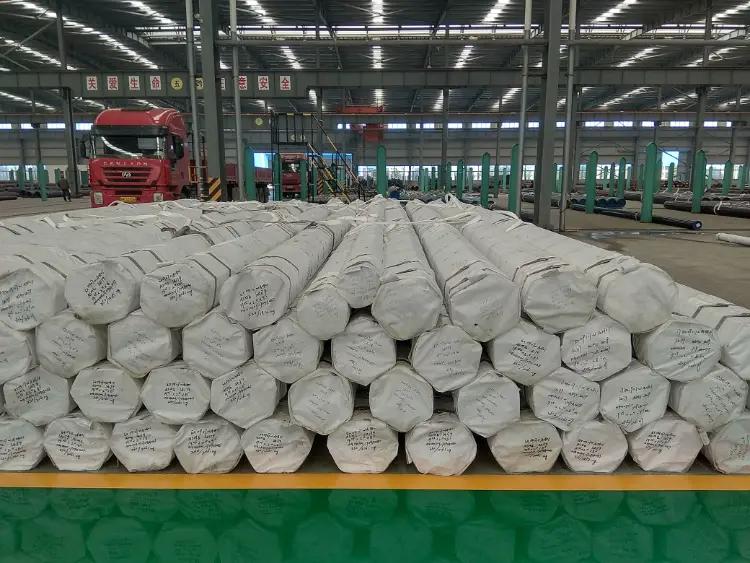
ASME SA179 Cold Material
ASTM A179 (SA179) Cold-Drawn Low-Carbon Seamless Steel Tube for Heat Exchangers and Condensers
Comprehensive technical data for ASTM A179 (ASME SA179) cold-drawn low-carbon seamless steel tubes used in heat exchangers, condensers, and similar heat-transfer equipment. Includes chemical composition, mechanical and physical properties, equivalent grades, and application guidelines.
Cold-drawing, cold-bending, welding (suitable for all common fusion welding methods), flaring, flattening, and machining.
- Phone : +8618037372205
- Email : [email protected]
- WhatsApp: Contact via Whtsapp
- WeChat: +8618037372205
ASME SA179 Cold Introduction
ASTM A179 (ASME SA179) specifies cold-drawn seamless low-carbon steel tubes primarily intended for heat-exchanger and condenser applications. The grade offers a good balance of ductility, thermal conductivity, and formability, making it suitable for below 650 °F (340 °C) service. The tubes are produced by cold drawing without subsequent heat treatment (unless otherwise agreed), which enhances surface finish and dimensional accuracy. Typical characteristics include:
- Minimum tensile strength of 325 MPa (47 ksi)
- Minimum yield strength of 180 MPa (26 ksi) in the longitudinal direction
- Elongation as high as 35% in 50 mm (2 in.) gauge length
- Excellent cold-bending and flaring capability
- Good thermal conductivity and weldability
The material is widely adopted in the fabrication of shell-and-tube heat exchangers, condensers, feedwater heaters, and similar pressure parts.
ASME SA179 Cold Chemical Composition
The ladle analysis limits according to ASTM A179/A179M. Elements not listed, such as silicon, are not specified but may be present as residuals. All values are in weight percent unless otherwise indicated.
| Chemical Element | Standard Value | Remarks |
|---|---|---|
| Carbon, C | 0.06 – 0.18 | Ladle analysis |
| Manganese, Mn | 0.27 – 0.63 | Ladle analysis |
| Phosphorus, P | ≤ 0.035 | Maximum |
| Sulfur, S | ≤ 0.035 | Maximum |
ASME SA179 Cold Thermal & Electrical Physical Properties
The following values are representative for low-carbon steel grades similar to A179. Actual values may vary slightly depending on the exact composition and condition. Data are derived from standard reference materials for carbon steel at 20 °C unless indicated otherwise.
| Property | Standard Value | Unit | Test Condition / Remarks |
|---|---|---|---|
| Density (ρ) | 7.85 | g/cm³ | Room temperature |
| Modulus of Elasticity (E) | 200 | GPa | Tension, room temperature |
| Shear Modulus (G) | 80 | GPa | Room temperature, calculated from E and ν |
| Poisson's Ratio (ν) | 0.29 | - | Elastic range, room temperature |
| Thermal Expansion Coefficient (α) | 11.7 × 10⁻⁶ | /K | From 0 °C to 100 °C |
| Thermal Conductivity (λ) | 51.9 | W/(m·K) | At 20 °C |
| Specific Heat Capacity (c) | 486 | J/(kg·K) | At 20 °C |
| Electrical Resistivity (ρₑ) | 0.142 × 10⁻⁶ | Ω·m | At 20 °C |
ASME SA179 Cold Mechanical Properties
Mechanical test results according to ASTM A179/A179M, performed on longitudinal strip or full-section specimens at room temperature. Tubes must also pass bending, flattening, and flaring tests as described below.
| Property | Standard Requirement | Unit | Test Condition |
|---|---|---|---|
| Tensile Strength (Rm) | ≥ 325 (47 ksi) | MPa | Room temperature, longitudinal |
| Yield Strength (ReH) | ≥ 180 (26 ksi) | MPa | Room temperature, longitudinal, 0.2% offset or 0.5% extension under load |
| Elongation (A) | ≥ 35 | % | 50 mm (2 in.) gauge length |
| Elongation (A) | ≥ 25 | % | 200 mm (8 in.) gauge length |
| Bend Test | No cracks after 180° bending | - | Bend radius = nominal tube OD, through the complete 180° arc |
| Flattening Test | No cracks or breaks when flattened to a distance equal to 3 times the wall thickness (for D/t ≤ 10) or specified H | - | Per ASTM A450/A450M |
| Flaring Test | No cracks or breaks after expanding the tube end to 15 % increase in OD | - | 60° conical mandrel, per ASTM A450/A450M |
ASME SA179 Cold Fully Equivalent Standards and Replaceable Grades
| Country/Region | Standard | Grade | Remarks |
|---|---|---|---|
| USA / International | ASME SA179/SA179M | SA179 | Identical to ASTM A179; recognized by the ASME Boiler and Pressure Vessel Code. |
| USA | ASTM A179/A179M | A179 | Source specification for SA179; chemical and mechanical requirements are the same. |
ASME SA179 Cold Application Introduction
ASTM A179 tubes are engineered for efficient heat transfer in closed-loop systems. Their cold-drawn surface and good ductility allow cost-effective fabrication of complex tube bundles and coils. Key application areas include:
Product Applications: Shell-and-tube heat exchangers, Surface condensers, Evaporators and reboilers, Feedwater heaters, Oil coolers, Air-cooled heat exchangers (fin-tube bundles), Steam surface condensers, Boiler components (economisers, superheaters limited to design temperature)
Processed into products: Heat-exchanger tubes (straight or U-bent), Return bends and U-tube bundles, Tube-to-tubesheet joints (expanded or welded), Fin-tube elements, Coiled hairpin heat-exchanger elements, Transfer line exchangers, Desuperheater tubes
Application industries: Chemical and petrochemical processing, Power generation (conventional and nuclear), Oil & gas (refining, LNG), Food and beverage processing, HVAC and refrigeration, Marine and shipbuilding, Pulp and paper, Pharmaceutical manufacturing
ASME SA179 Cold Similar / Replaceable Material Recommendations
| Country/Region | Standard | Grade | Comparison / Remarks |
|---|---|---|---|
| European Union | EN 10216-1 | P235TR1 | Higher minimum yield strength (235 MPa) and tensile strength (360–500 MPa), but similar carbon-manganese steel for pressure purposes. Often used interchangeably for heat-exchanger tubes after verification. |
| Japan | JIS G3461 | STB 340 | Carbon steel tubes for boiler and heat exchanger; tensile strength ≥ 340 MPa, yield ≥ 175 MPa. Comparable but slight differences in elongation and flaring requirements. |
| China | GB/T 8163 | 10 | Seamless steel tube for liquid service; C: 0.07–0.13, Mn: 0.35–0.65, tensile strength 335–475 MPa, yield ≥ 195 MPa. Widely used as a substitute in non-critical exchangers. Verify design limits. |
| China | GB/T 3087 | 10 | Seamless steel tube for low and medium pressure boiler; C: 0.07–0.13, Mn: 0.35–0.65, tensile strength 335–475 MPa, yield ≥ 195 MPa. Suitable alternative for boiler/heat-exchanger tubing. |
| Germany (withdrawn) | DIN 17175 | St35.8 | Legacy specification; C ≤ 0.17, Mn ≥ 0.40, tensile strength 360–480 MPa, yield ≥ 235 MPa. Historically interchangeable, but higher strength requires re-evaluation of design stresses. |
Notes:
ASTM A179/A179M tubes are normally supplied in accordance with the supplementary requirements of ASTM A450/A450M (General Requirements for Carbon and Low-Alloy Steel Tubes). Pressure tests: Each tube shall withstand hydrostatic test pressure without leakage, or alternatively, be subjected to a nondestructive electric test per the standard. Heat treatment: Cold-drawn tubes are typically used in the as-drawn condition; stress relief annealing can be agreed upon to improve corrosion resistance or to meet specific forming requirements. Welding: SA179 exhibits good weldability by all common fusion methods, but preheating and post-weld heat treatment may be applied depending on service conditions and thickness. For elevated-temperature service above 650 °F (340 °C), alternative materials such as ASTM A210 (medium-carbon) or alloyed steels should be evaluated.
- Share



