
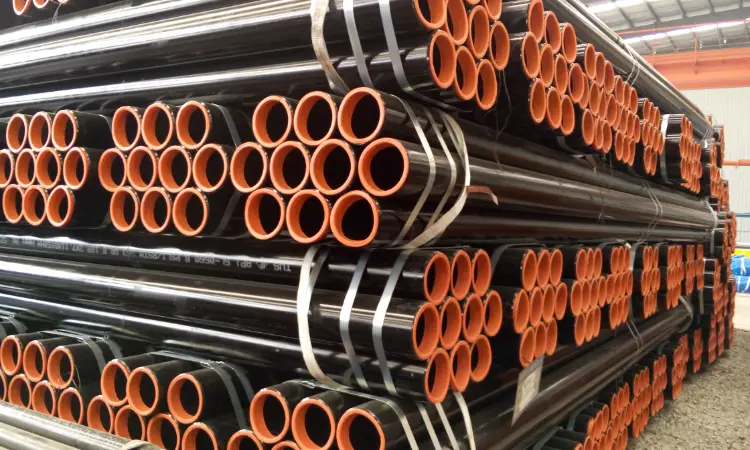
API 5L Grade B ERW Pipe Material
API 5L Grade B ERW Pipe: Chemical Composition, Mechanical & Physical Properties
Comprehensive material data for API 5L Grade B electric resistance welded (ERW) pipe according to official standards. Includes chemical composition, mechanical properties, physical properties, international equivalents and application guide.
Electric Resistance Welding (ERW), cold/hot forming, machining, welding, coating
- Phone : +8618037372205
- Email : [email protected]
- WhatsApp: Contact via Whtsapp
- WeChat: +8618037372205
API 5L Grade B ERW Pipe Introduction
API 5L Grade B ERW pipe is a carbon steel line pipe manufactured by electric resistance welding process in accordance with American Petroleum Institute specification 5L. It is widely used for conveying gas, water, and oil in both onshore and offshore pipelines. Key characteristics:
- Minimum yield strength 241 MPa (35 ksi)
- Minimum tensile strength 414 MPa (60 ksi)
- Good weldability and formability
- Available in PSL1 and PSL2 with different testing requirements
Typical delivery condition is as-welded or normalised. The material exhibits reliable mechanical performance and cost-effectiveness for moderate pressure and structural applications.
API 5L Grade B ERW Pipe Chemical Composition
Chemical composition limits as per API 5L Grade B for both PSL1 and PSL2. PSL1 has less stringent limits, while PSL2 additionally restricts carbon equivalent (CEIIW ≤ 0.43%) and may set maximum values for Nb, V, Ti. Elements not listed are not specified but may be added for deoxidation or grain refinement within limits.
| Element | PSL1 max % | PSL2 max % | Remarks |
|---|---|---|---|
| Carbon (C) | 0.28 | 0.24 | Decreases as thickness increases for PSL2 |
| Manganese (Mn) | 1.20 | 1.20 | Minimum not specified, but typically ≥ 0.30 |
| Phosphorus (P) | 0.030 | 0.025 | |
| Sulfur (S) | 0.030 | 0.015 | |
| Silicon (Si) | 0.40 | 0.40 | Often added for deoxidation; typical 0.10–0.35 |
| Copper (Cu) | 0.50 | 0.50 | Residual element |
| Nickel (Ni) | 0.50 | 0.50 | Residual element |
| Chromium (Cr) | 0.50 | 0.50 | Residual element |
| Molybdenum (Mo) | 0.15 | 0.15 | Residual element |
| Vanadium (V) | 0.05 | 0.05 | Microalloy element; may be added |
| Niobium (Nb) | 0.05 | 0.05 | Microalloy element; may be added |
| Titanium (Ti) | 0.04 | 0.04 | Microalloy element; grain refinement |
| Aluminium (Al) | 0.05 | 0.05 | Deoxidation element; total Al |
API 5L Grade B ERW Pipe Physical Properties
The values below are representative for room temperature unless otherwise indicated, and apply to carbon steels similar to Grade B. These are not mandatory in API 5L but are essential for engineering design. Density is mass-based. Specific heat and thermal conductivity vary with temperature; data given for 20°C and 100–200°C range.
| Property | Typical Value | Unit | Condition / Temperature |
|---|---|---|---|
| Density (ρ) | 7.85 | g/cm³ | Room temperature |
| Elastic modulus (E) | 205 | GPa | Room temperature, tensile |
| Shear modulus (G) | 80 | GPa | Calculated from E and ν |
| Poisson's ratio (ν) | 0.3 | - | Elastic range |
| Thermal expansion coefficient (α) | 11.7–12.5 (average 12.1) | 10⁻⁶/K | 20–100°C |
| Thermal expansion coefficient (α) | 12.6–13.7 | 10⁻⁶/K | 20–200°C |
| Thermal conductivity (λ) | 50–55 (approx. 52) | W/(m·K) | 20°C |
| Thermal conductivity (λ) | 48–52 | W/(m·K) | 100°C |
| Specific heat capacity (cp) | 486 | J/(kg·K) | 20–100°C |
| Electrical resistivity (ρ_e) | 0.16–0.18 | μΩ·m | 20°C |
API 5L Grade B ERW Pipe Mechanical Properties
Tensile and toughness properties per API 5L for Grade B pipe. Transverse strip or round bar specimens are used depending on pipe size. Elongation minimum is calculated by formula for PSL1, or a fixed minimum for PSL2 (e.g., 23% for strip specimens). Charpy impact may be specified for PSL2 orders; standard test temperature is often 0°C or -10°C. Notched bar impact values below are typical for mandatory toughness orders.
| Property | Required Value | Unit | Test Condition |
|---|---|---|---|
| Yield Strength (ReH) | ≥ 241 (35 ksi) | MPa | Transverse direction, 0.5% total extension |
| Tensile Strength (Rm) | ≥ 414 (60 ksi) | MPa | Transverse direction |
| Elongation (A) | ≥ 23 (typical) | % | Gauge length 50 mm, strip specimen, based on formula |
| Elongation (A) | ≥ 27 (typical) | % | Gauge length 2 in, round bar specimen |
| Tensile ratio Rm/ReH | ≥ 1.15 | - | PSL2 requirement |
| Charpy V-notch (KV) – base metal | ≥ 27 (typical average at 0°C) | J | Transverse, full-size 10×10, PSL2 with toughness option |
| Bend test | No cracks or openings >3 mm | - | 180° bend over mandrel diameter according to standard |
API 5L Grade B ERW Pipe Fully Equivalent Standards and Replaceable Grades
| Country / Region | Standard | Grade / Designation | Remarks |
|---|---|---|---|
| United States | ASTM A53 | Grade B Type E (ERW) | Identical strength and chemistry; widely interchangeable with API 5L B |
| United States | ASTM A135 | Grade B | ERW pipe; similar requirements |
| International | ISO 3183 | L290 | PSL1/2; fully harmonized with API 5L |
| Europe | EN 10208-1 | L290 | For combustible fluids; L290 is the strength designator equivalent to 241 MPa |
| China | GB/T 9711 | L290 (PSL1/2) | Adopted ISO 3183; corresponds to Grade B |
| Japan | JIS G3452 | SGP (nominal) | SGP is common carbon steel pipe for ordinary piping; strength similar but not a direct match; JPI 5L Grade B is the exact equivalent |
| Russia | GOST 10705 | K34 (approx.) | Analogous welded pipe; strength range 34 kgf/mm² ~ min 240 MPa |
API 5L Grade B ERW Pipe Application Introduction
API 5L Grade B ERW pipe is one of the most common carbon steel pipes used for moderate pressure fluid transportation and general structural applications.
- Oil & Gas: Gathering lines, flowlines, distribution pipelines for crude oil, natural gas, and products.
- Water & Sewage: Transmission mains, fire water lines, cooling water circuits.
- Construction: Piling, structural supports, scaffolding, bollards.
- Mechanical Engineering: Bushings, spacers, rollers, conveyor pipes, hydraulic cylinder bodies (non critical).
Due to good weldability and formability, it is easily fabricated into fittings, bends, flanged spools, and prefabricated piping sections.
Product Applications: ERW line pipe (3/4″ through 24″ or larger), Spiral welded pipe (when Grade B is used for HSAW), Pipe piles and structural tubes, Fittings (tees, elbows, reducers) manufactured from Grade B pipe, Coated pipes (FBE, 3LPE, coal tar enamel)
Processed into products: Flowlines for oil/gas wells, Water injection and disposal lines, Fire protection piping networks, Handrails, guard rails, and fencing, Tubular bus bars (if provided with conductive coating), Rollers, idlers for conveyor systems, Shaft sleeves and protective casings, Structural columns and bracing members
Application industries: Oil and Gas (upstream, midstream, downstream), Petrochemical and Chemical Plants, Water Treatment and Distribution, Construction and Civil Engineering, Mining and Slurry Transportation, Shipbuilding and Marine Construction
API 5L Grade B ERW Pipe Similar or Nearby Alternative Materials
| Country / Region | Standard | Grade / Designation | Remarks |
|---|---|---|---|
| United States | ASTM A106 | Grade B | Seamless carbon steel pipe; similar strength (min YS 240 MPa) but higher temperature applications; not ERW |
| China | GB/T 700 | Q235B | Structural carbon steel; YS ≥ 235 MPa, TS 370-500 MPa; often used for welded pipes but lower tensile strength minimum |
| Europe | EN 10025-2 | S235JR | Structural steel; yield ~235 MPa; suitable for non-critical piping, lower strength |
| International | API 5L | X42 | Higher strength line pipe (YS ≥ 290 MPa); can replace Grade B if higher strength acceptable, normalized |
| Japan | JIS G3101 | SS400 | Structural steel; YS 245 MPa, TS 400-510 MPa; widely used for welded tubes when line pipe specification not mandated |
Notes:
- Weld seam quality: ERW pipe undergoes post-weld heat treatment (normalizing of weld zone) to ensure consistent mechanical properties across the weld and base metal.
- Hydrostatic testing is mandatory per API 5L; typical test pressure achieves a hoop stress of 60–85% of specified minimum yield strength.
- For sour service (H₂S environments), supplementary requirements such as HIC and SSC testing are needed; standard Grade B is not guaranteed for sour service unless specifically ordered with NACE MR0175 compliance.
- Dimensional tolerances follow API 5L; outside diameter ±0.75% for pipe sizes from 2 3/8″ to 20″.
- For critical applications, PSL2 material with Charpy impact testing at low temperature (e.g., -10°C, -29°C) is recommended.
- The carbon equivalent (CEₘ) is typically limited to ≤ 0.25 for welding without preheat when thickness is moderate.
- Share



