
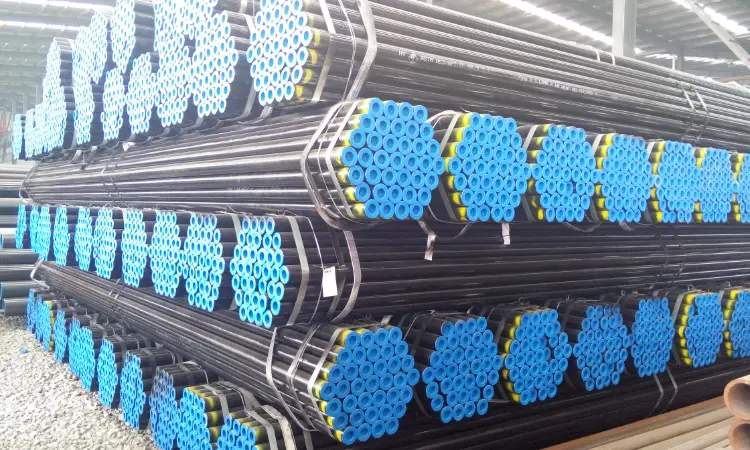
API 5L Grade A ERW Pipe Material
API 5L Grade A ERW Pipe | Carbon Steel Line Pipe Properties
Comprehensive material data for API 5L Grade A ERW pipe, including chemical composition, mechanical and physical properties, international equivalents, and applications in oil & gas transmission and structural systems.
Electric resistance welding (ERW), cold forming from hot‐rolled strip/coil, optional heat treatment (as welded or normalized)
- Phone : +8618037372205
- Email : [email protected]
- WhatsApp: Contact via Whtsapp
- WeChat: +8618037372205
API 5L Grade A ERW Pipe Introduction
API 5L Grade A ERW (Electric Resistance Welded) pipe is a carbon steel line pipe widely used for conveying gas, water, and oil in pipeline systems. Key attributes:
- Minimum yield strength 205 MPa (30 ksi), providing adequate strength for moderate pressure applications;
- Good weldability and formability suitable for ERW manufacturing;
- Complies with API 5L PSL1 requirements, ensuring basic quality for less critical services;
- Typical delivery in welded condition, often supplied in NPS 1/2 to 24 inch sizes.
This grade offers a cost‐effective solution for transmission lines where higher strength grades are not mandatory.
API 5L Grade A ERW Pipe Chemical Composition
The chemical requirements for API 5L Grade A PSL1 pipe are based on heat analysis. Limits are maximum unless otherwise specified. Elements not mentioned are unrestricted unless intentionally added.
- C provides base strength;
- Mn improves hardenability and strength;
- P and S are controlled for ductility and weldability.
Optional elements like Cu, Ni, Cr, Mo are not mandated but if added must be reported.
| Chemical Element | Maximum or Range (wt. %) | Remarks |
|---|---|---|
| Carbon (C) | 0.25 | max, heat analysis |
| Manganese (Mn) | 1.20 | max, heat analysis |
| Phosphorus (P) | 0.030 | max |
| Sulfur (S) | 0.030 | max |
API 5L Grade A ERW Pipe Physical & Thermal Properties
Typical data for carbon steel with similar composition (0.20% C max, 1.20% Mn). Exact values vary with actual chemistry and temperature. These are not specification requirements but serve as engineering reference.
- Density: 7.85 g/cm³;
- Elastic modulus: 205 GPa at room temperature;
- Thermal expansion coefficient approximately 12.0×10⁻⁶ /K between 20 °C and 100 °C.
| Property | Typical Value | Unit | Test Condition / Temperature |
|---|---|---|---|
| Density (ρ) | 7.85 | g/cm³ | 20 °C |
| Elastic Modulus (E) | 205 | GPa | 20 °C |
| Shear Modulus (G) | 79 | GPa | 20 °C (calculated from E and ν) |
| Poisson's Ratio (ν) | 0.29 | – | 20 °C |
| Thermal Expansion Coefficient (α) | 12.0 | μm/(m·K) | 20 °C to 100 °C |
| Thermal Conductivity (λ) | 50 | W/(m·K) | 20 °C |
| Specific Heat Capacity (cp) | 470 | J/(kg·K) | 20 °C |
| Electrical Resistivity (ρe) | 0.22 | μΩ·m | 20 °C |
API 5L Grade A ERW Pipe Mechanical Properties
Mechanical properties apply to the pipe body in the as‐welded condition. Tensile testing transverse to the weld.
- Yield strength is determined at 0.5% total extension;
- Elongation formula per API 5L: Af = C × (A0.2 / U0.9) where C=1940 (SI units), A is cross‐sectional area of tensile test specimen, U is specified minimum tensile strength.
Typical minimum elongations are based on wall thickness.
| Property | Specified Value | Unit | Test Condition |
|---|---|---|---|
| Yield Strength (Rt0.5) | min 205 | MPa | Transverse strip specimen, 0.5% total extension |
| Tensile Strength (Rm) | min 335 | MPa | Transverse strip specimen |
| Elongation (A) | Calculated per API 5L formula (typical >20%) | % | Gauge length 50 mm, transverse |
| Bend Test | No cracks on bend test | – | 180° bend, mandrel diameter = 4×wall thickness (for wall >12.7 mm use larger D) |
| Charpy V‐notch Impact | Not required for PSL 1 (by agreement only) | J | – |
API 5L Grade A ERW Pipe Completely Equivalent Material Standards & Substitutable Grades
| Country/Region | Standard | Grade | Remarks |
|---|---|---|---|
| USA | ASTM A53/A53M | Grade A (Type E, ERW) | Welded pipe, same strength level, similar chemistry |
| International | ISO 3183 | L210 | PSL 1, equivalent to API 5L Grade A |
| Europe | EN 10217-1 | P235TR1 | Welded tube, guaranteed yield 235 MPa, close but slightly higher strength |
| Japan | JIS G3452 | SGP | Carbon steel pipe for ordinary piping, comparable carbon‑manganese steel |
API 5L Grade A ERW Pipe Application Introduction
API 5L Grade A ERW pipe is primarily utilized in moderate‑pressure fluid transmission and structural applications. Typical service environments:
- Low‑pressure gas distribution networks;
- Water supply and sewage lines;
- Oil and petroleum product gathering systems (sweet service);
- Structural columns, piling, and scaffolding where lower strength is acceptable.
The pipe can be further processed by hot‑dip galvanizing or coating for corrosion protection.
Product Applications: Line pipes for onshore pipelines, Water well casings and riser pipes, Prefabricated pipe spools, Bollards and sign supports, Greenhouse frames
Processed into products: Welded pipe sections (NPS 2 to 24), Pipe bends and elbows (formed from pipe), Tubular scaffolding poles, Concrete‑filled steel tube columns, Casing pipes for bored piles
Application industries: Oil & Gas (gathering lines, flowlines), Water Utility (potable water, raw water transmission), Construction & Infrastructure (piling, structural supports), Mining (slurry transport, dewatering lines), Fire Protection (fire main piping)
API 5L Grade A ERW Pipe Similar / Nearby Substitute Materials
| Country/Region | Standard | Grade | Remarks |
|---|---|---|---|
| USA | API 5L | Grade B (L245) | Higher strength (YS 245 MPa, TS 415 MPa), widely used for higher‑pressure pipelines |
| USA | ASTM A53/A53M | Grade B (Type E, ERW) | Higher strength than Grade A, often interchangeable for structural applications |
| International | ISO 3183 | L245 | Corresponds to API 5L Grade B, offers increased pressure carrying capacity |
| Europe | EN 10217-1 | P235TR2 | Al-killed, quality TR2, similar strength but improved toughness at low temperature |
Notes:
- API 5L Grade A is typically supplied as PSL 1 (Product Specification Level 1), which represents basic quality requirements without mandatory Charpy testing or NDE of the seam weld.
- ERW pipes are produced from hot‑rolled coils; the weld seam has a metallurgical bond that may be heat‑treated (annealed) to refine microstructure.
- Dimension standards such as ASME B36.10M or API 5L govern outside diameter and wall thickness.
- For sour service (H₂S containing environments) or low‑temperature toughness, consider using PSL 2 grades or fully killed steels with supplementary requirements.
- Share



