
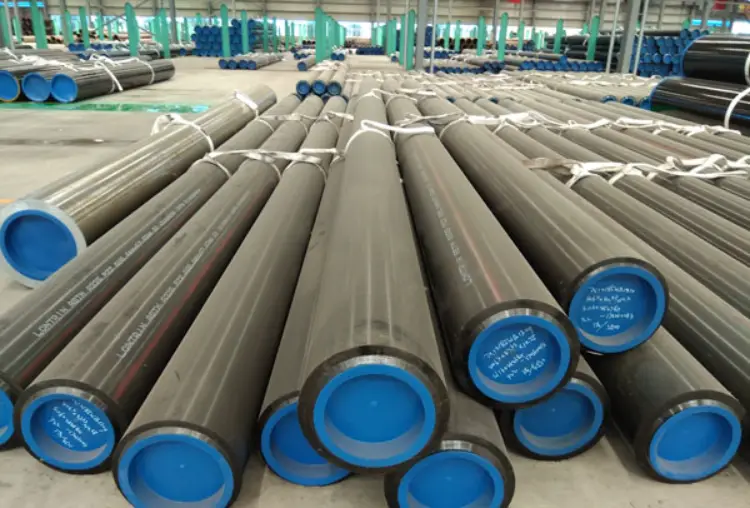
Q460E Steel SSAW Pipe Material
Q460E Steel SSAW Pipe: High-Strength Low-Alloy Structural Material for Demanding Welded Piping
Explore Q460E steel for spiral submerged arc welded pipes. Grade per GB/T 1591, ideal for low-temperature structural applications with high strength.
Hot Rolling, Welding, Cold Bending, Cutting, Forming
- Phone : +8618037372205
- Email : [email protected]
- WhatsApp: Contact via Whtsapp
- WeChat: +8618037372205
Q460E Steel SSAW Pipe Introduction
Q460E steel, standardized under GB/T 1591, is a high-strength low-alloy structural steel designed for welded structures such as Spiral Submerged Arc Welded (SSAW) pipes. It offers a minimum yield strength of 460 MPa and is characterized by its excellent low-temperature impact toughness, qualifying it for the 'E' quality level with guaranteed properties at -40°C. The material exhibits good weldability and cold formability, making it suitable for large-diameter pipelines and structural applications where high strength-to-weight ratio and durability are critical.
Q460E Steel SSAW Pipe Chemical Composition
The chemical composition for Q460E steel is defined by GB/T 1591-2018. It is a low-alloy steel with additions of niobium, vanadium, and titanium for grain refinement and precipitation strengthening, resulting in high strength combined with excellent toughness. The carbon equivalent (CEV) is typically controlled to ensure good weldability, which is crucial for the production of SSAW pipes.
| Element | Standard Value (wt.%) | Notes |
|---|---|---|
| Carbon (C) | ≤ 0.18 | Heat analysis |
| Silicon (Si) | ≤ 0.60 | Heat analysis |
| Manganese (Mn) | 1.00 - 1.70 | Heat analysis |
| Phosphorus (P) | ≤ 0.020 | Heat analysis |
| Sulfur (S) | ≤ 0.010 | Heat analysis |
| Niobium (Nb) | 0.01 - 0.05 | Heat analysis |
| Vanadium (V) | 0.01 - 0.12 | Heat analysis |
| Titanium (Ti) | 0.006 - 0.05 | Heat analysis |
| Chromium (Cr) | ≤ 0.30 | Heat analysis |
| Nickel (Ni) | ≤ 0.80 | Heat analysis |
| Copper (Cu) | ≤ 0.40 | Heat analysis |
| Molybdenum (Mo) | ≤ 0.20 | Heat analysis |
| Nitrogen (N) | ≤ 0.015 | Heat analysis |
| Aluminum (Al) | ≥ 0.015 | Total aluminum, min. |
| Carbon Equivalent (CEV) | ≤ 0.45 | Formula: C+Mn/6+(Cr+Mo+V)/5+(Ni+Cu)/15 |
Q460E Steel SSAW Pipe Thermal and Electrical Physical Properties
The physical properties listed below are typical reference values for low-alloy structural steels like Q460E. These properties are essential for design calculations involving thermal loading, heat transfer, and structural analysis. Slight variations can occur depending on the exact chemical composition (within the standard's range) and the specific thermo-mechanical processing route.
| Property | Typical Reference Value | Unit | Condition / Note |
|---|---|---|---|
| Density (ρ) | 7.85 | kg/dm³ | At 20°C |
| Modulus of Elasticity (E) | 207 | GPa | At 20°C |
| Shear Modulus (G) | 81 | GPa | At 20°C (approximate) |
| Poisson's Ratio (ν) | 0.29 | At 20°C | |
| Thermal Expansion Coefficient (α) | 11.1 | 10⁻&sup6;/K | Between 20°C and 100°C |
| Thermal Expansion Coefficient (α) | 12.3 | 10⁻&sup6;/K | Between 20°C and 300°C |
| Thermal Conductivity (λ) | 38.3 | W/(m·K) | At 100°C |
| Thermal Conductivity (λ) | 37.6 | W/(m·K) | At 400°C |
| Specific Heat Capacity (Cp) | 465 | J/(kg·K) | At 20°C to 100°C |
| Specific Heat Capacity (Cp) | 505 | J/(kg·K) | At 20°C to 400°C |
| Electrical Resistivity (ρe) | 0.21 | Ω·mm²/m | At 20°C |
Q460E Steel SSAW Pipe Mechanical Properties
Mechanical properties for Q460E steel per GB/T 1591-2018 are guaranteed for the base material. For SSAW pipes, the properties of the weld seam are ensured through the welding procedure and consumables to match the base metal strength. The 'E' designation mandates impact testing at -40°C. Values vary with product thickness and are typically verified through tensile and impact testing on the pipe body.
| Property | Standard Requirement Value | Unit | Test Condition / Thickness Range |
|---|---|---|---|
| Upper Yield Strength (ReH) | ≥ 460 | MPa | Thickness ≤ 16 mm |
| Upper Yield Strength (ReH) | ≥ 450 | MPa | Thickness >16 mm, ≤ 40 mm |
| Upper Yield Strength (ReH) | ≥ 440 | MPa | Thickness >40 mm, ≤ 63 mm |
| Tensile Strength (Rm) | 540 - 720 | MPa | Thickness ≤ 63 mm |
| Elongation after Fracture (A) | ≥ 17 | % | Thickness ≤ 16 mm, gauge length L0=5.65√S0 |
| Elongation after Fracture (A) | ≥ 16 | % | Thickness >16 mm, ≤ 40 mm, gauge length L0=5.65√S0 |
| Elongation after Fracture (A) | ≥ 15 | % | Thickness >40 mm, ≤ 63 mm, gauge length L0=5.65√S0 |
| Impact Energy (KV2) | ≥ 60 | J | Longitudinal, -40 °C |
| Bending Test | d = 3a | 180° bend test, d is mandrel diameter, a is specimen thickness. Thickness ≤ 16 mm. | |
| Bending Test | d = 4a | 180° bend test, d is mandrel diameter, a is specimen thickness. Thickness >16 mm, ≤ 60 mm. |
Q460E Steel SSAW Pipe Directly Equivalent Material Standards and Recommended Substitute Grades
| Country/Region | Standard | Grade | Notes |
|---|---|---|---|
| China | GB/T 1591-2018 | Q460E | Original design standard for the SSAW pipe base metal. |
| European Union | EN 10025-4:2019 | S460ML | Thermo-mechanically rolled, low-temperature toughness to -50°C (ML). Close equivalent for Q460E. |
| European Union | EN 10025-6:2019 | S460QL/S460QL1 | Quenched and tempered structural steel. Delivers similar strength but different processing route. Impact test at -40°C (QL). |
| International | ISO 4950-2:1995 | E460DD | High yield strength steel. DD grade is guaranteed for impact at -20°C. Check for -40°C option. |
| Japan | JIS G 3106 | SM570 | For structural use. Does not guarantee low-temperature toughness equivalent to {"E"} grade without specific agreement. |
Q460E Steel SSAW Pipe Application Introduction
Q460E steel in the form of SSAW pipe is engineered for high-pressure, large-diameter applications where structural integrity at low temperatures is paramount. Its high strength allows for reduced wall thickness, saving weight and material cost in large-scale projects. The material's excellent weldability and toughness make it a preferred choice for critical infrastructure.
Product Applications: Cross-country oil and gas trunk lines, Spiral welded steel pipe piles for deep foundations, Structural pipes for large-span bridges, Penstocks for hydroelectric power plants, Tubular structures for offshore jackets and decks
Processed into products: Pipe body and weld seam of SSAW pipes, Pipe-to-pipe girth weld joints, Flanges and fittings welded to the pipe, Branch outlets and reinforcements attached to the main pipe, Sucker rods and other tubular components
Application industries: Oil and Gas (Petroleum and Natural Gas Transmission), Infrastructure (Bridges, Stadiums, High-rise Buildings), Water Management (Penstocks, Water Mains), Offshore and Marine Engineering (Platform Jackets, Piling), Power Generation (Wind Turbine Towers)
Q460E Steel SSAW Pipe Similar or Nearly Equivalent Substitute Materials Recommendation
| Country/Region | Standard | Grade | Introduction and Analysis |
|---|---|---|---|
| China | GB/T 1591 | Q550E | Higher strength grade (min. yield 550 MPa) in the same standard family. Offers superior strength but may require more stringent welding controls compared to Q460E. Suitable for weight-critical designs. |
| United States | ASTM A572/A572M | Grade 65 [450] | A common high-strength low-alloy steel with a 450 MPa minimum yield. It provides similar strength but does not have the same inherent low-temperature impact toughness guarantee as the {"E"} class unless supplemented with special requirements per ASTM A709 or customer specifications. |
| European Union | EN 10025-3 | S460N | Normalized structural steel with minimum 460 MPa yield. The N grade offers good toughness but the ML grade from EN 10025-4 is a closer process-matching equivalent to the typical TMCP delivery of Q460E. |
| United States | API 5L | X65 (L450) | A pipeline steel grade with a minimum yield of 450 MPa. While designed for pipelines, its toughness requirements and chemical composition can be adjusted in the project specification to be functionally similar to Q460E for SSAW pipes. |
Notes:
For SSAW pipes, the base metal properties must be verified on a flattened specimen representing the pipe body. The weld seam and Heat Affected Zone (HAZ) require separate qualification through tensile, bend, and impact tests per the applicable pipe manufacturing standard (e.g., SY/T 5040 for SSAW pipes for piling, or project-specific specifications). Dimensional tolerances for diameter, wall thickness, out-of-roundness, and straightness should follow the respective pipe product standard. Non-destructive testing (NDT) like ultrasonic or radiographic inspection of the full weld length is mandatory.
- Share



