
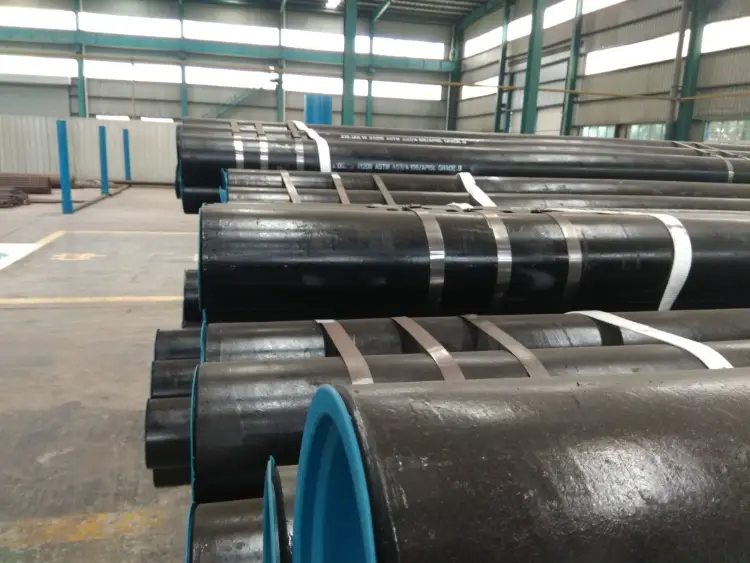
API 5L Grade A SSAW Pipe Material
API 5L Grade A SSAW Pipe: Carbon Steel Line Pipe for Low-Pressure Fluid Transmission
Comprehensive material data for API 5L Grade A spiral submerged arc welded pipe, including chemical composition, mechanical properties, thermal and electrical properties, international equivalents, and application guidance.
Welding (SAW, ERW), hot rolling, cold forming, bending, cutting, beveling
- Phone : +8618037372205
- Email : [email protected]
- WhatsApp: Contact via Whtsapp
- WeChat: +8618037372205
API 5L Grade A SSAW Pipe Introduction
API 5L Grade A (also designated L210 in ISO 3183) is a carbon steel grade commonly used in the manufacture of spiral submerged arc welded (SSAW) pipes for low-pressure fluid transmission. Key characteristics:
- Minimum yield strength of 210 MPa (30.5 ksi)
- Minimum tensile strength of 335 MPa (48.6 ksi)
- Low carbon content (≤0.22%) for good weldability
- Suitable for water, gas, and oil conveyance as well as structural applications
- Typically supplied in PSL 1 with no additional impact test requirements
The material offers a good balance of strength, ductility, and cost-effectiveness for general-purpose piping.
API 5L Grade A SSAW Pipe Chemical Composition
Chemical composition limits according to API 5L (PSL 1) for Grade A. Only C, Mn, P, and S are specified; other residual elements are typical for low-carbon steel but not mandated. Note: These limits apply to heat analysis; product analysis may have slight deviations as per the standard.
| Element | Max Value (%) | Remarks |
|---|---|---|
| C | 0.22 | Max for welded pipe |
| Mn | 0.90 | Max |
| P | 0.030 | Max |
| S | 0.030 | Max |
API 5L Grade A SSAW Pipe Thermal and Electrical Physical Properties
The following physical properties are typical for low-carbon steel (such as Grade A) and are not specified in the API 5L standard. They are provided for engineering reference and may vary slightly depending on exact composition, heat treatment, and temperature. All values at room temperature unless stated otherwise.
| Property | Typical Value | Unit | Test Condition |
|---|---|---|---|
| Density (ρ) | 7.85 | g/cm³ | 20 °C |
| Elastic Modulus (E) | 205 | GPa | Room temperature (approx.) |
| Shear Modulus (G) | 80 | GPa | Estimated from E and ν |
| Poisson's Ratio (ν) | 0.3 | - | Room temperature |
| Thermal Expansion Coefficient (α) | 12.1 | 10⁻⁶/K | 20–100 °C |
| Thermal Conductivity (λ) | 45 | W/(m·K) | 20 °C (typical) |
| Specific Heat Capacity (cₚ) | 480 | J/(kg·K) | 20 °C |
| Electrical Resistivity (ρₑ) | 0.22 | μΩ·m | 20 °C |
API 5L Grade A SSAW Pipe Mechanical Properties
Minimum required mechanical properties for pipe body (transverse direction) per API 5L PSL 1 for Grade A. Elongation is calculated according to the standard formula and depends on the tensile test specimen dimensions; a typical value for a 12.5 mm wall thickness and 38.1 mm wide strip is provided as a reference. Welded joint: The tensile strength of the weld seam shall meet the minimum specified tensile strength of the base metal.
| Property | Minimum Requirement | Unit | Test Condition |
|---|---|---|---|
| Yield Strength (ReH) | 210 (30.5) | MPa (ksi) | Transverse, 0.5% extension under load or 0.2% offset |
| Tensile Strength (Rm) | 335 (48.6) | MPa (ksi) | Transverse strip specimen |
| Elongation (A) | Per API 5L Clause 9.10.2 (typically ≥ 27% for common sizes) | % | Transverse strip specimen; formula e = 625,000 A0.2/U0.9 (U.S.), where A is cross-sectional area in mm², U = specified min tensile strength in MPa. Example: for A=200 mm², U=335 MPa, e ≈ 28%. |
API 5L Grade A SSAW Pipe Fully Equivalent Material Standards and Substitutable Grades
| Country/Region | Standard | Grade | Remarks |
|---|---|---|---|
| International | API 5L | Grade A (L210) | Primary standard; PSL1 line pipe, spiral welded acceptable |
| International | ISO 3183 | L210 | Identical technical delivery conditions |
| Europe | EN 10208-1 | L210GA | Line pipe for combustible fluids; equivalent yield and tensile requirements |
| China | GB/T 9711.1 | L210 | Petroleum and natural gas industries line pipe; adopts API 5L specification |
API 5L Grade A SSAW Pipe Application Introduction
API 5L Grade A SSAW pipe is widely employed in infrastructure projects due to its economical combination of strength, weldability, and formability. Typical usage includes:
- Water and wastewater transmission mains
- Low-pressure natural gas distribution
- Oil and product low-pressure pipelines
- Structural piling and foundation support
- Marine and coastal protection structures
- Conduits and casing for underground utilities
When used in pressure service, compliance with design codes (ASME B31.4, B31.8, etc.) must be verified based on pipe dimensions and service conditions.
Product Applications: Spiral submerged arc welded (SSAW) pipes in various diameters (typically 16" to 100"+) and wall thicknesses, Line pipe for onshore and shallow underwater applications, Pipe piles with optional coatings, Casing pipes for wells and underground installations
Processed into products: Straight pipe sections with beveled ends, Pipe bends and elbows (hot or cold formed), Reducers and tees (fabricated from plate or forged fittings), Flanges and couplings (attached by welding), Pile shoes and reinforcement rings (for piling applications)
Application industries: Oil & Gas (low-pressure gathering lines, flowlines), Water Treatment and Distribution, Construction (piling, building frames), Marine Engineering (dock piling, seawalls), Municipal Infrastructure (culverts, drainage)
API 5L Grade A SSAW Pipe Similar/Comparable Material Alternatives
| Country/Region | Standard | Grade | Remarks |
|---|---|---|---|
| USA | ASTM A53 | Grade A | Similar strengths (yield 205 MPa, tensile 330 MPa); slightly higher carbon allowed (0.25% max); used for ordinary pipe and structural purposes, not specifically for line pipe. |
| International | API 5L | Grade B (L245) | Higher strength grade (yield 245 MPa, tensile 415 MPa); used when greater strength is needed; still carbon steel, but higher Mn content. |
| USA | ASTM A135 | Grade A | Electric-resistance-welded steel pipe; minimum yield 205 MPa, tensile 330 MPa; suitable for light structural and pressure applications. |
| Japan | JIS G3452 | SGP | Carbon steel pipes for ordinary piping; tensile strength minimum 290 MPa; not directly equivalent, but may substitute in some low-pressure applications with engineering review. |
Notes:
PSL 1 Considerations: This grade is typically ordered to PSL 1, which imposes basic requirements with no mandatory fracture toughness testing. For applications requiring impact resistance or sour service, higher PSL or Grade B may be necessary. Welding: Good weldability for common processes (SAW, SMAW, GMAW) with appropriate preheat for thicker sections. Corrosion Protection: External coating (3LPE, FBE) and internal lining recommended for underground or immersion service. Dimensional Tolerances: Refer to API 5L for OD, wall thickness, and straightness tolerances.
- Share



