
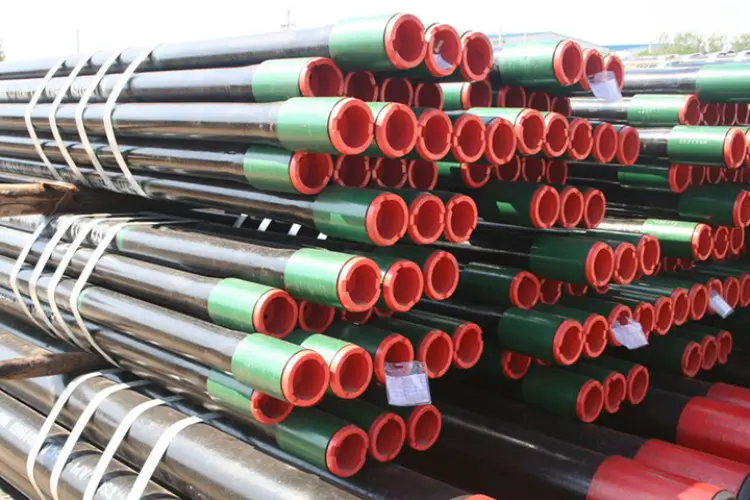
API 5CT K55 Oil Special Pipe
API 5CT K55 Oil Special Pipe: Complete Material Data & Equivalent Grades
Detailed technical data for API 5CT Grade K55 steel used in oil and gas well casing and tubing. Includes chemical composition, mechanical and physical properties, international equivalents, and application guidelines.
Hot rolling, cold drawing, welding (ERW), normalizing, normalizing and tempering
- Phone : +8618037372205
- Email : [email protected]
- WhatsApp: Contact via Whtsapp
- WeChat: +8618037372205
API 5CT K55 Oil Special Pipe Introduction
API 5CT K55 is a carbon steel grade specified by the American Petroleum Institute for use as casing and tubing in oil and natural gas wells. It is designed for moderate service conditions where a minimum yield strength of 55 ksi (379 MPa) and good weldability are required. The grade offers a balance of strength, ductility, and cost-effectiveness, making it widely applied in surface and intermediate casing strings. K55 is typically supplied in the as-rolled or normalized condition, and can be produced as seamless or electric resistance welded (ERW) pipe. Its chemical composition is controlled to ensure consistent mechanical properties and resistance to internal and external pressures encountered in downhole environments.
API 5CT K55 Oil Special Pipe Chemical Composition
The chemical composition of API 5CT K55 is not tightly defined by the standard; instead, the requirements are based on mechanical properties. The standard specifies only maximum limits for carbon and certain tramp elements. The typical compositional range presented below is based on common industrial practice to achieve the required strength and toughness. Supplementary requirements may apply for sour service (NACE MR0175).
| Element | Standard Value (wt. %) | Remarks |
|---|---|---|
| Carbon (C) | max 0.24 (API) / typical 0.18-0.22 | Low carbon ensures good weldability and toughness |
| Manganese (Mn) | max 1.30 (API) / typical 0.80-1.20 | Contributes to strength and hardenability |
| Phosphorus (P) | max 0.030 | Controlled for cleanliness and ductility |
| Sulfur (S) | max 0.030 | Kept low to avoid hot shortness |
| Silicon (Si) | typical 0.15-0.35 | Deoxidizer; not specified by API but commonly present |
| Copper (Cu) | max 0.25 (typical residual) | Not specified; may appear from raw materials |
| Nickel (Ni) | max 0.25 (typical residual) | Not specified; trace element |
| Chromium (Cr) | max 0.20 (typical residual) | Not specified; trace element |
| Molybdenum (Mo) | max 0.05 (typical residual) | Not specified; trace element |
| Nitrogen (N) | max 0.012 (typical) | Not specified; controlled in modern steelmaking |
API 5CT K55 Oil Special Pipe Thermal & Electrical Physical Properties
The following physical properties are representative for low‑carbon steel of the K55 type at ambient temperature, unless otherwise noted. These values may vary slightly with exact composition, heat treatment, and temperature. Data are derived from standard references for carbon steel (0.18‑0.22% C). Electrical resistivity increases with temperature and alloying content; the value given is for 20°C.
| Property | Typical Value | Unit | Test Condition |
|---|---|---|---|
| Density (ρ) | 7.85 | g/cm³ | 20°C |
| Elastic Modulus (E) | 205 | GPa | 20°C |
| Shear Modulus (G) | 80 | GPa | Calculated from E and ν |
| Poisson's Ratio (ν) | 0.30 | - | Within elastic range |
| Thermal Expansion (α) | 12.0 | 10⁻⁶/K | 20-100°C |
| Thermal Expansion (α) | 13.5 | 10⁻⁶/K | 20-300°C |
| Thermal Conductivity (λ) | 50 | W/(m·K) | 20°C |
| Specific Heat Capacity (cp) | 460 | J/(kg·K) | 20°C |
| Electrical Resistivity (ρe) | 0.20 | µΩ·m | 20°C |
API 5CT K55 Oil Special Pipe Mechanical Properties
Mechanical properties are determined at room temperature according to API 5CT test methods. The yield strength is measured as the stress at 0.5% total extension under load (ReH). Tensile testing is performed on full-section or strip specimens. Elongation requirements are calculated using the API formula: e = 625,000 * (A0.2 / U0.9), where A is the cross-sectional area (in²) and U is the specified minimum tensile strength (psi). No Charpy impact or hardness requirements are mandated for standard K55, unless agreed upon for specific applications (e.g., sour service).
| Property | Standard Requirement | Unit | Test Condition |
|---|---|---|---|
| Yield Strength (ReH) | min 55 ksi (379 MPa) / max 80 ksi (552 MPa) | psi (MPa) | At 0.5% total extension, room temperature |
| Tensile Strength (Rm) | min 95 ksi (655 MPa) | psi (MPa) | Room temperature |
| Yield to Tensile Ratio | max 0.85 (typical) | - | Indicative of strain hardening behavior |
| Elongation (A) | As per API formula; typical values range 25-30% for common casing sizes, min 20% | % | Gauge length 2 in (50.8 mm) or proportional specimen |
| Hardness (Rockwell B) | max 92 HRB (typical for as-rolled) | HRB | Not mandated; supplementary requirement |
API 5CT K55 Oil Special Pipe Identical Material Standards & Direct Replacement Grades
| Country/Region | Standard | Grade | Remarks |
|---|---|---|---|
| International | ISO 11960:2020 | K55 | Identical dimensional and mechanical requirements as API 5CT K55; fully interchangeable |
| China | GB/T 19830-2020 | K55 | Chinese equivalent standard; directly matches API 5CT K55 |
| Russia/CIS | GOST 632-80 | Group D (strength class 55) | Similar minimum yield 379 MPa; confirm by technical comparison |
API 5CT K55 Oil Special Pipe Application Introduction
API 5CT K55 is extensively used in the oil and gas industry for casing and tubing strings. Its strength level makes it suitable for medium-depth wells with moderate pressure and temperature conditions. The grade is often selected for surface and intermediate casing that protects freshwater zones and stabilises the borehole. It can be employed in both vertical and directional drilling operations. When combined with appropriate connection types (e.g., API BTC, LTC, premium connections), K55 pipe provides reliable structural integrity and gas-tight sealing. The material is not intrinsically resistant to sour service, but can be made NACE MR0175 compliant through controlled heat treatment and chemistry. K55 tubes are also used in water wells, geothermal applications, and basic structural pilings, where the required mechanical properties align.
Product Applications: Casing pipes for production, intermediate, and surface strings, Tubing pipes for conveying oil or gas to the surface, Couplings and connectors (if made from same grade), Pup joints and accessories, Tubular components in drilling equipment
Processed into products: Well casing segments (threaded and coupled), Slotted liners and screens (perforated K55 pipe), Tubing hangers and pack off bushings, Centralizers and stop collars (when fabricated from K55 material), Structural parts in subsea templates (if approved)
Application industries: Oil and gas exploration and production, Petroleum engineering and well construction, Geothermal energy extraction, Water well drilling and completion, Construction and structural piling (non-critical)
API 5CT K55 Oil Special Pipe Similar / Alternative Material Grades
| Country/Region | Standard | Grade | Remarks |
|---|---|---|---|
| International (API) | API 5CT | J55 | Same minimum yield (55 ksi), but lower tensile strength min 75 ksi; more cost-effective where tensile is not critical |
| International (API) | API 5CT | N80 | Higher minimum yield (80 ksi) and tensile; for deeper or more demanding wells; may require different welding procedures |
| International (ISO) | ISO 3183 / API 5L | X52 (L360) | Pipeline grade with similar yield strength (52 ksi, ~359 MPa); not identical, but sometimes used for structural OCTG if permitted |
| Europe | EN 10297-1 / EN 10219 | S355J2H / S355MH | Structural hollow section with min yield 355 MPa; approximate strength match, but not for downhole service |
| Japan | JIS G 3444 | STK 490 | General structural carbon steel tube with min yield 315 MPa; lower strength but similar in general fabrication |
Notes:
K55 is generally delivered with a protective varnish or coating unless otherwise specified. Normalizing is recommended to achieve uniform mechanical properties and to improve toughness after welding. For sour service (H₂S-containing environments), the material must comply with NACE MR0175/ISO 15156, which may require specific sulfur and hardness limits, as well as additional testing. Always verify the latest version of API 5CT for any revisions to chemical and mechanical requirements. The elongation formula provided in the standard is a design minimum; actual values are typically higher and can be tailored through heat treatment. When ordering, supplementary requirements such as Charpy V-notch testing (SR15) or non-destructive inspection (SR22) should be clearly specified.
- Share



