
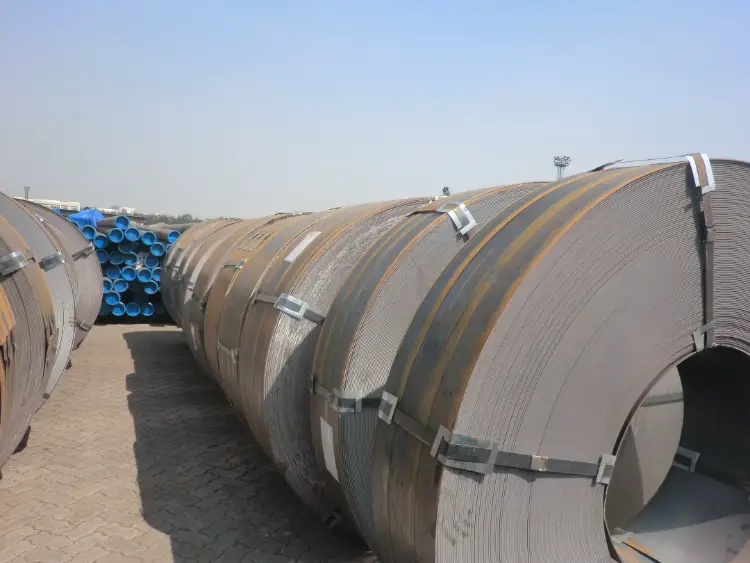
ABS Grade FQ63 Shipbuilding Steel Coil
ABS Grade FQ63 Shipbuilding Steel Coil: Quenched & Tempered High-Strength Marine Steel
Comprehensive technical data for ABS Grade FQ63 shipbuilding steel coil covering chemical composition, mechanical properties, thermal and electrical physical properties, international equivalents, and application guidance for offshore and marine structures.
Welding, cutting, cold forming, bending, machining
- Phone : +8618037372205
- Email : [email protected]
- WhatsApp: Contact via Whtsapp
- WeChat: +8618037372205
ABS Grade FQ63 Shipbuilding Steel Coil Introduction
ABS Grade FQ63 is a high-strength quenched and tempered (Q&T) structural steel for shipbuilding, certified by the American Bureau of Shipping. It offers a minimum yield strength of 620 MPa and excellent toughness at low temperatures, designated by the 'F' indicating fine grain practice and impact testing at -40°C. Supplied as coil and subsequently cut into plates, FQ63 is designed for weight-critical, high-stress components in marine and offshore environments. Its combination of high strength, good weldability, and reliable low-temperature impact properties makes it suitable for large container ships, offshore platforms, and specialized vessels operating in harsh conditions.
ABS Grade FQ63 Shipbuilding Steel Coil Chemical Composition - Ladle Analysis
Typical maximum limits as per ABS Rules for Grade FQ63. The steel is fine grain treated with sufficient aluminum (acid-soluble ≥0.015%) or other grain-refining elements. Carbon equivalent (CE) is controlled to ensure weldability. Actual values may be adjusted for thickness and manufacturing route.
| Chemical Element | Standard Value (max, unless range) | Remarks |
|---|---|---|
| C | 0.16 | Maximum |
| Mn | 0.90 - 1.70 | Depending on thickness |
| Si | ≤0.55 | |
| P | ≤0.025 | |
| S | ≤0.025 | |
| Al (acid soluble) | ≥0.015 | Minimum, for fine grain practice |
| Nb | ≤0.06 | |
| V | ≤0.10 | |
| Ti | ≤0.05 | |
| Cu | ≤0.35 | |
| Cr | ≤0.20 | May be adjusted |
| Ni | ≤0.40 | May be adjusted |
| Mo | ≤0.08 | May be adjusted |
| N | ≤0.012 | If adequate Al, V, or Ti |
| CE (CEV) | ≤0.45 - 0.52 | Typically controlled; varies with thickness |
ABS Grade FQ63 Shipbuilding Steel Coil Thermal and Electrical Physical Properties
Typical physical properties for quenched and tempered high-strength structural steels at room temperature. These values are not specified in the ABS material rules but are provided as engineering reference data for design calculations, assuming a density of 7.85 g/cm³.
| Property | Typical Value | Unit | Test Condition / Remarks |
|---|---|---|---|
| Density (ρ) | 7.85 | g/cm³ | At 20°C |
| Modulus of Elasticity (E) | 205 | GPa | At 20°C |
| Shear Modulus (G) | 80 | GPa | At 20°C, calculated from E and ν |
| Poisson's Ratio (ν) | 0.3 | Elastic range | |
| Thermal Expansion Coefficient (α) | 12.0 × 10⁻⁶ | K⁻¹ | Between 20°C and 100°C |
| Thermal Conductivity (λ) | 48 | W/(m·K) | At 20°C, approximate |
| Specific Heat Capacity | 460 | J/(kg·K) | At 20°C |
| Electrical Resistivity (ρ_e) | 0.22 | μΩ·m | At 20°C |
ABS Grade FQ63 Shipbuilding Steel Coil Mechanical Properties
Transverse or longitudinal tensile and impact properties as per ABS Rules for Grade FQ63, valid for thicknesses up to 50 mm. Impact tests are performed at -40°C (F-grade) on Charpy V-notch specimens. The steel must also meet bending test requirements without cracking.
| Property | Standard Required Value | Unit | Test Condition / Remarks |
|---|---|---|---|
| Yield Strength (ReH) | 620 (min) | MPa | Upper yield, t ≤ 50 mm |
| Tensile Strength (Rm) | 720 - 890 | MPa | t ≤ 50 mm |
| Elongation after fracture (A5) | 15 (min) | % | Gauge length 5.65√So, longitudinal |
| Elongation after fracture (A5) | 12 (min) | % | Transverse |
| Impact energy (KV) | 27 (min, average) | J | Longitudinal, -40°C, 10x10 mm specimen |
| Impact energy (KV) | 19 (min, individual) | J | Longitudinal, -40°C |
| Impact energy (KV) | 20 (min, average) | J | Transverse, -40°C (if applicable) |
| Bend test (d = bend diameter, a = thickness) | d = 3a | Thickness ≤ 25 mm, 180° | |
| Bend test | d = 4a | Thickness 25-50 mm, 180° |
ABS Grade FQ63 Shipbuilding Steel Coil Fully Equivalent Material Standards and Replaceable Grades
| Country/Region | Standard | Grade | Remarks |
|---|---|---|---|
| International / USA | ABS Rules | FQ63 | Original grade, quenched & tempered |
| Norway / Germany | DNV Rules | E620 | High-strength Q&T steel, CTOD tested |
| UK | LR Rules | EH620 | Equivalent to FQ63, -40°C impact |
| France | BV Rules | E620 | Equivalent Q&T marine steel |
| China | CCS Rules | E620 | Identical performance class |
| Japan | NK Rules | KE620 | Kawasaki mild steel group, equivalent |
| South Korea | KR Rules | RE620 | Same yield and impact class |
| Italy | RINA Rules | E620 | Fully comparable |
ABS Grade FQ63 Shipbuilding Steel Coil Application Introduction
ABS FQ63 steel coil is extensively utilized where high strength, weight savings, and excellent low-temperature toughness are critical. It is typically delivered in quenched and tempered condition and further processed by cutting, welding, and forming. Its high yield strength allows design of lighter and more load-efficient structures, making it a preferred choice for large modern ships and harsh environment offshore installations.
Product Applications: Hull plates and stiffeners for large container ships and bulk carriers, Deck plating, sheer strakes, and hatch coamings, Jack-up rig legs and bracings, Offshore platform topsides and module support beams, Heavy-lift crane booms and pedestals, Pressure hulls for submarines (with additional tests)
Processed into products: Longitudinal frames, girders, and floor plates, Bilge keels and rudder horns, Mooring equipment foundations, Load-bearing transition pieces, Padeyes and lifting lugs, Fatigue-critical welded nodes (with appropriate CTOD qualification)
Application industries: Shipbuilding (commercial and naval), Offshore oil & gas, Marine engineering, Port & crane machinery, Renewable energy (offshore wind substructures)
ABS Grade FQ63 Shipbuilding Steel Coil Similar/Alternative Material Recommendations
| Country/Region | Standard | Grade | Remarks |
|---|---|---|---|
| Europe | EN 10025-6 | S620Q / S620QL | Structural steel with min 620 MPa yield, Q&T, similar weldability; check CTOD requirements |
| International | ISO 4950-2 | E620 D / E620 E | High yield strength flat products, Q&T, suitable for offshore |
| USA | ASTM A514 / A517 | Grade Q / Grade B | Quenched & tempered alloy steel; min 690 MPa yield, higher strength alternative |
| Germany | DIN EN 10025-6 | S690Q | Minimum 690 MPa yield, can substitute where higher strength needed with redesign |
Notes:
Delivery condition: Quenched and tempered. Coil thickness typically ranges from 6 to 50 mm; plates cut from coil may require flattening and residual stress relief. Weldability: Low carbon equivalent ensures good weldability, but proper preheat, interpass temperature control, and low hydrogen consumables are mandatory. Certification: Each shipment comes with ABS inspection certificate (3.1 or 3.2 as per EN 10204). This grade may be supplied with extra requirements like through-thickness properties (Z-quality) or CTOD testing for critical applications. The information provided is based on the latest ABS Rules and is intended as a general reference; always verify with the mill certificate and the valid edition of the classification society rules.
- Share



