
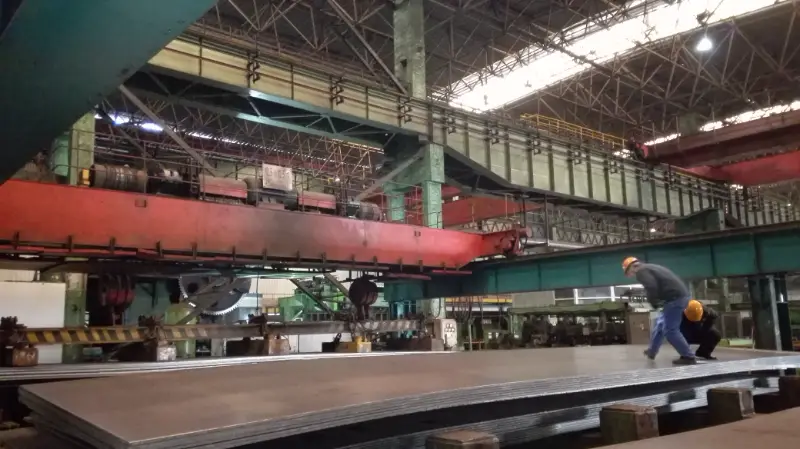
42CrMo Alloy Steel Plates Material
42CrMo Alloy Steel Plates: High Strength, Hardenability, and Wear Resistance Guide
Complete material data for 42CrMo alloy steel plates: chemical composition, mechanical and thermal properties, international equivalents, and typical applications in heavy machinery and automotive industries.
Hot rolling, forging, quenching, tempering, normalizing, annealing, machining, welding (with preheat and post-weld heat treatment)
- Phone : +8618037372205
- Email : [email protected]
- WhatsApp: Contact via Whtsapp
- WeChat: +8618037372205
42CrMo Alloy Steel Plates Introduction
42CrMo is a medium-carbon chromium-molybdenum alloy structural steel widely specified under GB/T 3077. It possesses excellent strength, toughness, and hardenability after quenching and tempering.
- High fatigue resistance and impact toughness
- Deep hardening capability across large sections
- Good machinability in the normalized or tempered condition
- Commonly used for gears, shafts, fasteners, and heavy-duty machinery parts
Typical delivery conditions include hot-rolled, normalized, annealed, or quenched and tempered plates, ensuring reliable mechanical performance in demanding environments.
42CrMo Alloy Steel Plates Chemical Composition according to GB/T 3077-2015
The chemical composition of 42CrMo steel plates is controlled to ensure optimal hardenability and mechanical properties. Carbon provides strength, chromium and molybdenum improve hardenability and high-temperature strength, while silicon and manganese aid deoxidation and strength. Phosphorus and sulfur are kept low to maintain ductility and toughness.
| Element | Content (%) | Remarks |
|---|---|---|
| C (Carbon) | 0.38 - 0.45 | |
| Si (Silicon) | 0.17 - 0.37 | |
| Mn (Manganese) | 0.50 - 0.80 | |
| Cr (Chromium) | 0.90 - 1.20 | |
| Mo (Molybdenum) | 0.15 - 0.25 | |
| P (Phosphorus) | ≤ 0.030 | max (quality steel) |
| S (Sulfur) | ≤ 0.030 | max (quality steel) |
| Cu (Copper) | ≤ 0.30 | residual element |
| Ni (Nickel) | ≤ 0.30 | residual element |
42CrMo Alloy Steel Plates Typical Physical Properties
These physical properties are approximate and may vary slightly depending on exact composition and heat treatment. They are typical for 42CrMo / AISI 4140 steel in the quenched and tempered condition. Data are provided for common design temperatures.
| Property | Typical Value | Unit | Temperature / Condition |
|---|---|---|---|
| Density (ρ) | 7.85 | g/cm³ | 20°C |
| Modulus of Elasticity (E) | 210 | GPa | 20°C |
| Shear Modulus (G) | 80 | GPa | 20°C |
| Poisson's Ratio (ν) | 0.3 | - | 20°C |
| Thermal Expansion (α) | 11.1×10⁻⁶ | K⁻¹ | 20 - 100°C |
| Thermal Expansion (α) | 12.1×10⁻⁶ | K⁻¹ | 20 - 200°C |
| Thermal Expansion (α) | 12.9×10⁻⁶ | K⁻¹ | 20 - 300°C |
| Thermal Expansion (α) | 13.5×10⁻⁶ | K⁻¹ | 20 - 400°C |
| Thermal Expansion (α) | 13.9×10⁻⁶ | K⁻¹ | 20 - 500°C |
| Thermal Conductivity (λ) | 42.6 | W/(m·K) | 20°C |
| Thermal Conductivity (λ) | 41.2 | W/(m·K) | 200°C |
| Thermal Conductivity (λ) | 39.5 | W/(m·K) | 400°C |
| Specific Heat Capacity (c) | 460 | J/(kg·K) | 20°C |
| Electrical Resistivity (ρ_e) | 0.22 | µΩ·m | 20°C |
42CrMo Alloy Steel Plates Mechanical Properties
The mechanical properties below are measured on test specimens heat-treated according to GB/T 3077: quenching at 850°C in oil and tempering at 560°C in water or oil. Actual values for plates may vary with section size and heat treatment. The steel exhibits high strength, good ductility, and excellent impact toughness.
| Property | Specified Value | Unit | Test Condition / Remark |
|---|---|---|---|
| Yield Strength (ReH/Rp0.2) | ≥ 930 | MPa | Quenched 850°C oil, tempered 560°C |
| Tensile Strength (Rm) | ≥ 1080 | MPa | Quenched 850°C oil, tempered 560°C |
| Elongation (A) | ≥ 12 | % | 5.65√S₀ gauge length |
| Reduction of Area (Z) | ≥ 45 | % | |
| Impact Energy (KV2) | ≥ 63 | J | Tested at 20°C, Charpy V-notch |
| Hardness (annealed) | ≤ 217 | HBW | For as-delivered annealed condition |
42CrMo Alloy Steel Plates Complete International Equivalents & Direct Substitutes
| Country/Region | Standard | Grade | Remarks |
|---|---|---|---|
| China | GB/T 3077 | 42CrMo | Original grade, widely used |
| USA | AISI/SAE | 4140 | Equivalent chromium-molybdenum steel |
| Germany | DIN 17200 / EN | 1.7225 / 42CrMo4 | Direct equivalent |
| Japan | JIS G4105 | SCM440 | Direct equivalent |
| UK | BS 970 | 708M40 / 42CrMo4 | Direct equivalent |
| EU | EN ISO 683-2 | 42CrMo4 | Harmonized European grade |
| International | ISO 683-2 | 42CrMo4 | International standard grade |
42CrMo Alloy Steel Plates Application Introduction
42CrMo alloy steel plates are versatile materials chosen for components that must withstand high static and dynamic loads. After quenching and tempering, they offer an excellent combination of strength, fatigue resistance, and impact toughness. Applications span machinery, automotive, oil & gas, and power generation sectors. Typical end products and components include:
Product Applications: High-tensile fasteners, studs, bolts, Gears, pinions, ring gears, Crankshafts and connecting rods, Axle shafts, drive shafts, propeller shafts, Hydraulic cylinder parts and piston rods, Flanges and forged rings for pressure applications
Processed into products: Gearbox shafts and hollow gears, Wind turbine main shaft and planet carriers, Oil drill collars and subs, Excavator bucket pins and bushings, Injection molding machine tie bars, Crane wheel gears and brake discs
Application industries: Heavy machinery and equipment, Automotive (drivetrain and engine components), Oil and gas drilling tools, Power generation (turbine shafts), Mining and earthmoving machinery, Mold and die manufacturing (structural parts)
42CrMo Alloy Steel Plates Similar / Alternative Alloy Steels
| Country/Region | Standard | Grade | Remarks |
|---|---|---|---|
| China | GB/T 3077 | 35CrMo | Slightly lower carbon, lower strength but better weldability |
| China | GB/T 3077 | 40Cr | Chromium steel without molybdenum, lower hardenability |
| Germany | DIN | 34CrMo4 (1.7220) | Similar chemistry, slightly lower carbon |
| USA | AISI | 4340 | Nickel-chromium-molybdenum steel, higher toughness and deep hardenability, often used as an upgrade |
Notes:
Processing notes:
- Preheat at 200-300°C before welding; post-weld stress relief at 600-650°C.
- Avoid tempering in the range of 250-400°C to prevent temper embrittlement.
- For large sections, oil quenching is preferred to achieve full hardness.
- Surface hardening (induction or flame) can be applied to increase wear resistance.
- Share



