
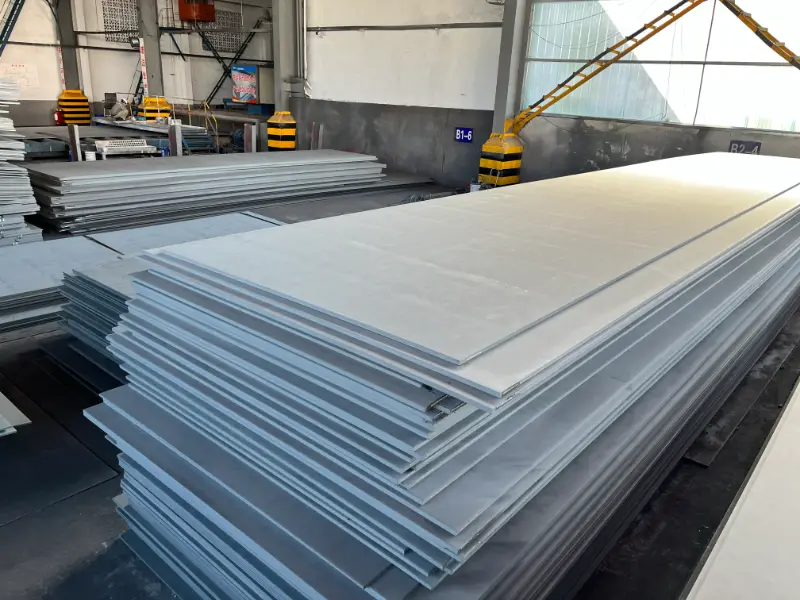
20CrMo Alloy Steel Plate Material
20CrMo Alloy Steel Plate: High-Strength Cr-Mo Carburizing Steel for Gears and Shafts
20CrMo is a chromium-molybdenum alloy structural steel widely used for manufacturing medium-strength carburized parts and high-pressure fasteners. It offers excellent hardenability, good toughness, and reliable heat treatment performance.
Hot rolling, forging, cold drawing, machining, carburizing, quenching and tempering
- Phone : +8618037372205
- Email : [email protected]
- WhatsApp: Contact via Whtsapp
- WeChat: +8618037372205
20CrMo Alloy Steel Plate Introduction
20CrMo alloy steel plate is a low-carbon chromium-molybdenum structural steel defined under Chinese GB standard. It is primarily designed for carburizing and subsequent quenching and tempering treatments to achieve high surface hardness, good wear resistance, and a tough core. The alloy provides an optimal balance of strength and ductility, making it suitable for components such as gears, shafts, bolts, and structural parts operating under medium to high loads. Key features:
- Excellent carburizing characteristics with uniform case depth
- High hardenability and consistent mechanical properties after heat treatment
- Good machinability in the normalized or annealed condition
- Wide application in automotive, machinery, and petrochemical industries
20CrMo Alloy Steel Plate Chemical Composition
Typical chemical composition for 20CrMo alloy steel according to GB/T 3077. The controlled additions of chromium and molybdenum enhance hardenability and high-temperature strength. Phosphorus and sulfur are minimized to improve toughness and cleanliness.
| Element | Standard Value (%) | Remarks |
|---|---|---|
| Carbon (C) | 0.17 – 0.24 | Controls core hardness and carburizing response |
| Silicon (Si) | 0.17 – 0.37 | Deoxidizer, strengthens ferrite |
| Manganese (Mn) | 0.40 – 0.70 | Improves hardenability and strength |
| Phosphorus (P) | ≤ 0.035 | Residual element, kept low for toughness |
| Sulfur (S) | ≤ 0.035 | Residual element, kept low for toughness |
| Chromium (Cr) | 0.80 – 1.10 | Primary hardenability and wear resistance enhancer |
| Molybdenum (Mo) | 0.15 – 0.25 | Increases high-temperature strength and temper resistance |
| Nickel (Ni) | ≤ 0.30 | Residual element (not intentionally added) |
| Copper (Cu) | ≤ 0.30 | Residual element |
20CrMo Alloy Steel Plate Thermal and Electrical Physical Properties
Physical property data for 20CrMo alloy steel at ambient conditions and elevated temperatures. These values are representative for a quenched and tempered low-alloy Cr-Mo steel and are suitable for engineering design calculations. Note: Properties vary slightly with heat treatment condition.
| Property | Typical Value | Unit | Test Condition / Temperature |
|---|---|---|---|
| Density (ρ) | 7.82 | g/cm³ | Room temperature |
| Elastic Modulus (E) | 210 | GPa | Room temperature |
| Shear Modulus (G) | 81 | GPa | Room temperature |
| Poisson's Ratio (ν) | 0.30 | - | Room temperature |
| Thermal Expansion Coefficient (α) | 11.3 | 10⁻⁶ / K | 20 – 100 °C |
| Thermal Expansion Coefficient (α) | 12.5 | 10⁻⁶ / K | 20 – 300 °C |
| Thermal Expansion Coefficient (α) | 13.8 | 10⁻⁶ / K | 20 – 500 °C |
| Thermal Conductivity (λ) | 42.0 | W / (m·K) | 20 – 100 °C |
| Specific Heat Capacity (c) | 460 | J / (kg·K) | 20 – 100 °C |
| Electrical Resistivity (ρ_e) | 0.23 | μΩ·m | 20 °C |
20CrMo Alloy Steel Plate Mechanical Properties
Mechanical properties after recommended heat treatment: quenching at 880 °C in oil or water, tempering at 500 °C in water or oil. Values depend on section thickness. The following data represent standard requirements per GB/T 3077 for bars ≤30 mm diameter. Plate specifications may vary; consult GB/T 11251 for specific thickness-dependent values.
| Property | Standard Required Value | Unit | Test Condition |
|---|---|---|---|
| Tensile Strength (Rm) | ≥ 885 | MPa | After heat treatment, room temperature |
| Yield Strength (ReH) | ≥ 685 | MPa | After heat treatment, room temperature |
| Elongation (A) | ≥ 12 | % | Gauge length 5d (proportional) |
| Reduction of Area (Z) | ≥ 50 | % | After heat treatment |
| Impact Energy (KV2) | ≥ 78 | J | Charpy U-notch (or V-notch equivalent), room temperature |
| Hardness (annealed) | ≤ 197 | HBW | Annealed condition |
| Bending Test | No cracks | - | 180° bend test, d=3a (typical for plates) |
20CrMo Alloy Steel Plate Fully Equivalent Material Standards and Substitute Grades
| Country/Region | Standard | Grade | Remarks |
|---|---|---|---|
| China | GB/T 3077 | 20CrMo | Original grade |
| Japan | JIS G4105 | SCM420 | Essentially identical Cr-Mo content |
| USA | ASTM A322 | 4118 | AISI/SAE equivalent; close match |
| Germany | DIN 17200 | 20CrMo5 (1.7264) | Near equivalent, slight Mn range variation |
| European Union | EN 10084 | 18CrMo4 (1.7243) | Very similar case-hardening steel |
| ISO | ISO 683-3 | 20CrMo5 | International standard equivalent |
20CrMo Alloy Steel Plate Application Introduction
20CrMo alloy steel plates and bars are predominantly used after carburizing, quenching and tempering to achieve a hard, wear-resistant surface with a ductile core. Typical applications demand moderate strength, good fatigue resistance, and reliability under cyclic loading. Recommended processing:
- Normalizing before machining
- Carburizing at 900-930 °C
- Direct or single quenching from carburizing temperature
- Tempering at 180-200 °C for high surface hardness (58-62 HRC)
Product Applications: Transmission gears and gear shafts, Diesel engine camshafts and crankshafts, High-strength bolts, studs and nuts (Grade 10.9 and 12.9), Hydraulic cylinder rods and pistons, Drive axles and steering components, Tool holders and machine tool spindles
Processed into products: Carburized gears (helical, spur, bevel), Spline shafts, Piston pins, Steering knuckles, Clutch discs, Bearing races (after case hardening), High-pressure flange studs, Crane wheel axles, Rotary hammer bits (machined blanks)
Application industries: Automotive and transportation, General machinery manufacturing, Petrochemical and energy, Construction and mining equipment, Aerospace (limited, non-critical parts)
20CrMo Alloy Steel Plate Similar / Closely Related Substitute Materials
| Country/Region | Standard | Grade | Remarks |
|---|---|---|---|
| China | GB/T 3077 | 20CrMnTi | Mn-Ti grade; higher toughness, slightly lower hardenability with Mo |
| China | GB/T 3077 | 20CrMnMo | Mn-Mo variant; deeper hardenability, used for larger sections |
| Japan | JIS G4105 | SCM415 | Lower carbon (0.15%) Cr-Mo steel; higher toughness, lower core strength |
| USA | ASTM A322 | 4120 | Similar Cr-Mo but lower carbon; alternative for thin-section parts |
| Germany | DIN 17200 | 25CrMo4 (1.7218) | Higher carbon variant; used for tempered parts without carburizing |
Notes:
Heat treatment recommendations: For optimal properties, homogenize at 850-900 °C, then quench in oil or polymer. Tempering above 450 °C may reduce surface hardness significantly; select tempering temperature based on final property requirements. Welding: Preheating to 200-300 °C is recommended; post-weld stress relief at 600-650 °C may be required to prevent cracking. International equivalents are functionally interchangeable but always verify chemical composition and hardenability limits against the specific application standard.
- Share



