
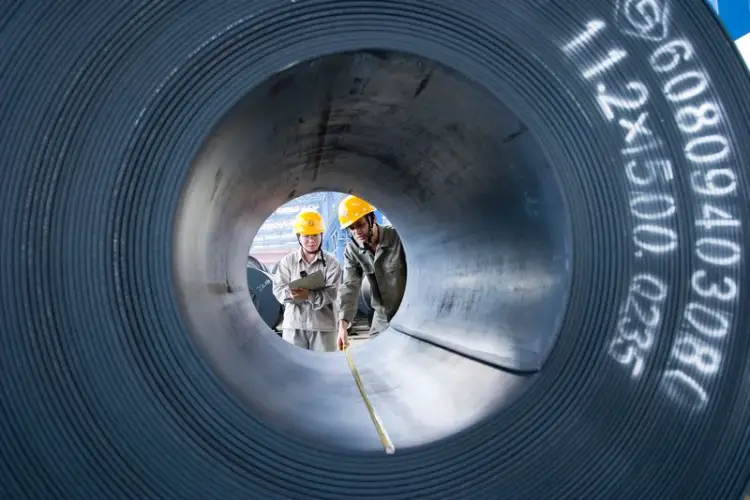
API 5L X80 PSL2 Line Pipe Steel Material
API 5L X80 PSL2 Line Pipe Steel - High-Strength Pipeline Material
Comprehensive material data for API 5L X80 PSL2 line pipe including chemical composition, mechanical properties, physical characteristics, equivalent grades, and application guidance.
Hot rolling, thermo-mechanical controlled processing (TMCP), quenching and tempering (Q+T), welding (SAW, ERW, HFW), forming
- Phone : +8618037372205
- Email : [email protected]
- WhatsApp: Contact via Whtsapp
- WeChat: +8618037372205
API 5L X80 PSL2 Line Pipe Steel Introduction
API 5L X80 PSL2 is a high-strength low-alloy (HSLA) line pipe steel specified in the American Petroleum Institute standard API 5L. It is designed for critical oil and gas transmission pipelines operating under high pressure and severe conditions. PSL2 denotes a higher product specification level with stricter chemical composition limits, enhanced mechanical properties, and mandatory fracture toughness requirements. Typical delivery condition is thermo-mechanical controlled process (TMCP) or quenched and tempered (Q+T), resulting in fine-grained microstructure with excellent strength and toughness balance. It is widely used in long-distance, high-pressure pipelines, including sour service and offshore applications, where reliability and safety are paramount.
API 5L X80 PSL2 Line Pipe Steel Chemical Composition
The chemical composition conforms to API 5L PSL2 requirements for X80 grade. Carbon equivalent (CE) is controlled to ensure weldability. Typical microalloying with Nb, V, and Ti is practiced to achieve grain refinement and precipitation strengthening.
| Element | Standard Value (max unless range) | Remarks |
|---|---|---|
| C | 0.12 (welded) / 0.24 (seamless) | Maximum; actual lower for toughness |
| Si | 0.45 | Maximum |
| Mn | 1.85 | Maximum; for both welded and seamless |
| P | 0.025 | Maximum |
| S | 0.015 | Maximum |
| V | 0.10 | Maximum; commonly added as microalloy |
| Nb | 0.10 | Maximum; commonly added |
| Ti | 0.06 | Maximum; for grain refinement |
| Cu | 0.50 | Maximum (residual or intentional) |
| Ni | 0.50 | Maximum |
| Cr | 0.50 | Maximum |
| Mo | 0.50 | Maximum |
| Al | 0.015–0.060 | Total aluminum; for grain size control |
| N | 0.012 | Maximum |
| B | 0.0005 | Maximum (if added) |
| CE IIW | 0.43 | Maximum carbon equivalent, typical |
API 5L X80 PSL2 Line Pipe Steel Thermal and Electrical Physical Properties
These values represent typical data for X80 pipeline steel at room temperature unless otherwise noted. They are not specification requirements but are provided for engineering calculations.
| Property | Typical Value | Unit | Test Condition / Remarks |
|---|---|---|---|
| Density (ρ) | 7.85 | g/cm³ | At 20°C |
| Elastic Modulus (E) | 207 | GPa | At 20°C |
| Shear Modulus (G) | 80 | GPa | Calculated from E and ν |
| Poisson's Ratio (ν) | 0.30 | - | At 20°C |
| Thermal Expansion Coefficient (α) | 11.7 | 10⁻⁶/K | 20–100°C |
| Thermal Expansion Coefficient (α) | 12.3 | 10⁻⁶/K | 20–200°C |
| Thermal Expansion Coefficient (α) | 12.9 | 10⁻⁶/K | 20–400°C |
| Thermal Conductivity (λ) | 50 | W/(m·K) | At 20°C |
| Thermal Conductivity (λ) | 44 | W/(m·K) | At 200°C |
| Specific Heat Capacity (c) | 480 | J/(kg·K) | At 20–100°C average |
| Electrical Resistivity (ρ_e) | 0.20 | μΩ·m | At 20°C |
API 5L X80 PSL2 Line Pipe Steel Mechanical Properties
Mechanical properties are tested on pipe body specimens in accordance with API 5L. Transverse samples are used for welded pipes. The minimum elongation is calculated per API 5L formula; typical values are shown for a 12.7 mm (0.5 in) wall thickness with tensile strength 625 MPa. Toughness test temperature is usually 0°C or as specified by purchaser.
| Property | Standard Required Value | Unit | Test Condition / Remarks |
|---|---|---|---|
| Yield Strength (Rt0.5) | 555 min – 705 max | MPa | Transverse strip test; 0.2% offset or 0.5% total extension |
| Tensile Strength (Rm) | 625 min – 825 max | MPa | Transverse strip test |
| Elongation (A) | ≥ 22 (typical) | % | On gauge length 50 mm or 2 in; calculated per API 5L formula; example for 12.7 mm WT |
| Yield/Tensile Ratio | ≤ 0.93 | - | Required for PSL2 |
| Charpy Impact Energy (KV) | ≥ 40 (avg) / ≥ 30 (single) | J | Full-size specimen (10x10 mm), transverse, at 0°C; for pipe body |
| Charpy Impact Energy (KV) | ≥ 27 (avg) / ≥ 20 (single) | J | If reduced-size specimens are used (proportional to cross-section) |
| Bend Test | No fracture or cracks | - | Mandrel diameter per standard or as agreed; typically 180° bend |
| Hardness | ≤ 250 HV10 or equivalent | HV | For sour service requirements may apply (optional) |
API 5L X80 PSL2 Line Pipe Steel Full Equivalent Material Standards and Substitutable Grades
| Country / Region | Standard | Grade | Remarks |
|---|---|---|---|
| International | ISO 3183 | L555 PSL2 | Equivalent to X80 PSL2; suffix M for TMCP delivery |
| Europe | EN 10208-2 | L555MB | PSL2 equivalent; M for TMCP, B for as-rolled |
| China | GB/T 9711 | L555M / L555 | L555M for PSL2 TMCP pipe; L555 for PSL2 non-specified |
| Russia | GOST R 52079 | K65 (К65) | Comparable strength class |
| India | IS 1235 | X80 PSL2 | Adopts API 5L directly |
API 5L X80 PSL2 Line Pipe Steel Application Introduction
API 5L X80 PSL2 is the material of choice for modern high-pressure, large-diameter gas transmission pipelines. Its high strength allows reduced wall thickness, saving weight and cost, while excellent toughness ensures crack arrest capability in adverse environments. It finds extensive use in Arctic and subsea pipelines.
Product Applications: Longitudinally welded pipes (LSAW, JCOE, UOE), Spiral welded pipes (SSAW/HSAW), Seamless pipes (for special applications), Fittings (induction bends, elbows, tees, reducers), Flanges and connectors
Processed into products: Main line pipe segments, Hot induction bends, Cold bends, Pipeline fittings (tees, elbows, caps), Flanges (weld neck, blind), Repair sleeves and pup pieces, Valve bodies (forged)
Application industries: Oil & Gas (upstream and midstream), Energy Transmission (natural gas, CO₂), Offshore Engineering, Pipeline Infrastructure (cross-country, river crossings), Hydrogen Transport (in pilot projects, after qualification)
API 5L X80 PSL2 Line Pipe Steel Similar / Closely Matching Alternative Materials
| Country / Region | Standard | Grade | Remarks |
|---|---|---|---|
| International | API 5L | X80 PSL1 | Lower testing requirements, no mandatory toughness; less stringent chemistry |
| International | API 5L | X70 PSL2 | Lower strength (yield 485 MPa min); similar toughness; widely used |
| Europe | EN 10208-2 | L485MB (X70) | Strength comparable to X70; good alternative for lower pressure design |
| China | GB/T 9711 | L485 (X70) | PSL2 grade with reduced strength |
Notes:
- All mechanical values are minimum requirements from API 5L unless a range is indicated.
- The chemical composition is indicative for PSL2 and may be further restricted by supplementary requirements (e.g., HIC, SSC) for sour service.
- Impact test temperature may be lowered to -10°C, -20°C or lower as per project specification.
- For sour service applications, additional testing (HIC, SSC per NACE MR0175/ISO 15156) is mandatory.
- Actual delivery condition and thermomechanical rolling parameters are agreed between manufacturer and purchaser.
- All data is based on API 5L 46th Edition (2018). For the latest edition, consult the standard directly.
- Share



