
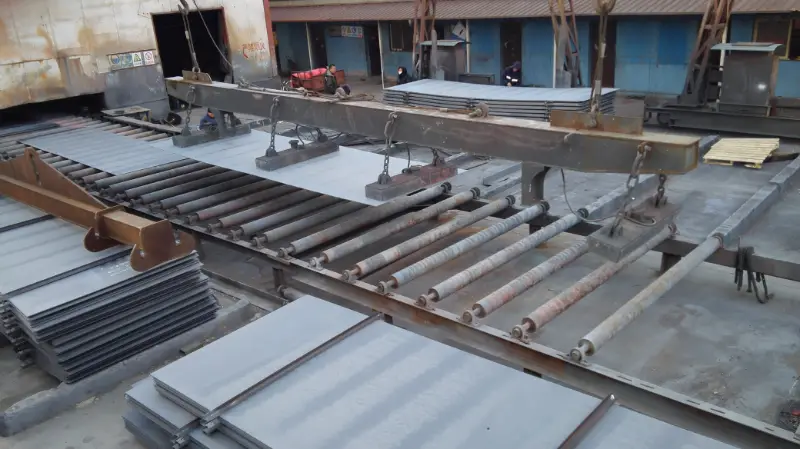
35CrMo Alloy Steel Plates Material
35CrMo Alloy Steel Plates: Full Data Sheet, Equivalents & Application Guide
In-depth technical profile of 35CrMo alloy steel plates: chemical composition, mechanical & thermal properties, international equivalent grades, and real-world applications for engineering and manufacturing.
Hot rolling, annealing, quenching & tempering, normalizing, nitriding, induction hardening
- Phone : +8618037372205
- Email : [email protected]
- WhatsApp: Contact via Whtsapp
- WeChat: +8618037372205
35CrMo Alloy Steel Plates Introduction
35CrMo is a Chinese standard alloy structural steel widely used in the form of plates, bars, and forgings. Classified under GB/T 3077, it is equivalent to 34CrMo4 (DIN 17200), SCM435 (JIS G4105), and AISI/SAE 4135. This Cr-Mo steel offers an excellent combination of high strength, good toughness, and medium hardenability. After quenching and tempering, it exhibits a fine tempered martensite or bainite microstructure, providing high tensile strength (≥985 MPa), good creep resistance at elevated temperatures, and resistance to hydrogen attack in moderate service. Its carbon content (0.32–0.40%) ensures a balance between weldability and strength. The alloy is capable of withstanding dynamic loads and is suitable for components that operate at temperatures up to about 500°C. 35CrMo plates are typically delivered in hot-rolled or annealed condition, and they can be subsequently heat-treated to achieve desired mechanical properties. The steel also responds well to nitriding and induction hardening, broadening its use in wear-resistant applications.
35CrMo Alloy Steel Plates Chemical Composition
The chemical composition conforms to GB/T 3077 for grade 35CrMo. The key alloying elements chromium and molybdenum enhance hardenability and high-temperature performance. Phosphorus and sulfur are strictly controlled to ensure cleanliness and toughness.
| Element | Standard Value (%) | Remarks |
|---|---|---|
| Carbon (C) | 0.32–0.40 | Primary hardenability element |
| Silicon (Si) | 0.17–0.37 | Deoxidizer, strength contributor |
| Manganese (Mn) | 0.40–0.70 | Hardenability and desulfurization |
| Chromium (Cr) | 0.80–1.10 | Carbide former, corrosion & heat resistance |
| Molybdenum (Mo) | 0.15–0.25 | High-temperature strength, hardenability |
| Phosphorus (P) | ≤0.035 | Max – impurity |
| Sulfur (S) | ≤0.035 | Max – impurity |
| Nickel (Ni) | ≤0.30 | Residual element |
| Copper (Cu) | ≤0.30 | Residual element |
35CrMo Alloy Steel Plates Thermal & Electrical Physical Properties
The following physical properties are typical for 35CrMo/34CrMo4 type alloy steel at room temperature unless specified. These values are reference data for engineering design and may slightly vary with actual heat treatment and composition.
| Property | Typical Value | Unit | Test Condition / Temperature |
|---|---|---|---|
| Density, ρ | 7.83 | g/cm³ | At 20°C |
| Modulus of elasticity, E | 206 | GPa | At 20°C |
| Shear modulus, G | 79.3 | GPa | At 20°C, estimated as E/[2(1+ν)] |
| Poisson's ratio, ν | 0.30 | – | At 20°C |
| Thermal expansion coefficient, α | 11.8 × 10⁻⁶ | K⁻¹ | 20–100 °C |
| Thermal expansion coefficient, α | 12.5 × 10⁻⁶ | K⁻¹ | 20–200 °C |
| Thermal expansion coefficient, α | 13.2 × 10⁻⁶ | K⁻¹ | 20–300 °C |
| Thermal conductivity, λ | 42.7 | W/(m·K) | At 100°C |
| Thermal conductivity, λ | 39.8 | W/(m·K) | At 200°C |
| Thermal conductivity, λ | 36.4 | W/(m·K) | At 300°C |
| Thermal conductivity, λ | 32.8 | W/(m·K) | At 400°C |
| Specific heat capacity, cₚ | 461 | J/(kg·K) | At 20–100°C |
| Specific heat capacity, cₚ | 477 | J/(kg·K) | At 100–200°C |
| Specific heat capacity, cₚ | 502 | J/(kg·K) | At 200–300°C |
| Electrical resistivity, ρₑ | 0.23 × 10⁻⁶ | Ω·m | At 20°C, typical |
35CrMo Alloy Steel Plates Mechanical Properties
Data refer to the quenched and tempered condition per GB/T 3077 (specimen diameter 25 mm, oil quenched from 850°C, tempered at 550°C water/oil cooled). All values are minimum unless otherwise stated. Hardness in the annealed or as-delivered condition is also provided.
| Property | Standard Requirement | Unit | Test Condition |
|---|---|---|---|
| Tensile strength, Rm | ≥985 | MPa | Room temp.; Q&T specimen |
| Yield strength (0.2%), ReH | ≥835 | MPa | Room temp.; Q&T specimen |
| Elongation after fracture, A | ≥12 | % | 5.65√S₀ gauge; Q&T specimen |
| Reduction of area, Z | ≥45 | % | Q&T specimen |
| Impact energy, KV₂ | ≥63 | J | Charpy U-notch or V-notch; Room temp.; Q&T specimen (often KV₂ = 63 J for V-notch) |
| Hardness | ≤229 | HBW | Annealed or as-delivered condition (not Q&T) |
35CrMo Alloy Steel Plates Full Equivalent International Standards & Substitutable Grades
| Country/Region | Standard | Grade | Remarks |
|---|---|---|---|
| China | GB/T 3077 | 35CrMo | Base grade; plate also per GB/T 11251 |
| Germany | DIN 17200 / EN 10083-3 | 34CrMo4 (1.7220) | Chemically identical within tolerances |
| Japan | JIS G4105 | SCM435 | Minor differences in Mn (0.60–0.85) and Cr (0.90–1.20) |
| USA | ASTM A29 / A29M | 4135 / 4137 | 4135 (C 0.33–0.38); 4137 (C 0.35–0.40); both match Cr-Mo range |
| UK | BS 970-1 | 708A37 | Equivalent Cr-Mo steel, EN series |
| EU | EN 10083-3 | 34CrMo4 | Identical to German grade |
| International | ISO 683-2 | 34CrMo4 | Same designation as EN |
35CrMo Alloy Steel Plates Application Introduction
35CrMo steel plates are employed where a combination of high strength, good toughness, and moderate temperature resistance is required. Thanks to its chromium and molybdenum content, this steel maintains mechanical properties up to ~500°C and resists creep in bolted flanges and pressure parts. Typical usage includes
- General mechanical engineering: shafts, axles, spindles, gears, and heavy-duty machine components.
- Automotive: crankshafts, connecting rods, steering knuckles, and fasteners (grade 10.9 bolts).
- Oil & gas: drill collars, tubing hangers, wellhead equipment, and hydrogen service valves.
- Power generation: turbine rotors, steam piping, and high-pressure vessels within temperature limits.
- Tooling: plastic mold plates and die holders due to good polishability after heat treatment.
Product Applications: Alloy steel plates (hot-rolled, annealed or Q&T), Forged shafts and rotor discs, High-strength bolts and threaded bars, Gears and pinions for medium-speed reducers, Mold base plates for plastic injection molds, Cylinder liners and pump bodies
Processed into products: Transmission shafts and axles, Crankshafts and connecting rods, Steering knuckles and wheel hubs, Drill collar and stabilizer bodies, Valve bodies and bonnets for high-temperature service (≤400°C), Turbine compressor discs, Hydraulic cylinder rods and pistons, Heavy-duty gearwheels and sprockets, Mold frames (A and B plates in tooling)
Application industries: Automotive & transportation, General machinery manufacturing, Oil & gas extraction and refining, Power generation (thermal, hydro), Pressure vessel & boiler (limited to moderate temperatures), Mining & construction equipment
35CrMo Alloy Steel Plates Similar / Nearby Substitute Materials
| Country/Region | Standard | Grade | Remarks |
|---|---|---|---|
| China | GB/T 3077 | 42CrMo (425CrMo4) | Higher C (0.38–0.45) and slightly higher Mo; strength ~1080 MPa; used for heavier sections |
| Germany | EN 10083-3 | 42CrMo4 (1.7225) | A direct upgradable alternative with higher hardenability |
| Japan | JIS G4105 | SCM440 | Higher carbon (0.38–0.43); strength >985 MPa; commonly substitutes for larger parts |
| USA | ASTM A29 | 4140 | 0.38–0.43 C, 0.15–0.25 Mo; higher strength variant; widely interchangeable for more demanding service |
| China | GB/T 3077 | 30CrMo | Lower carbon (0.26–0.34); lower strength but better weldability; used in thin-wall pressure vessels |
| EU | EN 10083-3 | 25CrMo4 (1.7218) | Lower carbon (0.22–0.29) for improved weldability; suitable for similar heat-resisting applications |
Notes:
Heat treatment guidelines: Austenitize at 850°C (oil quench), temper at 550°C for optimum strength and toughness (the standard Q&T condition). For improved impact at low temperatures, temper at slightly higher temperature. Weldability: Preheating to 200–300°C is recommended; post-weld heat treatment (stress relieving at 600–650°C) should be applied to avoid cold cracking. Surface hardening: Flame or induction hardening can achieve surface hardness up to 50 HRC. Nitriding at 500–520°C produces a hard, wear-resistant case (HV 600–700) with minimal distortion. The steel has good machinability at annealed condition (~60% machinability relative to low-carbon steel). As-delivered plates may be ordered with ultrasonic testing and specific cleanliness requirements per GB/T 11251.
- Share



