
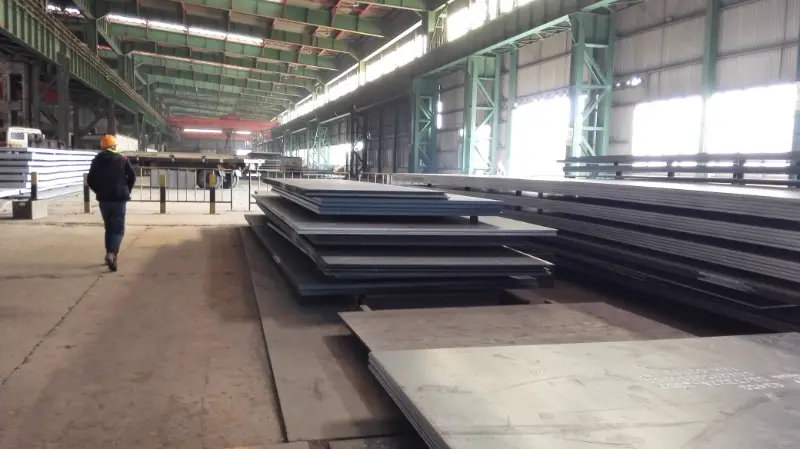
12Cr21Ni5Ti Stainless Steel
12Cr21Ni5Ti Stainless Steel: Dual-Phase Austenitic-Ferritic Strength & Corrosion Resistance
Complete material data for 12Cr21Ni5Ti (formerly 1Cr21Ni5Ti) duplex stainless steel according to GB/T 4237. Includes chemical composition, mechanical and thermal properties, international equivalents, and application guidance.
Suitable for cutting, bending, forming, welding (with appropriate filler). Solution annealing (solid solution treatment) is the typical heat treatment condition.
- Phone : +8618037372205
- Email : [email protected]
- WhatsApp: Contact via Whtsapp
- WeChat: +8618037372205
12Cr21Ni5Ti Stainless Steel Introduction
12Cr21Ni5Ti (also designated 1Cr21Ni5Ti) is a duplex (austenitic-ferritic) stainless steel standardized under GB/T 4237 and GB/T 3280. It offers a balanced microstructure that combines high strength with good toughness and excellent resistance to intergranular corrosion. The addition of titanium stabilizes the structure against sensitization during welding.
- Typical applications include chemical processing, petroleum, and food industries where both corrosion resistance and higher mechanical properties than conventional austenitic grades are required.
- The grade is capable of replacing 18-8 type stainless steels in many welded constructions, providing weight savings due to higher yield strength.
12Cr21Ni5Ti Stainless Steel Chemical Composition
The chemical composition of 12Cr21Ni5Ti is specified in GB/T 20878 and GB/T 4237. Titanium acts as a stabilizing element to prevent chromium carbide precipitation and enhance intergranular corrosion resistance.
- All values are maximum unless a range is indicated.
- Titanium content is controlled as a multiple of the carbon content to ensure effective stabilization.
| Element | Standard Value (%) | Remarks |
|---|---|---|
| C | 0.09 ~ 0.14 | Standard range |
| Si | ≤ 0.80 | |
| Mn | ≤ 0.80 | |
| P | ≤ 0.035 | |
| S | ≤ 0.030 | |
| Ni | 4.80 ~ 5.80 | |
| Cr | 20.00 ~ 22.00 | |
| Ti | 5×(C%-0.02) ~ 0.80 | Stabilization minimum to maximum, typically 0.20-0.60 |
12Cr21Ni5Ti Stainless Steel Thermal and Electrical Physical Properties
Physical property data are typical values for the duplex structure at ambient and elevated temperatures. These values can vary slightly depending on exact composition and heat treatment condition.
- The thermal expansion coefficient is similar to carbon steels, which facilitates joining with dissimilar materials.
- Thermal conductivity is higher than austenitic grades but lower than ferritic stainless steels.
| Property | Typical Value | Unit | Test Condition / Remarks |
|---|---|---|---|
| Density (ρ) | 7.80 | g/cm³ | At 20 °C |
| Modulus of Elasticity (E) | 200 | GPa | At 20 °C, tension |
| Shear Modulus (G) | 77 | GPa | Calculated from E and ν |
| Poisson's Ratio (ν) | 0.30 | - | At 20 °C |
| Thermal Expansion Coefficient (α) | 13.0 13.5 14.0 | 10⁻⁶/K | 20–100 °C 20–300 °C 20–500 °C |
| Thermal Conductivity (λ) | 15.0 | W/(m·K) | At 20 °C |
| Specific Heat Capacity (c) | 500 | J/(kg·K) | At 20 °C |
| Electrical Resistivity (ρe) | 0.75 | μΩ·m | At 20 °C |
12Cr21Ni5Ti Stainless Steel Mechanical Properties
Mechanical properties are for solution-annealed material (thickness ≤ 75 mm) according to GB/T 4237. The duplex structure provides higher yield and tensile strengths compared to standard austenitic grades such as 304L.
- Elongation is measured with proportional gauge length A for thickness > 3 mm, and A50mm for thickness ≤ 3 mm; values given below apply to standard test pieces.
- No impact test requirements are specified in the standard, but the grade exhibits good toughness at ambient temperatures.
| Property | Required Value | Unit | Test Condition |
|---|---|---|---|
| Yield Strength (Rp0.2) | ≥ 350 | MPa | Room temperature, tensile test |
| Tensile Strength (Rm) | ≥ 635 | MPa | Room temperature, tensile test |
| Elongation after fracture (A) | ≥ 20 | % | Proportional gauge length, L0=5.65√S0 |
| Hardness (HBW) | Not specified | HBW | Typical range: 200–280 |
| Bend test | No mandatory requirement | Solution-annealed condition |
12Cr21Ni5Ti Stainless Steel Exact Equivalent Material Standards and Replaceable Designations
| Country/Region | Standard | Designation | Remarks |
|---|---|---|---|
| China | GB/T 20878 | S22160 (12Cr21Ni5Ti) | Unified digital code; same as 1Cr21Ni5Ti |
| China | GB/T 4237 | 12Cr21Ni5Ti | Hot-rolled plate/coil |
| International (ISO) | ISO 15510 | X12CrNi21-5 | Chemical composition closely matches |
| Russia | GOST 5632 | 12Х21Н5Т (ЭП53) | Stabilized duplex stainless steel |
12Cr21Ni5Ti Stainless Steel Application Introduction
12Cr21Ni5Ti is primarily used where high mechanical strength and good corrosion resistance are required, especially in welded constructions. It serves as a drop-in replacement for conventional austenitic stainless steels in many chemical and petrochemical applications, offering weight and cost reductions.
Product Applications: Pressure vessels and storage tanks, Heat exchangers and condensers, Welded pipes and fittings, Plate heat exchangers, Structural components for corrosive environments
Processed into products: Tube sheets and baffles, Flanges and connectors, Pump shafts and valve bodies, Stirrer blades and agitator arms, Clad plates for chemical reactors
Application industries: Chemical processing (reactors, columns, piping), Petroleum and natural gas (offshore platforms, pipelines), Food and beverage (tanks, mixers), Pulp and paper (digesters, liquor tanks), Pharmaceutical equipment (sterile vessels)
12Cr21Ni5Ti Stainless Steel Similar or Near-Equivalent Alternative Materials
| Country/Region | Standard | Designation | Remarks |
|---|---|---|---|
| International | EN 10088-1 / ISO 15510 | X2CrNiN22-2 (1.4062) | Lean duplex with lower Ni; comparable pitting resistance but lower strength |
| USA | ASTM A240 | UNS S32101 (LDX 2101) | Low-Ni duplex; good strength and corrosion resistance; suitable alternative for many applications |
| International | EN 10088-1 | X2CrNiN23-4 (1.4362) | 2304 duplex; often interchangeable with 12Cr21Ni5Ti, but with higher Ni and N content |
Notes:
Welding: Welding can be performed with matching or slightly over-alloyed fillers (e.g., ER2209 or E2209) to maintain phase balance and corrosion resistance. Post-weld heat treatment is generally not required. Corrosion resistance: Due to titanium stabilization, the grade exhibits excellent resistance to intergranular corrosion after welding, comparable to stabilized austenitic types. Cold forming: The material has good formability but higher springback than austenitic grades, which must be considered during bending operations.
- Share



