
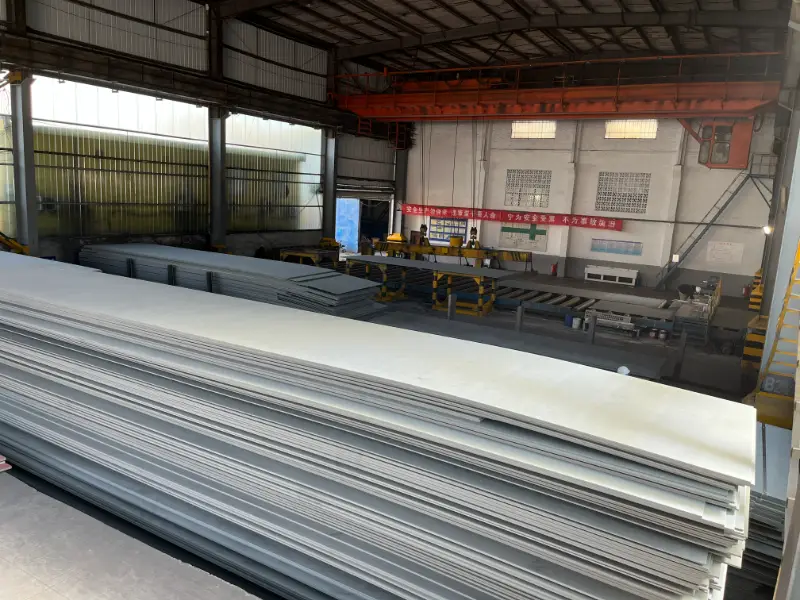
03Cr25Ni6Mo3Cu2N Duplex Stainless Steel
03Cr25Ni6Mo3Cu2N Duplex Stainless Steel: Superior Strength & Corrosion Resistance for Demanding Applications
In-depth technical data for 03Cr25Ni6Mo3Cu2N austenitic-ferritic stainless steel plate and coil according to GB/T4237, including composition, mechanical and physical properties, international equivalents, and processing guidelines.
Welding, cold forming, machining (strain hardening consideration), hot forming followed by solution annealing
- Phone : +8618037372205
- Email : [email protected]
- WhatsApp: Contact via Whtsapp
- WeChat: +8618037372205
03Cr25Ni6Mo3Cu2N Duplex Stainless Steel Introduction
03Cr25Ni6Mo3Cu2N is a nitrogen-enhanced austenitic-ferritic (duplex) stainless steel specified in GB/T 4237 for hot-rolled plates and coils. It combines high chromium (about 25%), molybdenum (3%), copper (2%), and nitrogen to achieve excellent resistance to pitting, crevice corrosion, and stress corrosion cracking in chloride-containing environments. With a balanced two-phase microstructure, it offers roughly double the yield strength of standard austenitic grades like 304L, along with good toughness and weldability. Typical applications include chemical processing equipment, offshore platforms, seawater handling systems, and pulp and paper machinery. The material is commonly delivered in solution-annealed condition, ensuring an optimal combination of mechanical and corrosion properties.
03Cr25Ni6Mo3Cu2N Duplex Stainless Steel Chemical Composition per GB/T 4237
The chemical composition of 03Cr25Ni6Mo3Cu2N is precisely controlled to achieve the duplex microstructure and required corrosion resistance. The values listed are the standard melt analysis limits for the hot-rolled plate/coil as per GB/T 4237. Nitrogen is deliberately added to enhance pitting resistance and strength, while carbon is minimized to prevent intergranular corrosion.
| Element | Standard Value (%) | Remarks |
|---|---|---|
| Carbon (C) | ≤ 0.03 | Low carbon for weldability |
| Silicon (Si) | ≤ 1.00 | |
| Manganese (Mn) | ≤ 2.00 | |
| Phosphorus (P) | ≤ 0.035 | |
| Sulfur (S) | ≤ 0.030 | |
| Chromium (Cr) | 24.0 - 26.0 | Key for corrosion resistance |
| Nickel (Ni) | 5.5 - 7.5 | Balances duplex structure |
| Molybdenum (Mo) | 2.5 - 3.5 | Enhances pitting resistance |
| Copper (Cu) | 1.5 - 2.5 | Improves resistance to reducing acids |
| Nitrogen (N) | 0.12 - 0.25 | Grain refinement and pitting equivalent |
03Cr25Ni6Mo3Cu2N Duplex Stainless Steel Thermal and Electrical Physical Properties
The physical properties of 03Cr25Ni6Mo3Cu2N are representative of a duplex stainless steel with approximately 25% Cr. These values are based on published data at room temperature unless a range is specified, and are intended for engineering calculations. Properties may vary slightly depending on exact heat treatment.
| Property | Typical Value | Unit | Test Condition / Remarks |
|---|---|---|---|
| Density (ρ) | 7.8 | g/cm³ | At 20°C |
| Elastic Modulus (E) | 200 | GPa | At 20°C |
| Shear Modulus (G) | 77 | GPa | At 20°C |
| Poisson's Ratio (ν) | 0.3 | - | At 20°C |
| Thermal Expansion Coefficient (α) | 13.0 | 10⁻⁶/K | 20°C to 100°C |
| Thermal Expansion Coefficient | 14.0 | 10⁻⁶/K | 20°C to 300°C |
| Thermal Conductivity (λ) | 15 | W/(m·K) | At 20°C |
| Specific Heat Capacity (c) | 480 | J/(kg·K) | At 20°C |
| Electrical Resistivity (ρ_e) | 0.85 | μΩ·m | At 20°C |
03Cr25Ni6Mo3Cu2N Duplex Stainless Steel Mechanical Properties
Mechanical properties are determined after solution annealing (1020-1100°C, followed by rapid cooling) and apply to plate thickness ranges as specified in the standard. The duplex structure provides high strength combined with good ductility. The listed values are the minimum requirements for acceptance unless otherwise agreed.
| Property | Standard Requirement | Unit | Test Condition / Remarks |
|---|---|---|---|
| Yield Strength (Rp0.2) | ≥ 450 | MPa | Room temperature, transverse direction |
| Tensile Strength (Rm) | ≥ 690 | MPa | Room temperature |
| Elongation (A50mm) | ≥ 25 | % | Gauge length 50mm (or proportional) |
| Brinell Hardness (HBW) | ≤ 290 | - | Typical acceptance limit |
| Bend Test (Diameter D, angle 180°) | D = 4a | - | a = plate thickness, no cracks |
| Impact Energy (KV2) | ≥ 60 (typical, optional) | J | At -40°C when required by agreement |
03Cr25Ni6Mo3Cu2N Duplex Stainless Steel Completely Equivalent Material Standards and Substitutable Designations
| Country / Region | Standard | Designation | Remarks |
|---|---|---|---|
| China | GB/T 4237 | 03Cr25Ni6Mo3Cu2N | Original specification |
| USA | ASTM A240 / A240M | UNS S32520 | Same nominal composition and mechanical properties |
| International | ISO 15510 | X2CrNiMoCuN25-6-3 | Aligns with UNS S32520 chemistry |
| Europe | EN 10028-7 | 1.4507 (X2CrNiMoCuN25-6-3) | Cu range 1.0-2.0; verify exact element limits with standard |
03Cr25Ni6Mo3Cu2N Duplex Stainless Steel Application Introduction
03Cr25Ni6Mo3Cu2N is tailored for aggressive chloride-containing environments where both high strength and reliable corrosion resistance are paramount. Its excellent resistance to pitting, crevice corrosion, and stress corrosion cracking makes it a workhorse in modern chemical processing, marine, and energy industries. The grade can be formed and welded with standard duplex procedures, but a post-weld solution anneal is recommended to restore full toughness and corrosion properties. In fabrication, attention must be paid to control heat input and interpass temperature to avoid detrimental phase formation.
Product Applications: Weldable structural components for marine environments, Pressure vessels and storage tanks for corrosive fluids, Plate heat exchangers and tube sheets, Hot-rolled coils for light-gauge forming, Seawater cooling water pipes and intakes, Ships and floating production storage and offloading (FPSO) modules
Processed into products: Shell and tube heat exchanger plates and tube plates, Distillation column internals, Pump impellers and casings for seawater service, Flanges, fittings, and fastening hardware, Scrubber internals in FGD units, Structural tie-rods and anchor plates in offshore foundations, Welded pipes and headers for high-pressure chloride systems
Application industries: Oil & Gas (offshore platforms, subsea piping), Chemical & Petrochemical (reactors, heat exchangers, tanks), Desalination and water treatment (seawater reverse osmosis, evaporators), Pulp & Paper (digesters, bleach washers), Flue Gas Desulfurization (FGD) systems, Marine engineering (propeller shafts, seawater pumps), Renewable energy (geothermal, biomass plants)
03Cr25Ni6Mo3Cu2N Duplex Stainless Steel Similar or Substitution Materials for Comparable Applications
| Country / Region | Standard | Designation | Remarks |
|---|---|---|---|
| China | GB/T 4237 | 022Cr25Ni7Mo4N | Super duplex with higher Mo (4%), higher strength and PREN; for more aggressive conditions |
| USA | ASTM A240 | UNS S32750 (Super Duplex 2507) | Higher alloyed super duplex; excellent pitting resistance, but costlier |
| Europe | EN 10028-7 | 1.4410 (X2CrNiMoN25-7-4) | Super duplex with 25Cr-7Ni-4Mo-N; enhanced strength and corrosion resistance |
| China | GB/T 4237 | 03Cr22Ni5Mo3N (UNS S31803/S32205) | Standard duplex with lower Cr, Mo, N; lower strength but widely available and cost-effective for less severe environments |
Notes:
- The material is generally supplied in the solution-annealed condition per the GB/T 4237 standard. Users must confirm that the condition provides the required pitting resistance equivalent number (PREN ≥ 40, typically).
- Hot forming should be carried out within the range of 1150–900°C and followed by a full solution anneal; prolonged exposure in the range of 300–1000°C can cause embrittlement due to intermediate phases.
- Welding consumables typically match the base material composition (e.g., AWS A5.9 ER25CrNi6Mo3Cu2N or equivalent nickel-alloyed filler) with a slight over-alloying of Ni to maintain phase balance.
- Service temperatures are generally limited to -40°C to 300°C because of the risk of 475°C embrittlement and sigma phase formation above 300°C.
- This data sheet is for informational purposes based on the public standard. For specific design, always refer to the latest edition of GB/T 4237 and the mill's test certificates.
- Share



