
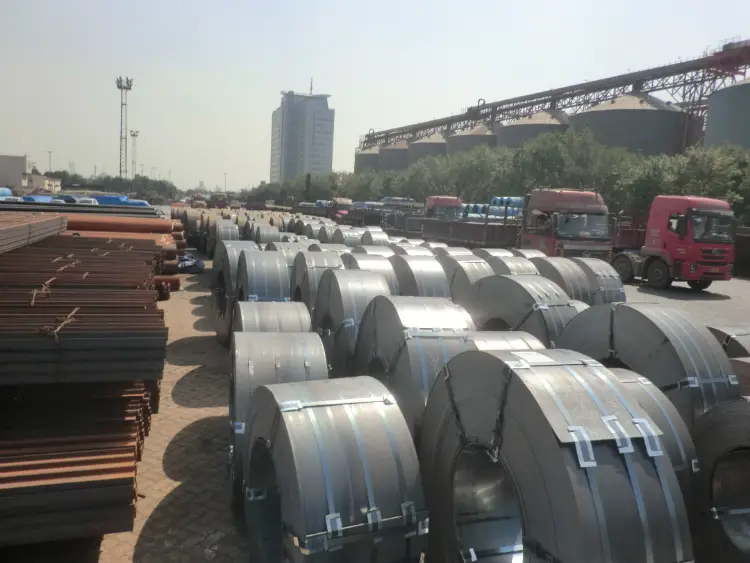
TB/T 1979 09CuPTiRE-B Weather Resistant Steel Coil
09CuPTiRE-B Weather-Resistant Steel Coil: TB/T 1979 Guide to Composition, Properties & Equivalents
Comprehensive technical data for 09CuPTiRE-B atmospheric corrosion-resistant steel coil under Chinese railway standard TB/T 1979. Includes chemical, mechanical and thermal properties, international equivalents, and application insights.
Hot rolling; cold forming; gas shielded welding, manual arc welding; shearing and bending
- Phone : +8618037372205
- Email : [email protected]
- WhatsApp: Contact via Whtsapp
- WeChat: +8618037372205
TB/T 1979 09CuPTiRE-B Weather Resistant Steel Coil Introduction
09CuPTiRE-B is a low-alloy atmospheric corrosion-resistant steel grade specified in the Chinese railway industry standard TB/T 1979. It belongs to the Cu-P-Ti-RE weathering steel family, designed to form a dense protective rust layer that significantly slows further corrosion, making it ideal for rolling stock exposed to outdoor climates without painting. The steel offers a minimum yield strength of 295 MPa, good weldability, and excellent toughness at low temperatures (impact energy ≥27 J at -40 °C). Typical supply condition is hot-rolled coil with thickness usually ranging from 1.5 to 12 mm. It is widely used for structural panels, frames, and beams of railway wagons and passenger coaches, as well as in containers and building cladding where both weight saving and corrosion resistance are required.
TB/T 1979 09CuPTiRE-B Weather Resistant Steel Coil Chemical Composition
The chemistry limits for 09CuPTiRE-B are defined by TB/T 1979. The alloy design relies on copper, phosphorus, titanium and rare earth elements (RE) to enhance atmospheric corrosion resistance. Phosphorus plays a key role in the patina formation, while titanium refines grain size and RE elements improve corrosion resistance and sulphide morphology.
| Element | Specified Value | Remarks |
|---|---|---|
| Carbon (C) | ≤ 0.12 | Maximum |
| Silicon (Si) | 0.20 – 0.40 | |
| Manganese (Mn) | 0.25 – 0.55 | |
| Phosphorus (P) | 0.07 – 0.12 | |
| Sulfur (S) | ≤ 0.020 | Maximum |
| Copper (Cu) | 0.25 – 0.45 | |
| Titanium (Ti) | ≤ 0.03 | Maximum |
| Rare Earth (RE) | 0.01 – 0.04 | CE equivalent |
| Iron (Fe) | Balance |
TB/T 1979 09CuPTiRE-B Weather Resistant Steel Coil Thermal and Electrical Physical Properties
Physical properties are not required by TB/T 1979 but are typical for this class of low-alloy weathering steel at room temperature. Values may vary slightly with manufacturing route and exact chemical analysis. The thermal conductivity and expansion are similar to carbon structural steel.
| Property | Typical Value | Unit | Test Condition |
|---|---|---|---|
| Density (ρ) | 7.85 | g/cm³ | 20 °C |
| Modulus of Elasticity (E) | 206 | GPa | 20 °C |
| Shear Modulus (G) | 79.3 | GPa | 20 °C |
| Poisson's Ratio (ν) | 0.30 | — | 20 °C |
| Thermal Expansion Coefficient (α) | 11.5 – 12.2 | 10⁻⁶/K | 20 – 100 °C |
| Thermal Conductivity (λ) | 45 – 55 | W/(m·K) | 20 °C |
| Specific Heat Capacity | 460 – 500 | J/(kg·K) | 20 – 100 °C |
| Electrical Resistivity (ρₑ) | 0.22 – 0.30 | µΩ·m | 20 °C |
TB/T 1979 09CuPTiRE-B Weather Resistant Steel Coil Mechanical Properties
The following mechanical properties are specified in TB/T 1979 for hot-rolled coil/plate in delivery condition. Testing is normally performed on transverse specimens. Impact energy is guaranteed at -40 °C, reflecting the steel's application in cold regions. The bend test confirms good formability.
| Property | Specified Requirement | Unit | Test Condition |
|---|---|---|---|
| Yield Strength (ReL) | ≥ 295 | MPa | Room temperature |
| Tensile Strength (Rm) | ≥ 390 | MPa | Room temperature |
| Elongation after Fracture (A) | ≥ 24 | % | Gauge length 50 mm, thickness ≤ 6 mm |
| Bend Test (Bend Diameter) | d = 2a | — | 180° bending; a = specimen thickness |
| Impact Energy (KV₂) | ≥ 27 | J | -40 °C, Charpy V-notch, longitudinal |
TB/T 1979 09CuPTiRE-B Weather Resistant Steel Coil Fully Equivalent Material Standards and Replaceable Grades
| Country/Region | Standard | Grade | Remarks |
|---|---|---|---|
| China | GB/T 4171 | Q295GNH | Identical chemical composition and mechanical requirements; the national standard successor to 09CuPTiRE-B. |
TB/T 1979 09CuPTiRE-B Weather Resistant Steel Coil Application Introduction
09CuPTiRE-B is engineered for unpainted and partly painted applications where atmospheric corrosion resistance and lightweight construction are critical. Its good cold formability and reliable low-temperature toughness make it a preferred material in the railway industry, replacing ordinary carbon steel to extend service life and reduce maintenance. It is also suitable for welded structures subjected to dynamic loads.
Product Applications: Unpainted side walls and roofs of freight and passenger cars, Intermodal shipping containers (dry bulk, open top), Chimney shells and flue ducts, Corrosion-resistant storage bins, Outdoor steel structures (bridges, towers) in rural or suburban atmospheres
Processed into products: Railway wagon bodyside panels, end walls, and roof sheets, Coach underframe cross members (when used as profiled sheet), Container corrugated wall and roof panels, Structural angles and formed channels for light steel framing, Guardrail beams and signpost panels
Application industries: Railway vehicle manufacturing (wagons, passenger coaches), Shipping and container fabrication, Structural engineering in moderately corrosive environments, Agricultural machinery exposed to weather, Architectural cladding and roofing
TB/T 1979 09CuPTiRE-B Weather Resistant Steel Coil Comparable / Near Equivalent Material Recommendations
| Country/Region | Standard | Grade | Remarks |
|---|---|---|---|
| China | TB/T 1979 | 09CuPCrNi-B | Weathering steel with similar strength (ReL ≥295 MPa) but different alloy design (Cu-Cr-Ni); slightly higher corrosion resistance in industrial atmospheres. |
| China | TB/T 1979 | 05CuPCrNi | Lower yield strength (≥245 MPa); used when higher ductility is needed; still offers good weathering performance. |
| China | GB/T 4171 | Q345GNH | Higher yield strength (≥345 MPa) weathering steel; suitable for more heavily loaded structures but requires greater forming force. |
| Japan | JIS G 3125 | SPA-H | High-strength weathering steel (ReL ≥345 MPa, Rm ≥480 MPa); contains Cr and Ni; widely used for containers; strength exceeds 09CuPTiRE-B. |
| USA | ASTM A588 / A588M | Grade A | Corten-type steel with minimum yield 345 MPa; alloyed with Cr, Ni, V; significantly stronger than 09CuPTiRE-B; not a direct substitute without redesign. |
| USA | ASTM A242 / A242M | Type 1 | Weathering steel with minimum yield 310–345 MPa depending on thickness; lower phosphorus variant; stronger and different patina formation rate. |
Notes:
Weathering behaviour: To form a stable and dense protective patina, the steel should be exposed to natural wet/dry cycles without constant moisture or aggressive chemicals (e.g., de-icing salts). In marine or heavily polluted industrial atmospheres, the corrosion rate may be higher, and painting may be required for long-term durability.
Welding: Matching weathering electrodes (e.g., E50C-G type) are recommended to maintain corrosion resistance in the weld zone. Preheating is generally not necessary for thicknesses below 25 mm.
Availability: Typical thickness range 1.5–12 mm, width up to ~2000 mm in coil form. Normalised delivery can be specified for improved toughness and uniformity. Certificates to TB/T 1979 must include heat analysis, tensile test, bend test and Charpy impact results.
- Share



