
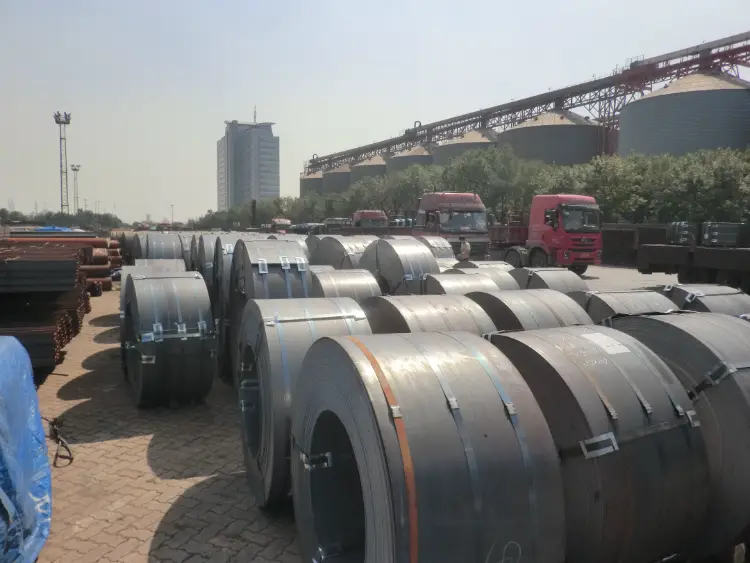
TB/T 1979 09CuPCrNi-B Weather Resistant Steel Coil
TB/T 1979 09CuPCrNi-B Weather Resistant Steel Coil - Composition, Properties & Equivalents
Complete data for 09CuPCrNi-B weather resistant steel coil specified by Chinese railway standard TB/T 1979, covering chemistry, mechanical & physical properties, and cross-reference equivalents.
Hot rolling, cold forming, welding, machining, cutting, punching
- Phone : +8618037372205
- Email : [email protected]
- WhatsApp: Contact via Whtsapp
- WeChat: +8618037372205
TB/T 1979 09CuPCrNi-B Weather Resistant Steel Coil Introduction
09CuPCrNi-B is a low-alloy atmospheric corrosion resistant steel (weathering steel) developed under Chinese standard TB/T 1979, primarily used for railway rolling stock and structural applications exposed to atmospheric conditions. The steel achieves its enhanced corrosion resistance through alloying with
- copper (Cu)
- chromium (Cr)
- nickel (Ni)
and controlled phosphorus content, forming a dense, adherent patina that reduces further corrosion. Compared to plain carbon steels, it offers approximately 2–4 times greater resistance to atmospheric corrosion, allowing unpainted usage in many environments. The grade is supplied as hot-rolled coil, sheet, or plate in thicknesses up to 20 mm, with guaranteed minimum yield strength of 295 MPa and tensile strength of 430 MPa. It also provides good toughness at low temperatures (down to -40°C) and satisfactory weldability with conventional methods. The material is widely adopted for railway wagons, containers, bridges, and architectural cladding, combining durability with cost effectiveness through reduced maintenance.
TB/T 1979 09CuPCrNi-B Weather Resistant Steel Coil Chemical Composition
The chemical composition according to TB/T 1979-2003 09CuPCrNi-B is tightly controlled to ensure consistent corrosion resistance and mechanical properties. Copper, chromium, and nickel are the key alloying elements that promote the formation of a protective oxide layer. Phosphorus and sulfur are kept at low levels to maintain toughness and weldability. Typical values shown below are for heat analysis; product analysis tolerances may apply per standard.
| Element | Standard Value (wt%) | Remarks |
|---|---|---|
| C (Carbon) | ≤0.12 | |
| Si (Silicon) | 0.17 – 0.37 | |
| Mn (Manganese) | 0.35 – 0.65 | |
| P (Phosphorus) | ≤0.030 | |
| S (Sulfur) | ≤0.030 | |
| Cu (Copper) | 0.25 – 0.45 | Key element for weathering resistance |
| Cr (Chromium) | 0.30 – 0.60 | Enhances patina formation |
| Ni (Nickel) | 0.25 – 0.50 | Improves toughness and corrosion resistance |
| Residual elements | Per standard limits | Sum of other elements not exceeding typical microalloying |
TB/T 1979 09CuPCrNi-B Weather Resistant Steel Coil Thermal and Electrical Physical Properties
The following physical property data are typical for low-alloy weathering steels of this class (approximate values at room temperature unless noted). They are suitable for engineering calculations such as thermal expansion, heat transfer, and electrical resistance. Actual values may vary slightly with processing and exact composition.
| Property | Typical Value | Unit | Test Condition / Temperature |
|---|---|---|---|
| Density (ρ) | 7.85 | g/cm³ | 20 °C |
| Modulus of elasticity (E) | 206 | GPa | Ambient |
| Shear modulus (G) | 79 | GPa | Calculated (E/2(1+ν)) |
| Poisson's ratio (ν) | 0.30 | — | Ambient |
| Thermal expansion coefficient (α) | 12.0 | 10⁻⁶ /K | 20–100 °C |
| Thermal expansion coefficient (α) | 12.8 | 10⁻⁶ /K | 20–200 °C |
| Thermal expansion coefficient (α) | 13.5 | 10⁻⁶ /K | 20–400 °C |
| Thermal conductivity (λ) | 50 | W/(m·K) | 20 °C |
| Specific heat capacity (cp) | 460 | J/(kg·K) | 20 °C |
| Electrical resistivity (ρ_e) | 0.22 | μΩ·m | 20 °C |
TB/T 1979 09CuPCrNi-B Weather Resistant Steel Coil Mechanical Properties
Mechanical properties are tested on transverse or longitudinal specimens according to TB/T 1979. Requirements vary with thickness. The steel provides a minimum yield strength of 295 MPa and tensile strength of 430 MPa, with good elongation and low-temperature impact toughness. For railway applications, -40°C Charpy V-notch impact energy is commonly specified (≥27 J for standard grades). Bend test is performed with the given bend diameter over a designated angle.
| Property | Required Value | Unit | Test Condition / Thickness |
|---|---|---|---|
| Yield Strength (ReH) | ≥295 | MPa | t ≤ 6 mm |
| Yield Strength (ReH) | ≥295 | MPa | 6 < t ≤ 16 mm |
| Yield Strength (ReH) | ≥295 | MPa | 16 < t ≤ 20 mm |
| Tensile Strength (Rm) | ≥430 | MPa | t ≤ 6 mm |
| Tensile Strength (Rm) | ≥430 | MPa | 6 < t ≤ 16 mm |
| Tensile Strength (Rm) | ≥430 | MPa | 16 < t ≤ 20 mm |
| Elongation (A) | ≥24 | % | t ≤ 6 mm, gauge 50 mm (or 200 mm) |
| Elongation (A) | ≥23 | % | 6 < t ≤ 16 mm |
| Elongation (A) | ≥22 | % | 16 < t ≤ 20 mm |
| Bend test (d = bend diameter, a = thickness) | d = 2a | t ≤ 6 mm, 180° bending | |
| Bend test | d = 3a | 6 < t ≤ 20 mm, 180° bending | |
| Impact energy (KV2) | ≥27 | J | -40 °C, longitudinal V-notch |
TB/T 1979 09CuPCrNi-B Weather Resistant Steel Coil Directly Equivalent Standards & Substitute Grades
| Country/Region | Standard | Grade | Remarks |
|---|---|---|---|
| China | GB/T 4171-2008 | Q295GNH (09CuPCrNi-B) | Identical chemical and mechanical requirements; 09CuPCrNi-B is the former designation under TB/T 1979. |
TB/T 1979 09CuPCrNi-B Weather Resistant Steel Coil Application Introduction
09CuPCrNi-B steel is designed for use in unpainted or minimally painted conditions in atmospheric environments where its natural patina provides long-term protection. Thanks to its good formability, weldability, and impact toughness at low temperatures, it is a preferred material in the transportation and construction sectors. Typical usage includes structural components exposed to weather, reducing life-cycle maintenance costs.
Product Applications: Railway freight car bodies (side walls, end walls, roofs), Corrugated container panels, Steel bridge decks and girders, Weathering steel facades and roofing sheets, Structural tubes and hollow sections for exposed structures
Processed into products: Railway wagon side sheets and floor plates, Container side rails and roof panels, Bridge bearing plates and expansion joints, Cold-formed purlins and girts for outdoor buildings, Bus and coach body frames, Guardrails and sign support structures
Application industries: Railway rolling stock manufacturing, Shipping container production, Bridge construction and rehabilitation, Architectural and building cladding, Industrial plant structures, Transmission and telecommunication towers
TB/T 1979 09CuPCrNi-B Weather Resistant Steel Coil Closely Related / Similar Weathering Steel Grades
| Country/Region | Standard | Grade | Remarks |
|---|---|---|---|
| Japan | JIS G3125 | SPA-H | Higher strength grade (yield ≈355 MPa, tensile ≈490 MPa); similar corrosion resistance concept; widely used in containers and structural parts. |
| Europe | EN 10025-5 | S355J0W (1.8959) / S355J2W | Higher strength (yield 355 MPa); similar atmospheric corrosion resistance; suitable for welded structures; not exact equivalent due to different mechanical requirements. |
| USA | ASTM A588 / A588M | Grade B | Yield ≥345 MPa; similar weathering characteristics; used in bridges and building structures; composition differs in P content. |
| China | GB/T 4171 | Q355GNH (09CuPCrNi-A) | Higher strength variant with yield 355 MPa; chemical adjustments for improved weather resistance; often used for heavier sections. |
Notes:
- The steel may be subjected to impact testing at -40°C for railway applications as agreed between purchaser and supplier.
- For welded structures, low heat input welding and appropriate consumables are recommended to avoid excessive grain growth and maintain corrosion resistance in the heat-affected zone.
- Atmospheric exposure test data indicate that the corrosion rate stabilises after 1–3 years of outdoor exposure, forming a tight patina that reduces further metal loss.
- Hardness is typically in the range of 140–180 HBW in the as-rolled condition.
- Surface finish options include pickled and oiled, shot-blasted, or as-rolled black.
- Share



