
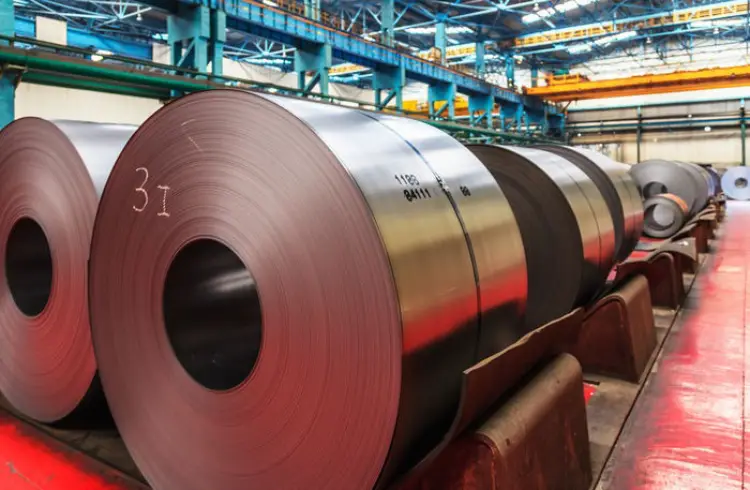
StE355 (DIN 17102) Weldable Fine Grain Structural Steel Coil
StE355 (DIN 17102) Weldable Fine Grain Structural Steel Coil - High-Strength, Normalized for Reliable Welding
Explore detailed material data for StE355 carbon and low-alloy high-strength steel coil according to DIN 17102, including chemical composition, mechanical properties, physical properties, international equivalents, and typical applications in construction, bridges, and heavy machinery.
hot forming, cold forming, welding (all common processes), bending, machining, drilling, normalizing
- Phone : +8618037372205
- Email : [email protected]
- WhatsApp: Contact via Whtsapp
- WeChat: +8618037372205
StE355 Weldable Fine Grain Structural Steel Coil Introduction
StE355, specified in the withdrawn German standard DIN 17102, is a weldable, normalized fine grain structural steel with minimum yield strength of 355 MPa. It belongs to the carbon and low-alloy high-strength steel family and was designed for excellent weldability combined with high toughness and good cold forming properties. The normalized delivery condition ensures a homogeneous and fine-grained microstructure, giving the material consistent mechanical properties across thicknesses up to approximately 100 mm. Typical applications include dynamically loaded steel structures, crane construction, bridges, pressure vessels, and offshore components where reliable notch toughness is essential. The grade is now commonly replaced by its direct successor in EN 10025-3, grade S355N (or S355NL for low-temperature toughness), but StE355 remains relevant in many stock specifications and rehabilitation projects. It offers good resistance to brittle fracture at low service temperatures when the appropriate quality (e.g., with impact test at -20 °C) is selected.
StE355 Weldable Fine Grain Structural Steel Coil Chemical Composition – Weight %
The chemical composition of StE355 is designed to achieve high strength and formability through controlled carbon content and manganese alloying, while aluminium is used for grain refinement.
- Carbon (C) is limited to ensure good weldability.
- Manganese (Mn) provides solid solution strengthening and improves notch toughness.
- Microalloying elements (Nb, V, Ti) may be added at the manufacturer's discretion to enhance strength, but the standard only specifies Al as a mandatory grain refiner.
- Maximum limits for phosphorous and sulphur guarantee clean steel suitable for critical applications.
All values are in weight percent according to DIN 17102, applicable for product thickness ≤ 100 mm.
| Element | Standard Value | Remarks |
|---|---|---|
| Carbon (C) | ≤ 0.20 | Heat analysis |
| Silicon (Si) | 0.10 – 0.50 | |
| Manganese (Mn) | 1.10 – 1.70 | |
| Phosphorus (P) | ≤ 0.035 | |
| Sulfur (S) | ≤ 0.030 | |
| Aluminium (Al) total | ≥ 0.020 | Grain refinement |
| Niobium (Nb)* | ≤ 0.05 | Optional microalloy |
| Vanadium (V)* | ≤ 0.05 | Optional microalloy |
| Titanium (Ti)* | ≤ 0.03 | Optional microalloy |
| Nitrogen (N) | ≤ 0.015 | Applies when microalloyed |
StE355 Weldable Fine Grain Structural Steel Coil Physical and Thermal Properties
The following physical properties are typical for low‑alloy structural steels in the normalised condition. Actual values can vary slightly with exact chemistry and heat treatment. These data are reliable for design calculations.
- All values are representative for StE355 and its EN successor S355N.
- Thermal conductivity and electrical resistivity decrease with increasing temperature, while specific heat capacity rises.
| Property | Standard Reference Value | Unit | Test Condition |
|---|---|---|---|
| Density (ρ) | ~ 7.85 | kg/dm³ (g/cm³) | 20 °C |
| Modulus of elasticity (E) | ~ 210 | GPa | 20 °C, tensile |
| Shear modulus (G) | ~ 81 | GPa | Calculated from E and ν |
| Poisson's ratio (ν) | ~ 0.3 | — | Elastic range |
| Thermal expansion coeff. (α) | ~ 11.7 | 10⁻⁶ /K | 20 – 100 °C, average |
| Thermal conductivity (λ) | ~ 52 | W/(m·K) | 20 °C |
| Specific heat capacity (cp) | ~ 470 | J/(kg·K) | 20 °C |
| Electrical resistivity (ρₑ) | ~ 0.22 | Ω·mm²/m | 20 °C |
StE355 Weldable Fine Grain Structural Steel Coil Mechanical Properties
Mechanical properties are determined in the normalised delivery condition on transverse test pieces (unless otherwise noted). The yield strength varies with plate thickness; the values below are guaranteed for coil/plate product forms.
- Impact energy (KV) is specified at -20 °C for quality class with guaranteed low-temperature toughness. Without quality suffix, standard impact test may be at +20 °C, but the commonly supplied variant matches the modern S355N requirement.
- Bend test is performed on folded specimens with the specified mandrel diameter without cracking.
| Property | Standard Requirement | Unit | Test Condition |
|---|---|---|---|
| Yield strength (ReH) | ≥ 355 | MPa | Thickness ≤ 16 mm |
| Yield strength (ReH) | ≥ 345 | MPa | Thickness > 16 ≤ 40 mm |
| Yield strength (ReH) | ≥ 335 | MPa | Thickness > 40 ≤ 63 mm |
| Yield strength (ReH) | ≥ 325 | MPa | Thickness > 63 ≤ 100 mm |
| Tensile strength (Rm) | 490 – 630 | MPa | Thickness ≤ 63 mm |
| Tensile strength (Rm) | 470 – 610 | MPa | Thickness > 63 ≤ 100 mm |
| Elongation (A5) | ≥ 22 | % | Gauge L0=5.65√S0, thickness ≤ 40 mm |
| Elongation (A5) | ≥ 21 | % | Thickness > 40 ≤ 100 mm |
| Impact energy (KV2) | ≥ 27 | J | Transverse, -20 °C (J2 quality) |
| Bend test (mandrel dia.) | 2t | t = thickness ≤ 16 mm, 180° end bend | |
| Bend test (mandrel dia.) | 3t | t > 16 ≤ 100 mm, 180° end bend |
StE355 Weldable Fine Grain Structural Steel Coil Exact Equivalent Standards & Substitutable Grades
| Country/Region | Standard | Grade | Remarks |
|---|---|---|---|
| Europe | EN 10025-3:2004 | S355N (1.0545) | Direct successor; normalized condition, KV -20°C ≥27 J |
| Europe | EN 10025-3 | S355NL (1.0546) | Low-temperature variant, KV -50°C ≥27 J |
| International | ISO 630-3 | Fe355D | Normalized fine grain steel |
| Germany (historical) | DIN 17100 | St52-3 | Different standard, similar strength but not fine grain treated |
StE355 Weldable Fine Grain Structural Steel Coil Application Introduction
StE355 is suited for welded structures subjected to static and dynamic loads, thanks to its combination of strength, good weldability, and guaranteed notch toughness.
- The normalized fine‑grained microstructure ensures uniform properties across thick sections and improves safety against brittle fracture.
- Typical use includes outdoor structures exposed to low ambient temperatures, provided the appropriate quality (impact tested at -20 °C) has been ordered.
Product Applications: Welded beams, columns and trusses, Bridge decks and structural plates, Crane booms and load-bearing frames, Offshore platform topsides, Boilermaking components, Vehicle frames and undercarriages, Storage tanks and silos
Processed into products: Flanges and webs of built-up girders, Lifting lugs and clevis joints, Rope drums and winch bases, Bogie frames for railway vehicles, Digger arms and excavator buckets, Pressure vessel shells (non-cryogenic), Welded sub-assemblies for heavy machinery
Application industries: Steel construction & civil engineering, Bridge building, Heavy machinery & crane manufacturing, Pressure vessel and tank fabrication (up to moderate temperatures), Offshore & marine engineering (with additional certification), Mining & earthmoving equipment, Transportation (railcar frames, truck chassis)
StE355 Weldable Fine Grain Structural Steel Coil Similar / Closest Alternative Grades
| Country/Region | Standard | Grade | Remarks |
|---|---|---|---|
| Europe | EN 10025-2 | S355J2 (+N) | Galvanized, non-fine grain; requires normalizing to approach StE355 |
| Europe | EN 10025-4 | S355M (TMCP) | Thermomechanically rolled, may replace StE355 in some applications |
| USA | ASTM A572 | Gr 50 | Similar yield & tensile, but no guaranteed fine grain or low-temp impact without supplement |
| China | GB/T 1591 | Q355D (N) | Normalized delivery, comparable toughness at -20 °C |
| Japan | JIS G 3106 | SM490B | Higher tensile range, not always normalised |
Notes:
DIN 17102 has been officially withdrawn since 1996 and superseded by the European standard EN 10025-3. When ordering new material, S355N (1.0545) should be specified. StE355 may still be found in existing stock or referenced in older design documentation. For welding, low-hydrogen procedures and preheating (depending on thickness) are recommended to prevent cold cracking. The steel is fully killed and aluminium‑treated, ensuring fine grain size. For thicknesses above 100 mm, special agreement on properties is required.
- Share



