
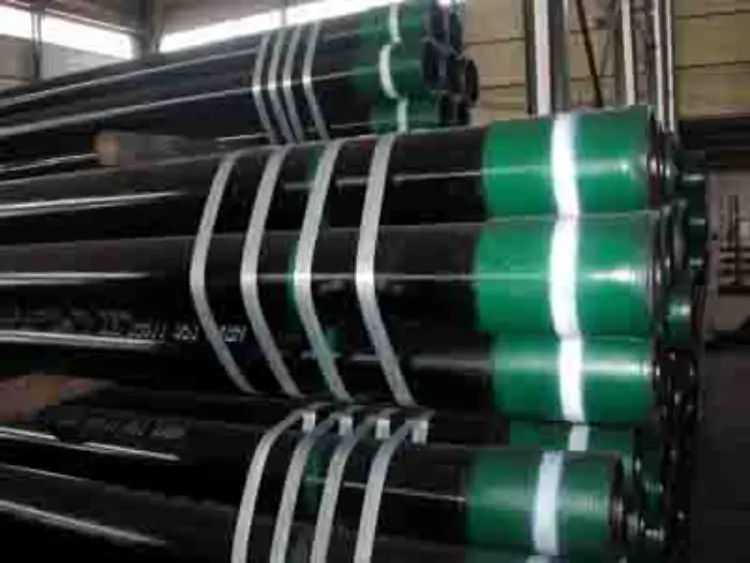
S355JR ERW Pipe
EN10025-2 S355JR ERW Pipe – High-Strength Structural Steel for Welded Tubular Applications
Comprehensive material data for S355JR steel used in electric resistance welded (ERW) pipes, including chemical composition, mechanical properties, physical characteristics, equivalent grades, and application guidance.
Electric Resistance Welding (ERW), cold forming, welding, cutting, machining, hot-dip galvanizing
- Phone : +8618037372205
- Email : [email protected]
- WhatsApp: Contact via Whtsapp
- WeChat: +8618037372205
S355JR ERW Pipe Introduction
S355JR is a hot-rolled, non-alloy structural steel grade defined by EN 10025-2, widely used for manufacturing Electric Resistance Welded (ERW) pipes. With a minimum yield strength of 355 MPa in the delivery condition, it offers an excellent balance of strength, ductility, and weldability.
- Typical carbon content is kept low to ensure good welding characteristics, while manganese provides solid solution strengthening.
- The "JR" designation indicates that the material guarantees minimum 27 J impact energy at +20°C (longitudinal), making it suitable for general structural applications where low-temperature toughness is not critical.
- As an ERW pipe substrate, S355JR is formed from hot-rolled strip and welded longitudinally, resulting in a cost-effective hollow section with uniform wall thickness, ideal for construction, machinery, and infrastructure projects.
S355JR ERW Pipe Chemical Composition
The composition limits for S355JR are specified in EN 10025-2:2019 for cast analysis. For ERW pipe applications, the composition of the steel strip must comply with these limits. The low carbon content ensures good weldability, while phosphorus and sulfur are strictly limited to maintain ductility and toughness. Nitrogen is controlled to avoid strain aging.
| Element | Value (max, %) | Remarks |
|---|---|---|
| Carbon (C) | 0.24 | Max. for t ≤ 40 mm; for t > 40 mm max. 0.24 as well, but check product analysis tolerance |
| Silicon (Si) | 0.55 | Max. – deoxidation element |
| Manganese (Mn) | 1.60 | Max. – strength and hardenability |
| Phosphorus (P) | 0.035 | Max. – residual element kept low for toughness |
| Sulfur (S) | 0.035 | Max. – low for good formability and weld quality |
| Nitrogen (N) | 0.012 | Max. – if sufficient aluminum is present, nitrogen is bound |
| Copper (Cu) | 0.55 | Max. – may be present from scrap; precaution against hot shortness |
| Others | - | No intentional additions of Nb, V, Ti etc. Microalloying not required for JR grade. |
S355JR ERW Pipe Thermal and Electrical Physical Properties
Physical properties are not mandated by EN 10025-2 but are essential for design calculations. The values below are typical reference data for carbon-manganese structural steels at room temperature and for temperature-dependent properties. Data can vary slightly with exact composition and processing.
| Property | Typical Value | Unit | Test Condition |
|---|---|---|---|
| Density (ρ) | 7850 | kg/m³ | at 20 °C |
| Young's modulus (E) | 210 × 10³ | MPa | at 20 °C |
| Shear modulus (G) | 81 × 10³ | MPa | at 20 °C |
| Poisson's ratio (ν) | 0.3 | - | elastic range |
| Thermal expansion coefficient (α) | 12 × 10⁻⁰ | /K | 20 - 100 °C |
| Thermal expansion coefficient (α) | 13 × 10⁻⁰ | /K | 20 - 200 °C |
| Thermal expansion coefficient (α) | 14 × 10⁻⁰ | /K | 20 - 400 °C |
| Thermal conductivity (λ) | 50 | W/(m⋅K) | at 20 °C |
| Specific heat capacity (cp) | 460 | J/(kg⋅K) | at 20 °C |
| Electrical resistivity (ρe) | 0.18 | Ω⋅mm²/m | at 20 °C |
S355JR ERW Pipe Mechanical Properties
The mechanical properties for S355JR are dependent on product thickness. The following values are minimum requirements for flat products according to EN 10025-2:2019. For ERW pipes, the relevant technical delivery conditions (e.g., EN 10219-1) may require adjustment for the welded zone. Values refer to longitudinal direction, except impact which is specified in longitudinal (V-notch).
| Property | Value | Unit | Test Condition / Thickness Range |
|---|---|---|---|
| Yield strength (ReH) | 355 min. | MPa | t ≤ 16 mm |
| Yield strength (ReH) | 345 min. | MPa | 16 mm < t ≤ 40 mm |
| Yield strength (ReH) | 335 min. | MPa | 40 mm < t ≤ 63 mm |
| Yield strength (ReH) | 325 min. | MPa | 63 mm < t ≤ 80 mm |
| Yield strength (ReH) | 315 min. | MPa | 80 mm < t ≤ 100 mm |
| Yield strength (ReH) | 295 min. | MPa | 100 mm < t ≤ 150 mm |
| Yield strength (ReH) | 285 min. | MPa | 150 mm < t ≤ 200 mm |
| Yield strength (ReH) | 275 min. | MPa | 200 mm < t ≤ 250 mm |
| Tensile strength (Rm) | 470 - 630 | MPa | t ≤ 100 mm |
| Tensile strength (Rm) | 450 - 600 | MPa | 100 mm < t ≤ 250 mm |
| Elongation after fracture (A) | 22 min. | % | t ≤ 16 mm, longitudinal, gauge length 5.65√So |
| Elongation after fracture (A) | 22 min. | % | 16 mm < t ≤ 40 mm |
| Elongation after fracture (A) | 21 min. | % | 40 mm < t ≤ 63 mm |
| Elongation after fracture (A) | 20 min. | % | 63 mm < t ≤ 100 mm |
| Elongation after fracture (A) | 18 min. | % | 100 mm < t ≤ 150 mm |
| Elongation after fracture (A) | 17 min. | % | 150 mm < t ≤ 200 mm |
| Elongation after fracture (A) | 17 min. | % | 200 mm < t ≤ 250 mm |
| Impact energy (KV2) | 27 min. | J | +20 °C, longitudinal, 10×10 mm test piece |
| Bend test | No cracks | - | Mandrel diameter: 2.0×t (for t ≤ 16 mm), 3.0×t (for t > 16 mm); 180° bend |
S355JR ERW Pipe Fully Equivalent Material Standards and Substitute Grades
| Country / Region | Standard | Grade | Remarks |
|---|---|---|---|
| Europe | EN 10025-2 | S355JR | Identical base specification |
| International | ISO 630-2 | S355JR | Identical technical content |
| United Kingdom | BS EN 10025-2 | S355JR | Direct adoption of EN |
| China | GB/T 1591 | Q345B | Comparable, but Q345B may have slightly wider composition range; minimum yield 345 MPa at t≤16mm |
| USA | ASTM A572/A572M | Grade 50 [345] | Equivalent strength level, yield 345 MPa; JR-impact at +20°C not always required unless specified |
| Japan | JIS G3106 | SM490A | Tensile 490-610 MPa, yield >325 MPa (t≤16mm), good weldability; close substitute |
| India | IS 2062 | E350 BR | Hot-rolled medium and high tensile structural steel; yield 350 MPa, similar carbon-equivalent concept |
S355JR ERW Pipe Application Introduction
S355JR ERW pipes are used extensively in structural engineering, general fabrication, and infrastructure projects. The combination of high strength, easy weldability, and dimensional accuracy makes them a preferred choice for:
- Construction: columns, beams, trusses, space frames, and architectural hollow sections.
- Infrastructure: bridge members, highway guardrails, lighting poles, and transmission towers.
- Industrial: machine supports, storage racks, conveyor frames, and hydraulic cylinders.
- Transport: chassis components, trailer frames, and agricultural equipment.
The ERW process ensures tight tolerances and a smooth surface finish, enabling direct use without further machining. For outdoor exposure, hot-dip galvanizing is commonly applied.
Product Applications: Welded structural hollow sections (round, square, rectangular), Scaffolding tubes and couplers, Bridge piers and girders, Road safety barriers (guardrails), Telecommunication towers and poles, Prefabricated steel buildings
Processed into products: ERW pipes as columns, struts, and bracings, Chassis members for trailers and truck bodies, Hollow axles and sleeves, Frames for agricultural implements (ploughs, harrows), Racks and shelving uprights, Handrail and balustrade posts
Application industries: Construction & Civil Engineering, Mechanical & General Fabrication, Automotive & Transportation, Agricultural Machinery, Energy & Transmission Structures, Furniture & Storage Systems
S355JR ERW Pipe Closely Related / Similar Structural Steel Alternatives
| Standard | Grade | Key Difference | Remarks |
|---|---|---|---|
| EN 10025-2 | S355J0 | Impact at 0 °C instead of +20 °C | Slightly better low-temperature toughness, otherwise identical to S355JR |
| EN 10025-2 | S355J2 | Impact at -20 °C | Improved cold weather performance; often used for exposed structures |
| EN 10025-2 | S355K2 | Impact at -20 °C (min 40 J) | Superior toughness grade; also controls carbon equivalent for welding |
| EN 10025-2 | S275JR | Lower yield strength, 275 MPa min. | Suitable for less demanding applications, weights may increase |
| ASTM A572 | Grade 42 [290] | Lower strength, yield 290 MPa | Alternative when strength overdesign is acceptable |
| GB/T 1591 | Q345C / Q345D | Lower Charpy transition temperatures | Chinese grades offering better toughness; Q345D at -20°C matches S355J2 |
Notes:
Welding considerations: S355JR is readily weldable by all common methods (MIG/MAG, MMA, TIG, submerged arc). Preheating is generally not required for thicknesses below 30 mm when using low-hydrogen procedures. For ERW pipe production, the strip edges are heated by electric resistance and forged together, resulting in a solid-state bond. Post-weld stress relief may improve toughness in the heat-affected zone.
Dimensional standards: Finished ERW pipes for structural use often conform to EN 10219-1 (cold-formed) or EN 10210-1 (hot-finished). The referenced steel grade remains S355JR from EN 10025-2.
Surface protection: For outdoor applications, hot-dip galvanizing to EN ISO 1461 is recommended. S355JR with silicon content below 0.04% may require special procedures to obtain uniform zinc coating.
- Share



