
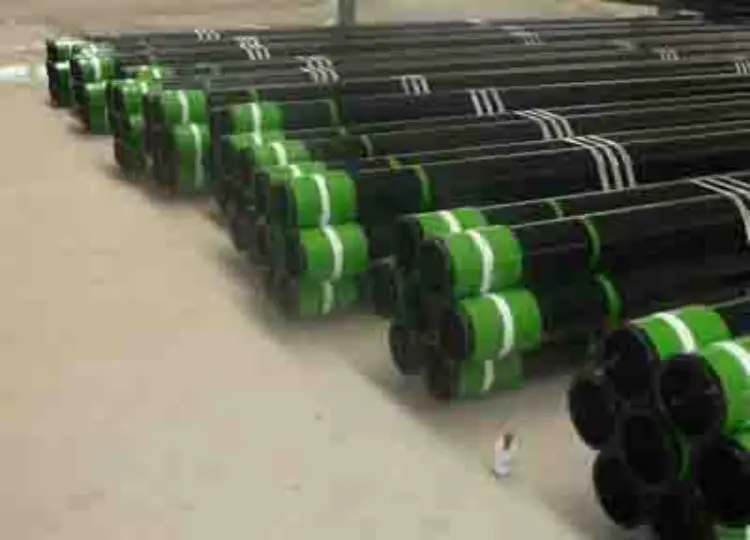
S355J0 Low Carbon Structural Steel for ERW Pipes
S355J0 Low Carbon Structural Steel for ERW Pipes - EN 10025-2 Grade Analysis & Equivalents
Comprehensive material data for S355J0 structural steel according to EN 10025-2, commonly used for ERW pipes. Includes chemical composition, mechanical and thermal properties, international equivalents, and application guidance.
Welding (ERW), hot rolling, cold forming, bending, cutting, machining
- Phone : +8618037372205
- Email : [email protected]
- WhatsApp: Contact via Whtsapp
- WeChat: +8618037372205
S355J0 Low Carbon Structural Steel for ERW Pipes Introduction
S355J0 is a non-alloy structural steel grade specified in EN 10025-2, designed for hot-rolled products such as plates, sections, and flats. It features a minimum yield strength of 355 MPa at ambient temperature, with guaranteed impact toughness at 0 °C (27 J). When formed into ERW (Electric Resistance Welded) pipes, the material retains excellent weldability, good formability, and reliable mechanical performance, making it suitable for structural hollow sections, pipelines, and general engineering applications. The grade is widely used across Europe and is comparable to ASTM A572 Gr. 50 and ISO S355D equivalents. Its balanced chemistry offers a cost-effective solution for load-bearing structures without requiring special heat treatment.
S355J0 Low Carbon Structural Steel for ERW Pipes Chemical Composition as per EN 10025-2
The chemical composition of S355J0 is controlled to ensure good weldability and mechanical properties. Maximum limits are specified for elements like carbon, phosphorus, and sulfur to maintain toughness. For ERW pipe production, the composition often matches the raw strip steel.
- C capped at 0.20% to avoid hardening during welding.
- Mn up to 1.60% provides strength without sacrificing ductility.
- Low impurity levels (P, S) ensure cleanliness and impact toughness at 0 °C.
| Element | Max Value (%) | Remarks |
|---|---|---|
| Carbon (C) | 0.20 | Ladle analysis; for product analysis +0.02 |
| Silicon (Si) | 0.55 | |
| Manganese (Mn) | 1.60 | Higher Mn may be permitted for thicker sections |
| Phosphorus (P) | 0.035 | Maintains toughness |
| Sulfur (S) | 0.035 | Low for good weldability |
| Copper (Cu) | 0.55 | If copper content exceeds 0.40%, hot shortness may occur |
| Nitrogen (N) | 0.012 | Max; for products greater than 150 mm thickness, consult manufacturer |
| Aluminium (Al) (optional) | ≥ 0.020 | Sufficient to guarantee fine grain practice if not stated |
| Other elements (Cr, Ni, Mo, etc.) | See standard | Not intentionally added, residuals ≤ 0.30 Cr, ≤ 0.30 Ni, ≤ 0.10 Mo, ≤ 0.05 V, etc. |
S355J0 Low Carbon Structural Steel for ERW Pipes Thermal and Electrical Physical Properties
These values are representative for low-alloy structural steel at room temperature unless otherwise noted. They are not specified in EN 10025-2 but are useful for design. Variations may occur depending on exact composition and processing.
- Density is standard for steel.
- Young's modulus is temperature-dependent; the value at 20 °C is given.
- Thermal expansion and thermal conductivity are typical for carbon-manganese steels.
- Electrical resistivity can vary with heat treatment.
| Property | Standard Value | Unit | Test Conditions |
|---|---|---|---|
| Density (ρ) | 7850 | kg/m³ | At 20 °C |
| Modulus of elasticity (E) | 210 | GPa | Longitudinal, 20 °C |
| Shear modulus (G) | approx. 81 | GPa | Calculated from E and ν |
| Poisson's ratio (ν) | 0.3 | — | At ambient temperature |
| Thermal expansion coefficient (α) | 11.1 × 10⁻⁶ | K⁻¹ | 20 – 100 °C |
| Thermal expansion coefficient (α) | 12.5 × 10⁻⁶ | K⁻¹ | 20 – 200 °C |
| Thermal expansion coefficient (α) | 13.2 × 10⁻⁶ | K⁻¹ | 20 – 300 °C |
| Thermal conductivity (λ) | 53 | W/(m·K) | At 20 °C |
| Thermal conductivity (λ) | 48 | W/(m·K) | At 200 °C |
| Specific heat capacity (cp) | 470 | J/(kg·K) | At 20 °C |
| Electrical resistivity (ρ_e) | 0.16 – 0.20 | μΩ·m | At 20 °C, annealed |
S355J0 Low Carbon Structural Steel for ERW Pipes Mechanical Properties – S355J0 to EN 10025-2
Mechanical properties depend on product thickness. For ERW pipes, properties may be influenced by the forming and welding process; data below refers to the parent plate/strip. Yield strength decreases with thickness. Tensile strength remains within the range 470–630 MPa for most thicknesses. Elongation is measured on gauge length 5.65√S₀ (L₀ = 5.65√S₀). Impact energy is verified at 0 °C (J0). Bendability is assessed by a mandrel test with a diameter related to thickness.
| Property | Standard Value | Unit | Test Conditions |
|---|---|---|---|
| Yield Strength (ReH) | ≥ 355 | MPa | Nominal thickness ≤ 16 mm |
| Yield Strength (ReH) | ≥ 345 | MPa | 16 < t ≤ 40 mm |
| Yield Strength (ReH) | ≥ 335 | MPa | 40 < t ≤ 63 mm |
| Yield Strength (ReH) | ≥ 325 | MPa | 63 < t ≤ 80 mm |
| Yield Strength (ReH) | ≥ 315 | MPa | 80 < t ≤ 100 mm |
| Yield Strength (ReH) | ≥ 295 | MPa | 100 < t ≤ 150 mm |
| Yield Strength (ReH) | ≥ 285 | MPa | 150 < t ≤ 200 mm |
| Yield Strength (ReH) | ≥ 275 | MPa | 200 < t ≤ 250 mm |
| Tensile Strength (Rm) | 470 – 630 | MPa | t ≤ 100 mm |
| Tensile Strength (Rm) | 450 – 600 | MPa | 100 < t ≤ 250 mm |
| Elongation after fracture (A) | ≥ 22 | % | t ≤ 40 mm, longitudinal, L₀ = 5.65√S₀ |
| Elongation after fracture (A) | ≥ 21 | % | 40 < t ≤ 63 mm, longitudinal |
| Elongation after fracture (A) | ≥ 20 | % | 63 < t ≤ 100 mm, longitudinal |
| Elongation after fracture (A) | ≥ 19 | % | 100 < t ≤ 150 mm, longitudinal |
| Impact energy (KV) | ≥ 27 | J | 0 °C, longitudinal, V-notch, average of 3 specimens, min. individual 18 J |
| Bend test (mandrel diameter) | d = 2a | — | t ≤ 16 mm, 180° bend, a = specimen thickness |
| Bend test (mandrel diameter) | d = 3a | — | 16 < t ≤ 100 mm |
| Hardness (Brinell) | approx. 130 – 170 | HBW | Typical for as-rolled condition, not mandatory |
S355J0 Low Carbon Structural Steel for ERW Pipes Completely Equivalent Material Standards and Grade Substitutions
| Country/Region | Standard | Grade | Remarks |
|---|---|---|---|
| Europe | EN 10219-1 | S355J0H | Cold-formed welded structural hollow sections; direct equivalent for ERW pipes |
| Europe | EN 10210-1 | S355J0H | Hot-finished structural hollow sections |
| International | ISO 630-2 | S355D | Technical delivery conditions for structural steels; similar impact test at 0 °C |
| USA | ASTM A572 | Grade 50 | High-strength low-alloy structural steel; typical substitution, yield 345 MPa (50 ksi) |
| China | GB/T 1591 | Q355D | Closest Chinese grade with 0 °C impact requirement; yield 355 MPa |
| Japan | JIS G3106 | SM490A | Welded structural steel; yield ≥ 325 MPa, tensile 490–610 MPa, may need additional verification for impact |
S355J0 Low Carbon Structural Steel for ERW Pipes Application Introduction
S355J0 ERW pipes are extensively used in construction and mechanical engineering where a balance of strength, weldability, and cost is required.
- Structural hollow sections – rectangular, square, and circular tubes for buildings, bridges, and towers.
- Water and gas pipelines – low pressure, non-sour service.
- Fencing, railings, and scaffolding – due to good surface finish and moderate corrosion resistance after galvanizing.
- Mechanical parts – where machining and welding are the primary fabrication methods.
Product Applications: Structural frames of commercial buildings, Bridge girders and trusses, Telecommunication towers, Water well casings, Piling pipes, Scaffolding tubes, Conveyor rollers, Sign masts and lighting columns
Processed into products: Welded hollow sections (square/rectangular/round), Pipe elbows and tees, Bolted connections and brackets, Cut and machined rings, flanges, and sleeves, Formed profiles (e.g., C-channels, Z-purlins, when strip is further processed), Welded assemblies and subframes
Application industries: Civil and structural engineering, Building and construction, Oil and gas (low-pressure transmission), Automotive (chassis, bodies), Agricultural machinery, Shipbuilding (secondary structures), Mining and conveying
S355J0 Low Carbon Structural Steel for ERW Pipes Similar/Alternative Materials for Consideration
| Country/Region | Standard | Grade | Remarks |
|---|---|---|---|
| Europe | EN 10025-2 | S355J2 | Same strength but guaranteed impact at -20 °C instead of 0 °C; better toughness |
| Europe | EN 10025-2 | S355JR | Impact test at +20 °C only; lower toughness, sometimes used in less critical applications |
| Europe | EN 10025-2 | S355K2 | Higher toughness at -20 °C with stricter chemistry limits |
| Europe | EN 10025-2 | S275J0 | Lower strength (275 MPa yield), similar 0 °C impact; alternative when strength requirements are lower |
| USA | ASTM A709 | Grade 50 | Structural steel for bridges; similar strength, but classification may differ |
| Russia | GOST 27772 | C355 | Rolled structural steel equivalent |
Notes:
- S355J0 ERW pipes may be supplied with a mill test certificate according to EN 10204 Type 2.2 or 3.1, confirming chemical analysis and mechanical properties.
- For welded pressure applications, alternative standards like EN 10217-2 (P355NL1 etc.) might be more appropriate; confirm suitability with service conditions.
- When galvanizing is required, avoid high silicon content to ensure coating quality.
- Some fabricators apply a normalizing treatment to the pipe after welding to restore properties in the heat-affected zone.
- Share



