
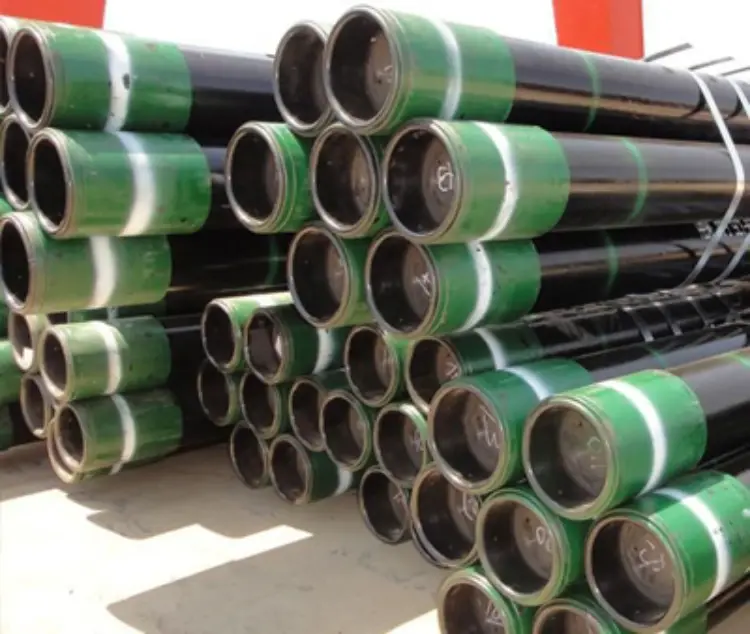
EN10025-2 S275J2 ERW Pipe
EN10025-2 S275J2 ERW Pipe: High-Toughness Structural Steel for Welded Hollow Sections
Comprehensive material data for EN10025-2 S275J2 steel used in electric resistance welded (ERW) pipes, including chemical composition, mechanical and physical properties, equivalent grades, and application guidance.
Resistance welding (ERW), cold forming, welding, machining, hot-dip galvanizing
- Phone : +8618037372205
- Email : [email protected]
- WhatsApp: Contact via Whtsapp
- WeChat: +8618037372205
EN10025-2 S275J2 ERW Pipe Introduction
S275J2 is a non-alloy structural steel grade defined in EN 10025-2, designed for hot-rolled products with guaranteed impact energy at -20 °C (J2 designation). When manufactured into ERW pipes, it is typically supplied according to EN 10219-1 (cold-formed welded structural hollow sections) under the grade S275J2H or as a custom product made from S275J2 strip/plate. The steel offers a minimum yield strength of 275 MPa for thicknesses ≤ 16 mm, excellent weldability, and good formability. It is widely used in structural applications where moderate strength and reliable low-temperature notch toughness are required. The J2 quality ensures 27 Joules minimum Charpy impact energy at -20 °C, making it suitable for outdoor structures in cold climates.
EN10025-2 S275J2 ERW Pipe Chemical Composition
The chemical composition of S275J2 is specified in EN 10025-2. Maximum limits apply unless a range is indicated. For thicknesses > 100 mm, carbon equivalent (CEV) may be higher. Elements marked with (*) are optional or influence grain refinement. The composition ensures good weldability with a typical CEV below 0.40.
| Chemical Element | Standard Value (≤ unless stated) | Remarks |
|---|---|---|
| Carbon (C) | ≤ 0.20% | For thickness > 100 mm, ≤ 0.22% |
| Silicon (Si) | ≤ 0.55% | |
| Manganese (Mn) | ≤ 1.50% | For thickness > 100 mm, ≤ 1.60% |
| Phosphorus (P) | ≤ 0.025% | |
| Sulfur (S) | ≤ 0.025% | |
| Copper (Cu) | ≤ 0.55% | |
| Nitrogen (N) | ≤ 0.012% | For fine-grain steels, Al or other grain-refining elements may be added |
| Aluminum (Al) total | ≥ 0.020% (if specified) | Grain refinement to achieve J2; alternatively other N-binding elements may be used |
| Chromium (Cr) | ≤ 0.30% | Residual element, not deliberately added |
| Nickel (Ni) | ≤ 0.30% | Residual element |
| Molybdenum (Mo) | ≤ 0.10% | Residual element |
| Carbon Equivalent (CEV) | ≤ 0.40% (typical) | Based on ladle analysis, for thickness ≤ 30 mm |
EN10025-2 S275J2 ERW Pipe Thermal and Electrical Physical Properties
The physical properties are typical for non-alloy structural steels and are not mandatory in EN 10025-2. They are provided for design calculations. Values may vary slightly depending on exact composition and heat treatment. Density and modulus are referenced at room temperature. Thermal properties are for temperatures near 20 °C unless stated otherwise.
| Property | Typical Value | Unit | Test Condition / Remarks |
|---|---|---|---|
| Density (ρ) | 7850 | kg/m³ | At 20 °C |
| Modulus of Elasticity (E) | 210 | GPa | At 20 °C |
| Shear Modulus (G) | 81 | GPa | At 20 °C |
| Poisson's Ratio (ν) | 0.30 | — | At 20 °C |
| Thermal Expansion Coefficient (α) | 12.0 × 10⁻⁶ | K⁻¹ | Between 20 °C and 100 °C |
| Thermal Expansion Coefficient (α) | 12.5 × 10⁻⁶ | K⁻¹ | Between 20 °C and 200 °C |
| Thermal Expansion Coefficient (α) | 13.0 × 10⁻⁶ | K⁻¹ | Between 20 °C and 300 °C |
| Thermal Conductivity (λ) | 53 | W/(m·K) | At 20 °C |
| Specific Heat Capacity (cp) | 460 | J/(kg·K) | At 20 °C |
| Electrical Resistivity (ρe) | 0.15 × 10⁻⁶ | Ω·m | At 20 °C |
EN10025-2 S275J2 ERW Pipe Mechanical Properties
The mechanical properties are valid for the base material before forming into ERW pipe. After cold forming, the properties may change. For ERW pipes conforming to EN 10219-1, the strength values for S275J2H are essentially the same, but ductility and impact values may be adjusted. The following values are according to EN 10025-2 for a hot-rolled condition. Impact testing is at -20 °C (longitudinal specimens for J2).
| Property | Standard Requirement | Unit | Test Condition / Thickness Range |
|---|---|---|---|
| Yield Strength (ReH) min. | 275 | MPa | t ≤ 16 mm |
| Yield Strength (ReH) min. | 265 | MPa | 16 < t ≤ 40 mm |
| Yield Strength (ReH) min. | 255 | MPa | 40 < t ≤ 63 mm |
| Yield Strength (ReH) min. | 245 | MPa | 63 < t ≤ 80 mm |
| Tensile Strength (Rm) | 410 – 560 | MPa | t ≤ 3 mm |
| Tensile Strength (Rm) | 410 – 560 | MPa | 3 < t ≤ 100 mm |
| Tensile Strength (Rm) | 400 – 540 | MPa | 100 < t ≤ 150 mm |
| Elongation (A) min. | 23% | % | Longitudinal, t ≤ 3 mm, L0 = 80 mm |
| Elongation (A) min. | 23% | % | Longitudinal, 3 < t ≤ 40 mm, L0 = 5.65√S0 |
| Elongation (A) min. | 22% | % | Longitudinal, 40 < t ≤ 63 mm |
| Elongation (A) min. | 21% | % | Longitudinal, 63 < t ≤ 100 mm |
| Charpy Impact Energy (KV2) min. | 27 | J | -20 °C, longitudinal |
| Bend Test (Mandrel Diameter) | 0.5a | — | t ≤ 16 mm, 180° bend, a = specimen thickness |
| Bend Test (Mandrel Diameter) | 1.0a | — | 16 < t ≤ 100 mm, 180° bend |
EN10025-2 S275J2 ERW Pipe Fully Equivalent Material Standards and Replaceable Grades
| Country/Region | Standard | Grade | Remarks |
|---|---|---|---|
| European Union | EN 10025-2:2004 | S275J2 | Base specification for structural steel |
| European Union (pipe) | EN 10219-1:2006 | S275J2H | For cold-formed welded structural hollow sections (ERW); identical chemical and mechanical base |
| International | ISO 630-2:2011 | S275J2 | International standard, identical properties |
| United Kingdom | BS EN 10025-2:2019 | S275J2 | British adoption of EN standard |
| Germany | DIN EN 10025-2:2019 | S275J2 | German adoption |
| France | NF EN 10025-2:2019 | S275J2 | French adoption |
| Italy | UNI EN 10025-2:2019 | S275J2 | Italian adoption |
| Spain | UNE EN 10025-2:2006 | S275J2 | Spanish adoption |
EN10025-2 S275J2 ERW Pipe Application Introduction
S275J2 ERW pipes combine moderate strength, good ductility, and excellent low-temperature impact resistance, making them ideal for structural frameworks subjected to dynamic loads and cold environments. The J2 quality ensures safety against brittle fracture in construction, offshore, and mechanical engineering. Typical ERW pipe dimensions range from 21.3 mm to 610 mm outside diameter and wall thickness up to 16 mm. The steel can be hot-dip galvanized without compromising toughness.
Product Applications: Structural hollow sections (circular, square, rectangular), ERW line pipes for low-pressure fluid transport, Scaffolding and temporary structures, Piling and foundation tubes, Furniture and storage rack systems
Processed into products: Steel frame joints and brackets, Welded lattice girders and space frames, Mechanical tubes for hydraulic cylinders (after honing), Conveyor rollers and idlers, Heat exchanger shells (when corrosion is not critical), Solar mounting structures and purlins
Application industries: Building and construction (columns, beams, trusses), Civil infrastructure (bridges, stadiums, towers), Offshore and marine engineering (platform substructures, piping supports), Automotive and transportation (chassis, roll cages, crane booms), Agricultural and forestry equipment, Machine building and mechanical engineering, Renewable energy (wind turbine towers, solar tracker supports)
EN10025-2 S275J2 ERW Pipe Near/Similar Substitute Materials Recommendation
| Country/Region | Standard | Grade | Remarks |
|---|---|---|---|
| European Union | EN 10025-2 | S275JR | Higher impact test temperature (20 °C). Lower toughness but otherwise similar composition. |
| European Union | EN 10025-2 | S275J0 | Impact test at 0 °C. Slightly lower toughness than J2. |
| European Union | EN 10025-4 | S275ML | Thermomechanically rolled, comparable strength and -50 °C impact toughness. |
| USA | ASTM A36/A36M | A36 | Comparable strength but without guaranteed low-temperature impact. May be dual certified. |
| USA | ASTM A572/A572M | Grade 50 | Higher yield (345 MPa), but similar weldability; Charpy test can be ordered. |
| Japan | JIS G3101 | SS400 | Similar tensile range, but no mandatory impact requirement. Not an exact substitute. |
| China | GB/T 700 | Q275B | Comparable strength with 20 °C impact test; not directly equivalent to J2. |
| International (pipe) | EN 10219-1 | S275J0H | Cold-formed hollow section with 0 °C impact; often acceptable when J2 not required. |
Notes:
ERW pipe specifics: When formed into ERW pipes, the S275J2 base material may experience a slight increase in yield strength and reduction in elongation due to cold working. The finished pipe is normally supplied according to EN 10219-1 as grade S275J2H, which requires Charpy impact at -20 °C on the parent metal and optionally on the weld zone. If the pipe is hot-finished, EN 10210 grade S275J2H applies. For welded pipes used in pressure applications, other standards such as EN 10217-1 may apply. Always confirm the exact delivery condition and supplementary requirements (e.g., weld seam heat treatment) with the manufacturer. The CEV limit of 0.40% ensures good weldability without preheat for thicknesses up to 30 mm in most conditions. The grain-refining elements (Al, Nb, V, Ti) are used to meet the J2 toughness, but their individual presence must be agreed upon if specified.
- Share



