
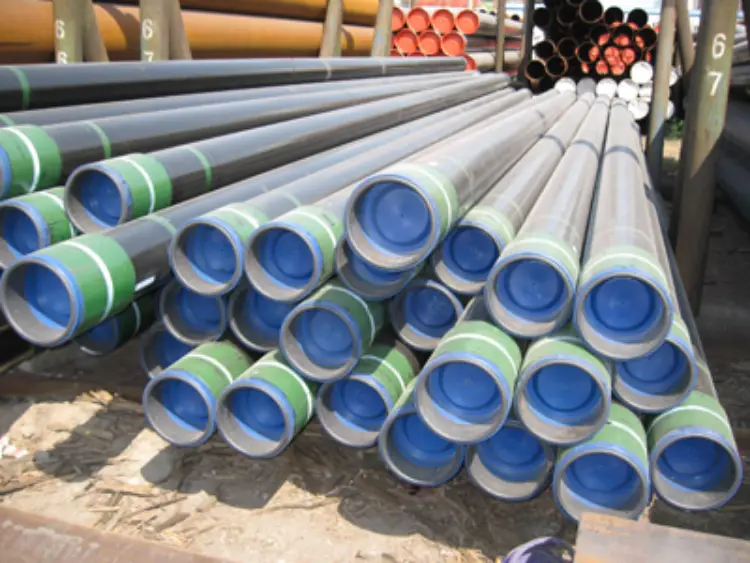
S275J0 EN 10025-2 ERW Pipe Steel
EN10025-2 S275J0 ERW Pipe: Hot-Rolled Structural Steel Hollow Section for Welded Construction
Comprehensive data for S275J0 steel grade manufactured into ERW pipes per EN 10025-2, including chemical composition, mechanical properties, physical performance, and global equivalent materials for structural applications.
Hot rolling of base steel, followed by cold forming and ERW welding; suitable for subsequent cold bending, cutting, and machining
- Phone : +8618037372205
- Email : [email protected]
- WhatsApp: Contact via Whtsapp
- WeChat: +8618037372205
S275J0 EN 10025-2 ERW Pipe Steel Introduction
S275J0 is a non-alloy structural steel grade specified in EN 10025-2, widely used for electric resistance welded (ERW) pipes and hollow sections in general construction and mechanical engineering. It offers a minimum yield strength of 275 MPa and guaranteed impact energy of 27 J at 0 °C (J0 quality). The steel is suitable for welding and cold forming, typically delivered in the as-rolled or normalized condition. ERW pipes made from S275J0 comply with EN 10219-1 or EN 10210-1 and are available in circular, square, and rectangular profiles. This material provides a good balance of strength, ductility, and weldability, making it ideal for load-bearing structures, frameworks, and mechanical components exposed to moderate low-temperature service.
S275J0 EN 10025-2 ERW Pipe Steel Chemical Composition
Ladle analysis according to EN 10025-2:2019, Table 2 for grade S275J0. Values are maximum unless stated otherwise. Silicon is typically present as a deoxidizer. The carbon equivalent value (CEV) ensures good weldability.
| Element | Content (%) | Remarks |
|---|---|---|
| Carbon (C) | ≤0.20 | Ladle analysis |
| Silicon (Si) | ≤0.55 | Typically present; no mandatory max, but usual limit |
| Manganese (Mn) | ≤1.50 | |
| Phosphorus (P) | ≤0.030 | |
| Sulfur (S) | ≤0.030 | |
| Nitrogen (N) | ≤0.012 | |
| Copper (Cu) | ≤0.55 | |
| Carbon Equivalent Value (CEV) | ≤0.40 | CEV = C + Mn/6 + (Cr+Mo+V)/5 + (Ni+Cu)/15 |
S275J0 EN 10025-2 ERW Pipe Steel Thermal and Electrical Physical Properties
Room-temperature physical properties for non-alloy structural steel, representative of S275J0 grade. These values are derived from general structural steel data and may vary slightly with exact composition and processing history.
| Property | Typical Value | Unit | Test Condition |
|---|---|---|---|
| Density (ρ) | 7850 | kg/m³ | at 20 °C |
| Modulus of elasticity (E) | 205 | GPa | at 20 °C |
| Shear modulus (G) | 80 | GPa | at 20 °C |
| Poisson's ratio (ν) | 0.3 | – | at 20 °C |
| Thermal expansion coefficient (α) | 11.7 ×10⁻⁶ | /K | 20–100 °C |
| Thermal conductivity (λ) | 52 | W/(m·K) | at 20 °C |
| Specific heat capacity | 486 | J/(kg·K) | at 20 °C |
| Electrical resistivity (ρ_e) | 0.18 ×10⁻⁶ | Ω·m | at 20 °C |
S275J0 EN 10025-2 ERW Pipe Steel Mechanical Properties
Minimum values for S275J0 steel according to EN 10025-2:2019, valid for thickness ≤16 mm (most common for ERW pipe wall thicknesses). The J0 designation requires minimum 27 J absorbed energy at 0 °C on longitudinal Charpy V-notch specimens. For thicknesses above 16 mm, please refer to the standard for adjusted values.
| Property | Standard Requirement | Unit | Test Condition |
|---|---|---|---|
| Yield strength (ReH) | ≥275 | MPa | t ≤16 mm, transverse test optional for pipes |
| Tensile strength (Rm) | 430 – 580 | MPa | t ≤16 mm |
| Elongation after fracture (A) | ≥18 | % | Longitudinal, proportional test piece, t ≤40 mm |
| Charpy V-notch impact energy (KV) | ≥27 | J | at 0 °C, longitudinal, standard specimen |
S275J0 EN 10025-2 ERW Pipe Steel Complete Equivalent Material Standards and Substitutable Grades
| Country/Region | Standard | Grade | Remarks |
|---|---|---|---|
| International | ISO 630-2 | S275J0 | Identical technical delivery conditions |
| European Union | EN 10025-2 | S275J0 | Original specification – fully equivalent |
S275J0 EN 10025-2 ERW Pipe Steel Application Introduction
EN10025-2 S275J0 ERW pipes are extensively used in structural and general engineering applications where reliable strength and good low-temperature toughness are needed. The hollow sections facilitate lightweight, torsion-resistant designs. Their consistent weldability and formability make them suitable for modern construction methods. Typical uses span building frames, bridges, offshore modules, machinery, and transport systems.
Product Applications: Structural trusses and frames, Scaffolding and formwork systems, Conveyor rollers and support structures, Pipe racks and industrial piping supports, Wind turbine tower internals, Guardrails and crash barriers
Processed into products: Welded hollow section beams and columns, Bracing members and struts, Joists and purlins, Machine base frames, Shaft sleeves and protective casings, Custom brackets and connectors
Application industries: Construction and civil engineering, Infrastructure (bridges, towers, stadiums), Mechanical engineering, Shipbuilding and offshore structures, Transportation (trailers, railway components), Agricultural and material handling equipment
S275J0 EN 10025-2 ERW Pipe Steel Similar / Alternative Substitute Materials
| Country/Region | Standard | Grade | Remarks |
|---|---|---|---|
| EU | EN 10025-2 | S275JR | Lower toughness: 27 J at +20 °C instead of 0 °C |
| EU | EN 10025-2 | S275J2 | Higher toughness: 27 J at -20 °C |
| EU | EN 10025-2 | S355J0 | Higher strength: ReH ≥355 MPa, same 0 °C toughness |
| Japan | JIS G3106 | SM490A | Weldable structural steel, similar strength level but different impact temperature |
| USA | ASTM A572 | Grade 50 | Comparable strength, but no mandatory impact energy – may require supplementary testing |
| United Kingdom | BS 4360 (superseded) | 43C | Historic equivalent with 0 °C impact, now replaced by EN standards |
Notes:
ERW pipe manufacturing: The ERW process involves cold forming a hot-rolled strip into a tubular shape and welding the seam using electric resistance. Common standards for the finished pipe include EN 10219-1 (cold-formed welded structural hollow sections) and EN 10210-1 (hot-finished, but S275J0 is also produced in hot-finished hollow sections). Dimensional tolerances and surface quality are per the chosen hollow section standard. For welded structures, preheating is typically not required at moderate thicknesses due to the low CEV. The material can be galvanised or painted for corrosion protection.
- Share



