
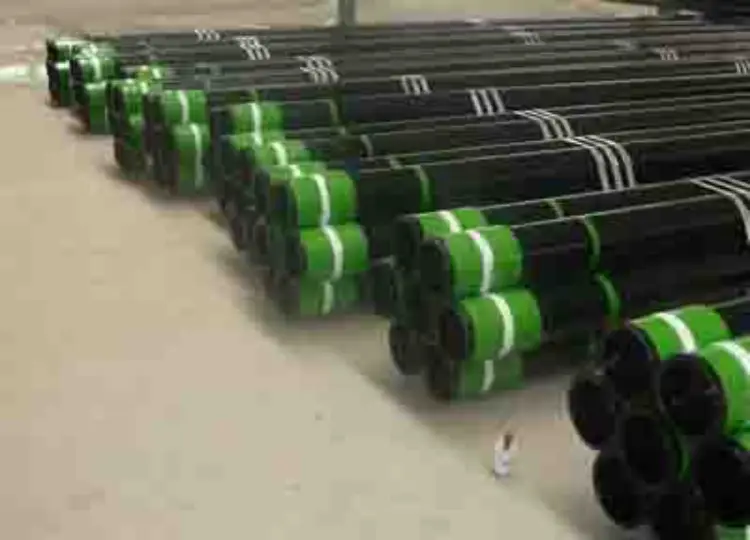
S355J2 ERW Pipe per EN 10025-2
S355J2 ERW Pipe per EN 10025-2: High-Strength Structural Steel Tube Properties and Data
Explore the full material datasheet of S355J2 ERW pipe according to EN 10025-2: chemical composition, mechanical and thermal properties, international equivalents, and application guidance.
ERW (Electric Resistance Welded) pipe forming from hot-rolled strip; suitable for cold forming, bending, welding, cutting, galvanizing
- Phone : +8618037372205
- Email : [email protected]
- WhatsApp: Contact via Whtsapp
- WeChat: +8618037372205
S355J2 ERW Pipe per EN 10025-2 Introduction
S355J2 is a hot-rolled non-alloy structural steel designated by EN 10025-2, widely used for electric resistance welded (ERW) pipes and hollow sections. It offers a minimum yield strength of 355 MPa and guarantees impact toughness of at least 27 J at -20°C (J2 quality).
- Balanced chemical composition for good weldability and formability.
- Available in normalized (+N) or thermomechanically rolled (+M) condition, ensuring consistent mechanical properties across wall thicknesses.
- Typical ERW pipe manufacturing involves forming steel strip into tubular shape and welding the seam without filler metal, resulting in a cost-effective product for structural, mechanical, and pressure applications.
S355J2 ERW pipes are suitable for cold and hot forming, welding, and galvanizing, making them a versatile choice for construction, offshore structures, machinery, and automotive parts.
S355J2 ERW Pipe per EN 10025-2 Chemical Composition
The table shows the limiting chemical composition for S355J2 according to EN 10025-2:2019, based on heat analysis.
- Elements like Nb, V, Ti may be added for grain refinement, and the sum of Nb+V+Ti shall not exceed 0.22%.
- The carbon equivalent (CEV) is typically controlled for good weldability; max CEV = 0.45% for thickness ≤30 mm.
- For ERW pipe production, close control of chemistry ensures consistent weld seam quality.
| Element | Standard Value (max %) | Remarks |
|---|---|---|
| Carbon (C) | 0.22 | For thickness ≤40 mm; for >40 mm, C ≤0.24% |
| Silicon (Si) | 0.55 | |
| Manganese (Mn) | 1.60 | |
| Phosphorus (P) | 0.030 | |
| Sulfur (S) | 0.030 | |
| Copper (Cu) | 0.55 | |
| Nitrogen (N) | 0.012 | If sufficient other N-binding elements are present, N limit may be higher |
| Aluminium (Al) total | ≥0.020 | Finished product analysis; for fine grain practices |
| Chromium (Cr) | 0.30 | Residual; higher values by agreement |
| Nickel (Ni) | 0.30 | Residual |
| Molybdenum (Mo) | 0.10 | Residual |
| Niobium (Nb) | 0.05 | May be added |
| Vanadium (V) | 0.12 | May be added |
| Titanium (Ti) | 0.05 | May be added |
| CEV (typical) | ≤0.45 | Based on t ≤30 mm; CEV=C+Mn/6+(Cr+Mo+V)/5+(Ni+Cu)/15 |
S355J2 ERW Pipe per EN 10025-2 Thermal and Electrical Physical Properties
The following physical properties are typical for S355J2 steel at room temperature, unless otherwise noted. These values can be used for design calculations but are not part of the mandatory requirements of EN 10025-2.
- Density and elastic moduli may vary slightly with thickness and processing.
- Thermal properties are given for a temperature range of about 20 °C to 100 °C unless stated otherwise.
| Property | Value | Unit | Test Condition |
|---|---|---|---|
| Density (ρ) | 7850 | kg/m³ | 20 °C |
| Elastic modulus (E) | 210 | GPa | 20 °C |
| Shear modulus (G) | 81 | GPa | 20 °C |
| Poisson's ratio (ν) | 0.3 | -- | 20 °C |
| Thermal expansion coefficient (α) | 11.7 × 10⁻⁶ | 1/K | 20 – 100 °C |
| Thermal expansion coefficient (α) | 12.5 × 10⁻⁶ | 1/K | 20 – 200 °C |
| Thermal expansion coefficient (α) | 13.6 × 10⁻⁶ | 1/K | 20 – 400 °C |
| Thermal conductivity (λ) | 53 | W/(m·K) | 20 °C |
| Specific heat capacity (cp) | 470 | J/(kg·K) | 20 °C |
| Electrical resistivity (ρe) | 0.2 × 10⁻⁶ | Ω·m | 20 °C |
S355J2 ERW Pipe per EN 10025-2 Mechanical Properties
Mechanical properties from EN 10025-2:2019 are given for the base steel. For ERW pipe, the weld zone may have slightly different properties, but the pipe standard (e.g., EN 10219) references these values for the parent metal.
- J2 quality guarantees a minimum impact energy of 27 J at -20 °C (longitudinal).
- Bend test is specified as 180° around a former with diameter related to thickness.
| Property | Value | Unit | Test Condition |
|---|---|---|---|
| Minimum yield strength ReH | 355 | MPa | Thickness ≤ 16 mm |
| Minimum yield strength ReH | 345 | MPa | Thickness 16 < t ≤ 40 mm |
| Minimum yield strength ReH | 335 | MPa | Thickness 40 < t ≤ 63 mm |
| Minimum yield strength ReH | 325 | MPa | Thickness 63 < t ≤ 80 mm |
| Minimum yield strength ReH | 315 | MPa | Thickness 80 < t ≤ 100 mm |
| Tensile strength Rm | 470 - 630 | MPa | Thickness ≤ 40 mm |
| Tensile strength Rm | 470 - 630 | MPa | Thickness 40 < t ≤ 63 mm |
| Tensile strength Rm | 470 - 630 | MPa | Thickness 63 < t ≤ 80 mm |
| Tensile strength Rm | 450 - 600 | MPa | Thickness 80 < t ≤ 100 mm |
| Minimum elongation after fracture A (L0=5.65√S0) | 22 (longitudinal) / 20 (transverse) | % | Thickness ≤ 40 mm |
| Minimum elongation after fracture A | 21 (longitudinal) / 19 (transverse) | % | Thickness 40 < t ≤ 63 mm |
| Minimum elongation after fracture A | 20 (longitudinal) / 18 (transverse) | % | Thickness 63 < t ≤ 100 mm |
| Charpy impact energy (KV) J2 | ≥ 27 | J | Temperature -20 °C; longitudinal, standard specimen |
| Bend test (180°) | d = 3a | mm | t ≤ 16 mm (a = specimen thickness) |
| Bend test (180°) | d = 4a | mm | t ≥ 16 mm |
S355J2 ERW Pipe per EN 10025-2 Exact Equivalent Material Standards and Substitutable Grades
| Country / Region | Standard | Grade | Remarks |
|---|---|---|---|
| Europe | EN 10025-2 | S355J2 | Identical base material for pipes |
| International | ISO 630-2 | S355J2 | Identical designation |
| United States | ASTM A572/A572M | Grade 50 [355] | Close match; typically supplied to A572 Gr.50 with Charpy requirements as per supplementary S2 (27J at -20°C) |
| Japan | JIS G 3106 | SM490A | Similar strength, J2 toughness may require specification of low-temperature properties |
| China | GB/T 1591-2018 | Q355D | Equivalent in strength and toughness (D= -20°C impact) |
| United Kingdom (superseded) | BS 4360 | 50D | Obsolete but matches S355J2 |
| Russia | GOST R 52927 | 09G2S (09Г2С) or 10HSND | Approximate; verify impact requirements |
S355J2 ERW Pipe per EN 10025-2 Application Introduction
S355J2 ERW pipe is widely used in applications demanding a combination of high strength, good ductility, and reliable low-temperature toughness. Its excellent weldability and formability make it a first-choice material for structural hollow sections, mechanical tubing, and pressure-loaded piping.
- Available in various wall thicknesses, diameters, and profiles (round, square, rectangular), it can be tailored to specific design requirements.
- Common fabrication processes include cutting, drilling, bending, welding, and hot-dip galvanizing without significant loss of mechanical properties.
Product Applications: Structural frames and trusses, Scaffolding and falsework, Piling and foundation pipes, Transmission towers, Trailer and truck chassis, Hydraulic cylinders and pneumatic piping
Processed into products: Welded columns and beams, Boom arms and crane components, Bridge cross-bracing, Roll-over protective structures (ROPS), Pressure vessel shells (subject to additional standards), Conveyor rollers and idler tubes
Application industries: Construction and civil engineering, Offshore and marine structures, Machinery and equipment manufacturing, Automotive and transportation, Agricultural equipment, Energy and power transmission
S355J2 ERW Pipe per EN 10025-2 Similar / Alternative Material Recommendations
| Country / Region | Standard | Grade | Remarks |
|---|---|---|---|
| Europe | EN 10025-2 | S355J0 | Lower toughness: 27J at 0°C instead of -20°C |
| Europe | EN 10025-2 | S355K2 | Higher toughness: 40J at -20°C |
| Europe | EN 10025-2 | S275J2 | Lower yield strength (275 MPa) but same J2 toughness; suitable for less demanding loads |
| Europe | EN 10025-3 | S355N/NL | Normalized fine grain steel, similar strength, often used for thicker sections |
| Europe | EN 10025-4 | S355M/ML | Thermomechanically rolled, similar strength, good weldability |
| International | ISO 630-2 | S355J0 or S355K2 | Direct toughness level substitution |
Notes:
ERW Pipe Specific Notes: For finished ERW pipes, the manufacturing standards such as EN 10219 (cold-formed welded structural hollow sections) or EN 10217 (welded pressure purpose tubes) may impose additional requirements on weld seam integrity, flattening, and flaring tests. The base steel still conforms to EN 10025-2. It is recommended to specify the pipe standard and supplementary testing if critical.
- For low-temperature applications, ductile-toughness requirements (J2) must be met in the weld zone as well.
- Galvanized S355J2 ERW pipe may need hydrogen embrittlement consideration if not properly baked after pickling.
- When replacing with an equivalent grade, always compare complete specifications including thickness-dependent strength and impact requirements.
- Share



