
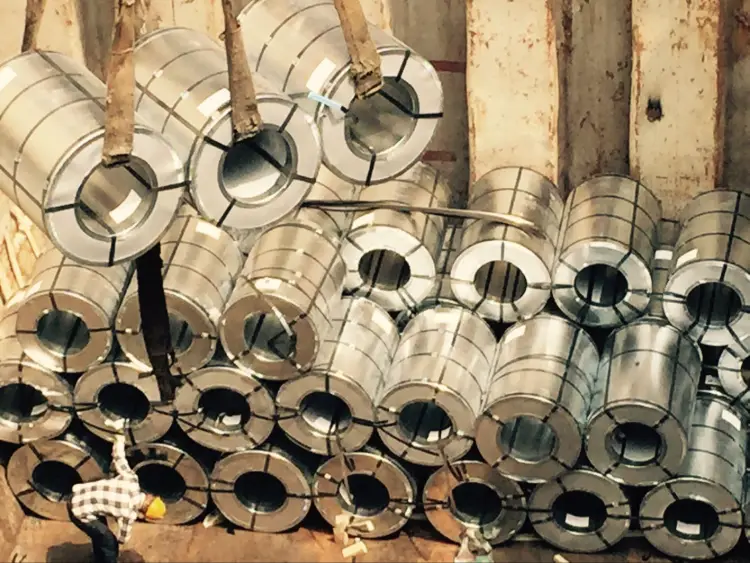
S355J0W Weather Resistant Steel Coil EN 10155-1993
S355J0W Weather Resistant Steel Coil EN 10155-1993: High-Strength Structural Steel with Atmospheric Corrosion Resistance
S355J0W weather resistant steel according to EN 10155-1993. Technical data including chemical composition, mechanical properties, thermal and electrical physical properties, international equivalents, and application guidelines.
Hot rolling, cold forming, bending, shearing, welding (all common methods), oxy-fuel and plasma cutting
- Phone : +8618037372205
- Email : [email protected]
- WhatsApp: Contact via Whtsapp
- WeChat: +8618037372205
S355J0W Weather Resistant Steel Coil EN 10155-1993 Introduction
S355J0W is a hot-rolled weather-resistant structural steel defined in the European standard EN 10155:1993 (now partially superseded by EN 10025-5). The designation 'S' stands for structural steel, '355' indicates the minimum yield strength of 355 MPa for thicknesses up to 16 mm, 'J0' specifies that the steel must guarantee an impact energy of at least 27 J at 0°C (longitudinal), and 'W' denotes improved atmospheric corrosion resistance (weathering steel).
This steel relies on the formation of a stable, adherent oxide layer (patina) when exposed to alternating wet and dry cycles, which significantly reduces the corrosion rate compared to ordinary carbon steel. Typical applications include bridges, building facades, railway vehicles, and transmission towers, often used in unpainted condition to exploit the aesthetic patina. The steel offers good weldability and forming properties, making it suitable for demanding structural projects where durability and low maintenance are priorities.
S355J0W Weather Resistant Steel Coil EN 10155-1993 Chemical Composition
Typical chemical composition according to EN 10155:1993 for grade S355J0W. The steel is alloyed with copper, chromium, and nickel to enhance atmospheric corrosion resistance. Microalloying elements such as niobium, vanadium, or titanium may be added for grain refinement and strength. The carbon equivalent (CEV) is controlled to ensure good weldability.
| Element | Standard Value (max or range) | Remarks |
|---|---|---|
| Carbon (C) | ≤ 0.16% | If applicable, the value may be lowered for improved toughness and weldability |
| Silicon (Si) | ≤ 0.50% | Deoxidizer and strength contributor |
| Manganese (Mn) | 0.50 – 1.50% | Important for strength and hardenability; upper limit depends on thickness |
| Phosphorus (P) | ≤ 0.030% | Controlled to low level to avoid cold shortness |
| Sulfur (S) | ≤ 0.030% | Low sulfur content for improved formability and toughness |
| Aluminium (Al, total) | ≥ 0.020% | Fine grain practice, usually minimum required |
| Chromium (Cr) | 0.40 – 0.80% | Key element for corrosion resistance, promotes dense patina |
| Copper (Cu) | 0.25 – 0.55% | Essential for weathering properties; excess may cause hot shortness |
| Nickel (Ni) | ≤ 0.65% | Adds strength and corrosion resistance, balances copper effects |
| Nitrogen (N) | ≤ 0.009% | For Al-killed fine grain steels, limited to avoid strain aging |
| Others (Nb,V,Ti) | Microalloying possible | Often present for grain refinement and precipitation strengthening |
S355J0W Weather Resistant Steel Coil EN 10155-1993 Thermal and Electrical Physical Properties
Physical properties are not directly specified in EN 10155 but represent typical values for low-alloy structural steels. These values assist in design calculations for thermal expansion, heat conduction, and electrical conductivity. Actual values may vary slightly with specific heat treatment and composition.
| Property | Typical Value | Unit | Test Condition / Reference |
|---|---|---|---|
| Density (ρ) | 7.85 | g/cm³ | 20°C |
| Elastic modulus (E) | 210 | GPa | 20°C, tensile |
| Shear modulus (G) | 81 | GPa | 20°C, calculated from E and ν |
| Poisson's ratio (ν) | 0.30 | - | Elastic range, 20°C |
| Thermal expansion coefficient (α) | 12.0 | ×10⁻⁶/K | 20–100°C, average linear |
| Thermal expansion coefficient (α) | 12.5 | ×10⁻⁶/K | 20–200°C, average linear |
| Thermal expansion coefficient (α) | 13.0 | ×10⁻⁶/K | 20–300°C, average linear |
| Thermal conductivity (λ) | 42 | W/(m·K) | 20°C |
| Specific heat capacity (c) | 460 | J/(kg·K) | 20–100°C |
| Electrical resistivity (ρ_e) | 0.25 | µΩ·m | 20°C |
S355J0W Weather Resistant Steel Coil EN 10155-1993 Mechanical Properties
Mechanical properties specified in EN 10155:1993 for S355J0W plates and wide flats. The minimum impact energy is guaranteed for longitudinal V-notch Charpy specimens at 0°C (J0 classification). Values vary with material thickness; thicker sections exhibit lower strength and elongation.
| Property | Standard Requirement | Unit | Test Condition / Thickness Range |
|---|---|---|---|
| Yield strength (ReH) | ≥ 355 | MPa | t ≤ 16 mm |
| Yield strength (ReH) | ≥ 345 | MPa | 16 mm < t ≤ 40 mm |
| Yield strength (ReH) | ≥ 335 | MPa | 40 mm < t ≤ 63 mm |
| Yield strength (ReH) | ≥ 325 | MPa | 63 mm < t ≤ 80 mm |
| Yield strength (ReH) | ≥ 315 | MPa | 80 mm < t ≤ 100 mm |
| Tensile strength (Rm) | 470 – 630 | MPa | t ≤ 100 mm |
| Elongation after fracture (A) | ≥ 22 | % | t ≤ 40 mm (longitudinal) |
| Elongation after fracture (A) | ≥ 21 | % | 40 mm < t ≤ 63 mm (longitudinal) |
| Elongation after fracture (A) | ≥ 20 | % | 63 mm < t ≤ 100 mm (longitudinal) |
| Impact energy (KV, 0°C) | ≥ 27 | J | Longitudinal Charpy V-notch, average of 3 specimens |
| Impact energy (KV, 0°C) | ≥ 40 | J | Minimum single value allowed (if not specified otherwise) |
| Bend test (mandrel diameter) | 3t (t ≤ 16 mm) | - | 180° bend, specimen width ≥ 50 mm |
| Bend test (mandrel diameter) | 3t (16 < t ≤ 40 mm) | - | 180° bend, specimen width ≥ 50 mm |
| Bend test (mandrel diameter) | 4t (40 < t ≤ 60 mm) | - | 180° bend, specimen width ≥ 50 mm |
S355J0W Weather Resistant Steel Coil EN 10155-1993 Completely Equivalent Material Standards and Substitutable Grades
| Country/Region | Standard & Grade | Material Number / Designation | Remarks |
|---|---|---|---|
| Europe | EN 10025-5:2019 S355J0W | 1.8959 | Direct successor to EN 10155; identical chemical and mechanical requirements |
| Germany | DIN EN 10155 S355J0W | S355J0W | National adoption of the European standard |
| UK | BS EN 10155 S355J0W | S355J0W | British adoption, identical requirements |
| Sweden | SS-EN 10155 S355J0W | S355J0W | Swedish implementation |
| France | NF EN 10155 S355J0W | S355J0W | French implementation |
| Italy | UNI EN 10155 S355J0W | S355J0W | Italian implementation |
| Spain | UNE EN 10155 S355J0W | S355J0W | Spanish implementation |
| International | ISO 4952:2003 Fe 490WD | Fe 490WD | Similar weathering steel, but verification of equivalence is required |
S355J0W Weather Resistant Steel Coil EN 10155-1993 Application Introduction
S355J0W is engineered for structures exposed to the atmosphere where reduced maintenance and long service life are critical. The steel develops a dense, protective oxide layer (patina) that inhibits further corrosion when subjected to natural wet-dry cycles. This allows its use without protective paint coatings in many environments, offering aesthetic and economic advantages.
The steel is suitable for:
- Unpainted or 'rusty look' architectural applications
- High-cycle fatigue environments such as bridges and crane structures
- Welded fabrications requiring good low-temperature toughness (0°C impact guarantee)
- Components formed by cold bending and press braking
Welding should follow established procedures for weathering steel, using matching or slightly over-alloyed filler metals to preserve corrosion resistance. Design details must ensure proper drainage to avoid prolonged wetness that could lead to accelerated corrosion.
Product Applications: Welded plate girders for bridges, Rolled beam and column sections for building frameworks, Weathering steel cladding panels and screens, Container corner castings and box beams, Railway carriage underframes and body structures, Lattice transmission towers and pole structures
Processed into products: Bridge main girders and cross beams, Stiffeners and gusset plates, Flange and web plates for welded beams, Cold-formed lipped channels and Z-sections, Laser/plasma cut brackets and connectors, Pressed and welded pipe sections, Anchor boxes and base plates
Application industries: Civil engineering and infrastructure (bridges, viaducts, overpasses), Architecture and building construction (facades, canopies, sculptures), Railway industry (rail cars, freight wagons, bogie frames), Shipping and container manufacturing (ISO container corners, structural frames), Energy and utilities (transmission towers, wind turbine towers, chimney stacks), Mining and heavy machinery (structural parts exposed to outdoor climate)
S355J0W Weather Resistant Steel Coil EN 10155-1993 Similar or Alternative Weather Resistant Steel Grades with Comparable Performance
| Country/Region | Standard & Grade | Nominal Specification | Remarks |
|---|---|---|---|
| USA | ASTM A588/A588M Grade A | Minimum yield 345 MPa, tensile 485 MPa | Similar weathering properties; thicker sections may have lower strength; check toughness level (no J0 requirement) |
| Japan | JIS G3114 SMA490AW | Minimum yield 365 MPa (t≤16 mm), tensile 490–610 MPa | Closest Japanese equivalent; often considered interchangeable; 0°C impact not always mandatory |
| China | GB/T 4171 Q355NHD | Minimum yield 355 MPa, tensile 470–630 MPa | Chinese weathering steel with similar composition; J0 equivalent must be specified separately |
| Europe | EN 10025-5 S355J2W | Minimum yield 355 MPa, impact at -20°C | Higher toughness class (J2) for more demanding applications; otherwise identical chemistry |
| Europe | EN 10025-5 S355K2W | Minimum yield 355 MPa, impact at -20°C with higher average (40J) | Superior toughness; suitable for severely cold climates; same corrosion resistance |
| Russia | GOST R 55374 15HSNDA | Yield ≥ 345 MPa, tensile ≥ 490 MPa | Commonly used weathering steel in Russia; contains Cr, Ni, Cu; verify mechanical properties for substitution |
Notes:
Weathering behaviour: Optimal patina formation requires exposure to alternating wet and dry periods and avoidance of constant humidity or de-icing salt spray. In marine environments or heavily industrial atmospheres, additional protection may be required.
Weldability: The carbon equivalent (CEV) typically around 0.40–0.44 ensures good weldability with low-hydrogen processes. Preheating may be necessary for thick sections according to EN 1011-2.
Formability: Suitable for cold forming with minimum bend radii as per EN 10155. Hot forming may alter mechanical properties and require re-normalizing.
Certification: When ordering to EN 10155, specify inspection document type (e.g., 3.1 according to EN 10204) and any special requirements, such as normalizing rolling or improved flatness for laser cutting.
- Share



