
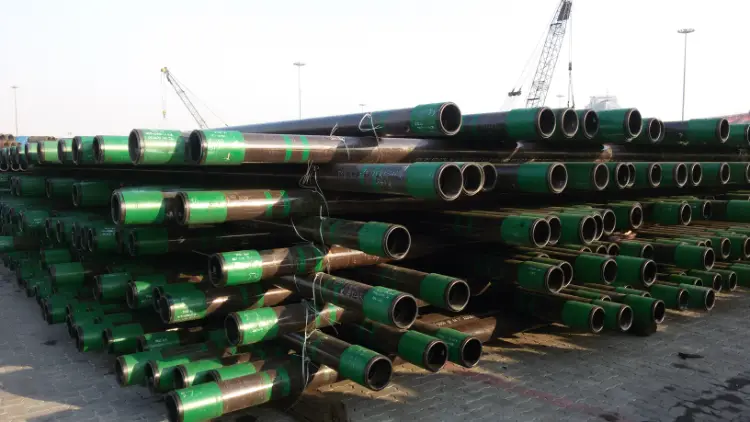
S355J0H ERW Pipe
S355J0H ERW Pipe: High-Strength Structural Hollow Section for European Construction
Comprehensive material data for S355J0H welded structural hollow sections according to EN 10219, including chemical composition, mechanical properties, and physical characteristics.
Cold forming, bending, flanging, welding, drilling, cutting, galvanizing
- Phone : +8618037372205
- Email : [email protected]
- WhatsApp: Contact via Whtsapp
- WeChat: +8618037372205
S355J0H ERW Pipe Introduction
S355J0H is a non-alloy structural steel grade for welded circular, square, and rectangular hollow sections, manufactured by electric resistance welding (ERW). Key features:
- Minimum yield strength of 355 MPa for thicknesses up to 16 mm
- Good weldability due to low carbon equivalent
- 27 J impact energy at 0 °C (J0 quality class)
- Excellent formability for cold bending and structural fabrication
It is widely used in building construction, bridges, offshore structures, and mechanical engineering where high strength-to-weight ratio and reliable toughness are required.
S355J0H ERW Pipe Chemical Composition
The chemical composition conforms to EN 10219-1:2006 for non-alloy structural steel grade S355J0H. Key controls: Maximum phosphorus and sulfur are limited to ensure good weldability and toughness. Nitrogen is kept low to avoid strain aging. A minimum aluminum content is required if aluminum is used as the grain-refining element.
- Carbon equivalent (CEV) is typically ≤ 0.45% for good weldability.
| Element | Standard Value (max or range) | Remarks |
|---|---|---|
| C | ≤ 0.20 % | Carbon |
| Si | ≤ 0.55 % | Silicon |
| Mn | ≤ 1.60 % | Manganese |
| P | ≤ 0.035 % | Phosphorus |
| S | ≤ 0.035 % | Sulfur |
| N | ≤ 0.009 % | Nitrogen |
| Al (total) | ≥ 0.020 % | If added as grain-refining element |
| Cr | ≤ 0.30 % | Residual (not specified in standard but typically present) |
| Ni | ≤ 0.30 % | Residual |
| Mo | ≤ 0.10 % | Residual |
| Cu | ≤ 0.35 % | Residual |
S355J0H ERW Pipe Thermal and Electrical Physical Properties
Physical properties are not mandatory in EN 10219 but are provided as typical values for S355J0H steel at room temperature. These values depend on chemical composition and microstructure and are valid for standard grades.
- Properties may vary with temperature; for elevated temperature design refer to EN 1993-1-2.
- Electrical resistivity and thermal conductivity are typical for low-alloy carbon steels.
| Property | Typical Value | Unit | Condition |
|---|---|---|---|
| Density (ρ) | 7850 | kg/m³ | At 20 °C |
| Modulus of Elasticity (E) | 210 | GPa | At 20 °C |
| Shear Modulus (G) | 81 | GPa | Calculated from E and ν |
| Poisson's ratio (ν) | 0.3 | – | At 20 °C |
| Thermal expansion coefficient (α) | 11.1 × 10⁻⁶ | K⁻¹ | 20 °C to 100 °C |
| Thermal expansion coefficient (α) | 12.5 × 10⁻⁶ | K⁻¹ | 20 °C to 300 °C |
| Thermal conductivity (λ) | 50 | W/(m·K) | At 20 °C |
| Specific heat capacity (cp) | 460 | J/(kg·K) | At 20 °C |
| Electrical resistivity (ρ_e) | 0.22 | Ω·mm²/m | At 20 °C |
S355J0H ERW Pipe Mechanical Properties
Mechanical properties are specified in EN 10219-1 for the finished hollow section. Tensile testing is performed on longitudinal specimens. Impact energy is based on Charpy V-notch tests at 0 °C. The bend test is normally required only by agreement; the values given are typical radii for 180° cold bending without cracking.
- All thickness ranges use the nominal wall thickness of the hollow section.
| Property | Standard Requirement | Unit | Test Conditions / Remarks |
|---|---|---|---|
| Yield Strength (ReH) | ≥ 355 | MPa | Wall thickness t ≤ 16 mm |
| Yield Strength (ReH) | ≥ 345 | MPa | 16 mm < t ≤ 40 mm |
| Yield Strength (ReH) | ≥ 335 | MPa | 40 mm < t ≤ 63 mm |
| Yield Strength (ReH) | ≥ 325 | MPa | 63 mm < t ≤ 80 mm |
| Yield Strength (ReH) | ≥ 315 | MPa | 80 mm < t ≤ 100 mm |
| Yield Strength (ReH) | ≥ 295 | MPa | 100 mm < t ≤ 120 mm |
| Tensile Strength (Rm) | 470 – 630 | MPa | Wall thickness ≤ 120 mm |
| Elongation (A) | ≥ 22 | % | Longitudinal, t ≤ 40 mm, gauge length 5.65√S₀ |
| Elongation (A) | ≥ 21 | % | Longitudinal, 40 < t ≤ 63 mm |
| Elongation (A) | ≥ 20 | % | Longitudinal, 63 < t ≤ 100 mm |
| Charpy Impact Energy (KV₂) | ≥ 27 J | J | At 0 °C, longitudinal specimen |
| Bend Test (180°) | 3t | mm | For t ≤ 16 mm, mandrel diameter |
| Bend Test (180°) | 4t | mm | For 16 < t ≤ 40 mm |
| Bend Test (180°) | 5t | mm | For 40 < t ≤ 63 mm |
S355J0H ERW Pipe Equivalent Standard Grades and Direct Substitutes
| Country/Region | Standard | Grade | Remarks |
|---|---|---|---|
| Europe | EN 10219-1 | S355J0H | Identical – original specification |
| UK | BS EN 10219-1 | S355J0H | Identical – adopted European standard |
| Germany | DIN EN 10219-1 | S355J0H | Identical – supersedes former DIN 59413 |
| France | NF EN 10219-1 | S355J0H | Identical |
| Italy | UNI EN 10219-1 | S355J0H | Identical |
| Sweden | SS-EN 10219-1 | S355J0H | Identical |
| International | ISO 630-5 | S355J0 | Equivalent quality for sections, not specifically for hollow sections |
| China | GB/T 6728 | Q355D | Hollow section, impact 0 °C 27 J, yield ≥355 MPa; close match |
| USA | ASTM A500 | Grade C | Similar strength (yield 345 MPa) but not identical; verify charpy |
S355J0H ERW Pipe Application Introduction
S355J0H ERW pipes offer an excellent balance of strength, formability, and cost-effectiveness. Primary uses:
- Structural frameworks for buildings and industrial plants
- Bridges and pedestrian walkways
- Offshore structural elements (with suitable coating)
- Machinery parts requiring welded profiles
- Agricultural equipment and greenhouses
- Scaffolding and falsework systems
The material can be easily welded, cold-bent, and punched, making it suitable for automated fabrication lines.
Product Applications: Structural steel frameworks, Bridges (pedestrian and vehicular), Crane booms and lattice members, Scaffolding tubes and couplers, Greenhouse profiles, Roll cages and safety barriers, Conveyor galleries and support structures, Wind turbine tower internals
Processed into products: Columns and beams, Truss chords and web members, Bracing elements, Vehicle chassis rails, Trailer drawbars, Tube connectors and couplings, Curtain wall mullions, Sign gantry supports
Application industries: Building and infrastructure construction, Bridge engineering, Offshore and marine structures, Mechanical engineering, Agricultural machinery, Steel frame systems (pre-engineered buildings), Transmission and telecommunication towers, Transport equipment (trailers, chassis)
S355J0H ERW Pipe Similar or Closely Related Materials
| Country/Region | Standard | Grade | Remarks |
|---|---|---|---|
| Europe | EN 10219-1 | S355J2H | Same strength, impact at -20 °C (better toughness) |
| Europe | EN 10219-1 | S275J0H | Lower yield strength (275 MPa), same impact class |
| Europe | EN 10219-1 | S355K2H | Same strength, impact at -20 °C with 40 J (superior toughness) |
| Europe | EN 10210-1 | S355J0H | Hot-finished hollow section; same mechanicals but different tolerance |
| USA | ASTM A500 | Grade B | Lower yield (317 MPa), not impact tested |
| Japan | JIS G 3466 | STKR490 | Similar application, yield ≥325 MPa, tensile ≥490 MPa |
| China | GB/T 1591 | Q355D | Plate/strip grade, not tube-specific but comparable mechanical |
Notes:
- ERW pipes are produced with a longitudinal seam; weld quality shall be verified by non-destructive testing per EN 10219-2.
- For dynamic applications (fatigue), designers should consider stress categories according to EN 1993-1-9.
- Corrosion protection is not inherent; typical systems include hot-dip galvanizing, painting, or metallization.
- The CEV (Carbon Equivalent Value) is usually controlled to ≤0.45 to ensure good weldability without preheating (based on standard structural steel guidelines).
- Standard lengths: 6 m, 12 m; other lengths by agreement.
- Dimensional tolerances and shape are covered in EN 10219-2.
- Share



