
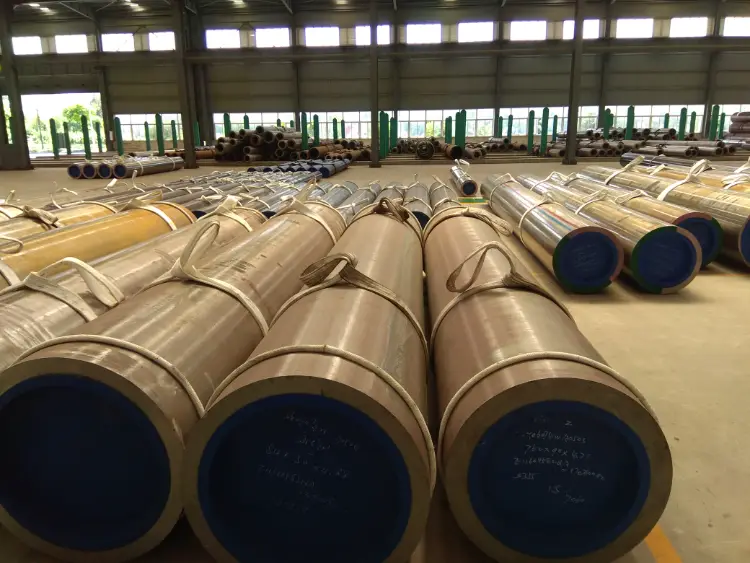
EN10219 S355J2H ERW Pipe
EN10219 S355J2H ERW Pipe: High-Strength Cold-Formed Structural Hollow Section
Comprehensive material data sheet for S355J2H ERW pipes according to EN 10219, including chemical composition, mechanical properties, thermal and electrical properties, international equivalents, and application guidance.
Electric resistance welding (ERW), cold forming, bending, machining, sawing, hot-dip galvanizing, painting, welding, cutting
- Phone : +8618037372205
- Email : [email protected]
- WhatsApp: Contact via Whtsapp
- WeChat: +8618037372205
EN10219 S355J2H ERW Pipe Introduction
S355J2H is a structural steel grade for cold-formed welded hollow sections according to EN 10219-1. It belongs to the non-alloy or fine-grain steel family and is widely used in construction, machinery, and offshore engineering. The designation indicates a minimum yield strength of 355 MPa and guaranteed impact energy of 27 J at -20 °C (J2). The material is supplied as electric resistance welded (ERW) pipes and hollow profiles in round, square, rectangular, and elliptical shapes. Its high strength, good weldability, and excellent toughness at low temperatures make it suitable for dynamically loaded and safety-critical structures. Typical delivery conditions include as-welded, normalised, or fine-grain treated, and the steel can be galvanised to improve corrosion resistance.
EN10219 S355J2H ERW Pipe Chemical Composition of S355J2H
The chemical composition complies with EN 10219-1 for S355J2H. Values are maximum limits unless otherwise stated. Fine grain elements (e.g., Al ≥0.020%) may be added to achieve the required toughness. The carbon equivalent (CEV) ensures good weldability without preheating under standard conditions.
| Element | Standard Value (max %) | Remarks |
|---|---|---|
| Carbon (C) | 0.22 | ≤0.22% for all thicknesses |
| Silicon (Si) | 0.55 | Deoxidation element |
| Manganese (Mn) | 1.60 | If non-alloy, Mn can be increased to 1.80% upon agreement |
| Phosphorus (P) | 0.035 | Phosphorus content must not exceed this limit |
| Sulfur (S) | 0.035 | Sulfur content must not exceed this limit |
| Carbon Equivalent (CEV) | 0.45 | CEV = C + Mn/6 + (Cr+Mo+V)/5 + (Ni+Cu)/15 |
| Aluminium (Al) total | ≥0.020 | Required when fine grain practice is applied |
EN10219 S355J2H ERW Pipe Thermal and Electrical Physical Properties of S355J2H
Physical properties are typical for carbon-manganese structural steels and are based on published data for similar grades. Actual values may vary slightly depending on exact composition and manufacturing conditions. These values are not mandatory from the product standard but are useful for design calculations.
| Property | Typical Value | Unit | Test Condition / Remarks |
|---|---|---|---|
| Density (ρ) | 7850 | kg/m³ | At 20 °C |
| Modulus of elasticity (E) | 210 | GPa | At 20 °C, longitudinal |
| Shear modulus (G) | 81 | GPa | At 20 °C, derived from E and Poisson's ratio |
| Poisson's ratio (ν) | 0.3 | — | At 20 °C, within elastic range |
| Thermal expansion coefficient (α) | 11.1 | 10⁻⁶/K | Temperature range 20 – 100 °C |
| Thermal expansion coefficient (α) | 12.2 | 10⁻⁶/K | 20 – 200 °C |
| Thermal expansion coefficient (α) | 13.0 | 10⁻⁶/K | 20 – 300 °C |
| Thermal expansion coefficient (α) | 13.8 | 10⁻⁶/K | 20 – 400 °C |
| Thermal conductivity (λ) | 53 | W/(m·K) | At 20 °C |
| Thermal conductivity (λ) | 51 | W/(m·K) | At 100 °C |
| Specific heat capacity (cₚ) | 460 | J/(kg·K) | At 20 °C |
| Electrical resistivity (ρₑ) | 0.22 | 10⁻⁶ Ω·m | At 20 °C, typical for low-alloy steel |
EN10219 S355J2H ERW Pipe Mechanical Properties of S355J2H
The following mechanical properties are based on longitudinal test specimens taken from the finished hollow section. Values are minimum required unless a range is given. The impact test is performed on Charpy V-notch specimens at -20 °C. Bending test follows Annex A of EN 10219-1.
| Property | Required Value | Unit | Test Condition / Remarks |
|---|---|---|---|
| Yield strength (ReH) | ≥355 | MPa | Wall thickness ≤ 16 mm |
| Yield strength (ReH) | ≥345 | MPa | Wall thickness 16 < t ≤ 40 mm |
| Yield strength (ReH) | ≥335 | MPa | Wall thickness 40 < t ≤ 65 mm |
| Tensile strength (Rm) | 490 – 630 | MPa | Wall thickness ≤ 3 mm (lower limit increased by 20 MPa) |
| Tensile strength (Rm) | 470 – 630 | MPa | Wall thickness > 3 mm |
| Elongation (A) | ≥20 | % | Longitudinal, L₀ = 5.65√S₀; thickness ≤ 40 mm |
| Elongation (A) | ≥22 | % | Longitudinal, L₀ = 5.65√S₀; thickness 40 < t ≤ 65 mm |
| Impact energy (KV₂) | ≥27 | J | -20 °C, longitudinal Charpy V-notch, thickness > 6 mm |
| Bend test (180°) | 3t | mm | Mandrel diameter = 3 × wall thickness (t); no cracks permitted |
EN10219 S355J2H ERW Pipe Internationally Equivalent or Fully Substitutable Standards and Grades
| Country / Region | Standard | Grade | Remarks |
|---|---|---|---|
| European Union | EN 10219-1 | S355J2H | Base standard; cold-formed welded hollow sections |
| International | ISO 10799-2 | S355J2H | Structurally identical; same chemical and mechanical requirements |
| China | GB/T 6728-2017 | Q355D | Welded cold-formed hollow section; Charpy 27J at -20 °C |
EN10219 S355J2H ERW Pipe Application Introduction
S355J2H ERW pipes and hollow sections are designed for demanding structural applications that require high strength, good ductility, and reliable toughness at sub-zero temperatures. Their excellent weldability and formability facilitate efficient fabrication. The material is widely used in both indoor and outdoor environments, and can be protected with paint or hot-dip galvanizing.
Product Applications: Welded hollow section columns and beams, Lattice towers and masts for power transmission and telecommunication, Prefabricated structural trusses and space frames, Guardrails, street lighting poles, and traffic sign supports, Wind turbine tower sections (both onshore and offshore), Offshore access platforms and walkways, Storage racks, shelving systems, and mezzanine floors, Agricultural machinery components (chassis, lifting arms)
Processed into products: Purlins, rafters, and bracing members in steel buildings, Guide rails and support brackets for lifting equipment, Couplers, sleeves, and reducers for scaffolding systems, Flanges, elbows, and tees for structural pipe connections, Base plates and bearing plates for anchoring, Welded assemblies for material handling (crane girder webs, hoist frames), Stiffeners and gusset plates integrated with hollow sections, Corner cleats and moment-resisting joints in frame structures
Application industries: Building and construction (steel frames, industrial halls, stadiums, high-rise structures), Bridge engineering (main girders, arches, trusses), Offshore and marine structures (platform leg supports, flare booms, handrails), Renewable energy (wind turbine towers, solar panel support structures), Transport and automotive (trailer frames, bus body frames, railway wagon components), Agricultural and forestry equipment (harvester arms, sprayer booms, greenhouse structures), Mechanical engineering and heavy machinery (boom sections, crane jibs, conveyors), Urban furniture and architectural metalwork (staircases, balustrades, sign gantries)
EN10219 S355J2H ERW Pipe Similar and Comparable Alternative Materials for Design or Supply Flexibility
| Country / Region | Standard | Grade | Remarks |
|---|---|---|---|
| European Union | EN 10219-1 | S355J0H | Similar strength; impact 27J at 0 °C instead of -20 °C |
| European Union | EN 10219-1 | S275J2H | Lower yield strength (275 MPa) but same -20 °C toughness |
| USA | ASTM A500 | Grade C | Circular cold-formed welded tube; min. yield 345 MPa; no guaranteed low-temperature impact |
| Japan | JIS G 3466 | STKR490 | Square/Rectangular hollow sections; yield ≥325 MPa; tensile 490-610 MPa |
| China | GB/T 1591-2018 | Q355D | Equivalent grade for plates and sections; same strength and -20 °C impact |
Notes:
Weldability: The low carbon equivalent (CEV ≤0.45) ensures good resistance to cold cracking, and preheating is generally not required for thicknesses below 30 mm under normal conditions. Corrosion protection: The ERW hollow sections can be delivered in hot-dip galvanized condition, enhancing durability for outdoor exposure. Testing and inspection: EN 10219 requires specific tests for finished products, including tensile, Charpy impact, and optional non-destructive testing (NDT) of the weld seam. Tolerances: Dimensional tolerances for diameter, wall thickness, straightness, and corner radii are defined in EN 10219-2. Sustainability: The steel is fully recyclable and produced via electric arc furnace or basic oxygen furnace routes, with increasing use of scrap in the charge.
- Share



