
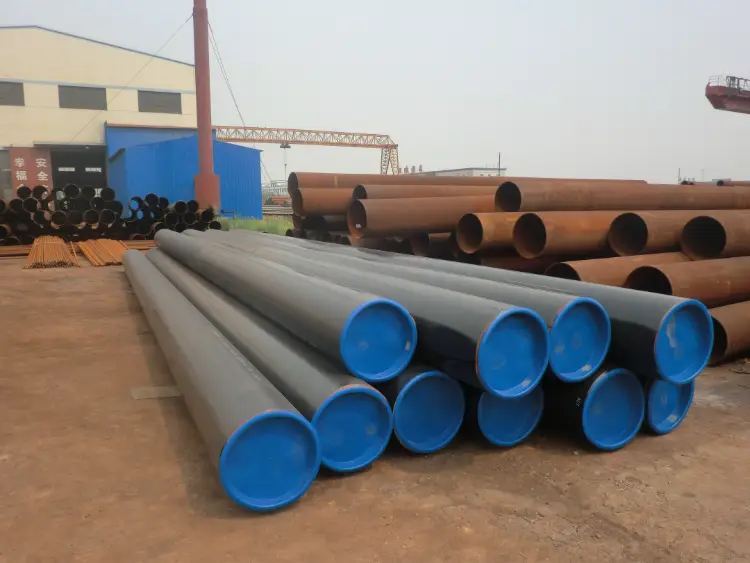
Q460C High-Strength Low-Alloy Structural Steel for LSAW Pipes
Q460C Low-Alloy High-Strength Steel for LSAW Pipes – Properties & Applications
Detailed material data for Q460C low-alloy high-strength structural steel under GB/T 1591, commonly used in longitudinal submerged arc welded (LSAW) pipes. Includes chemical composition, mechanical properties, thermal and electrical physical properties, international equivalents, and application guidance.
Thermomechanical rolling, normalizing, or quenching and tempering; welding (submerged arc welding), cold forming, machining
- Phone : +8618037372205
- Email : [email protected]
- WhatsApp: Contact via Whtsapp
- WeChat: +8618037372205
Q460C High-Strength Low-Alloy Structural Steel for LSAW Pipes Introduction
Q460C is a low-alloy high-strength structural steel grade defined in GB/T 1591-2018. It offers a minimum yield strength of 460 MPa (thickness ≤16 mm) and good toughness at 0°C, making it suitable for demanding structural applications. When manufactured into LSAW (Longitudinal Submerged Arc Welded) pipes, Q460C provides excellent load-bearing capacity, weldability, and resistance to brittle fracture. The material is mainly supplied in the form of hot-rolled plates or coils and subsequently processed into large-diameter pipes for construction, offshore structures, and heavy machinery. It has balanced chemical composition with microalloying elements such as Nb, V, Ti to refine grain and enhance strength without significantly sacrificing ductility or weldability.
Q460C High-Strength Low-Alloy Structural Steel for LSAW Pipes Chemical Composition
The chemical composition of Q460C according to GB/T 1591-2018 is designed to achieve high strength and good weldability. Carbon is limited to max 0.20% to retain toughness and weldability. Microalloying elements such as Nb, V, Ti are added for grain refinement and precipitation strengthening. The phosphorus and sulfur contents are strictly controlled to enhance ductility and impact toughness.
The table below lists the heat analysis limits (mass fraction).
| Element | Maximum Content (wt%) | Remarks |
|---|---|---|
| Carbon (C) | 0.20 | max |
| Silicon (Si) | 0.60 | max |
| Manganese (Mn) | 1.80 | max |
| Phosphorus (P) | 0.030 | max |
| Sulfur (S) | 0.025 | max |
| Niobium (Nb) | 0.11 | max |
| Vanadium (V) | 0.20 | max |
| Titanium (Ti) | 0.20 | max |
| Chromium (Cr) | 0.30 | max |
| Nickel (Ni) | 0.80 | max |
| Copper (Cu) | 0.55 | max |
| Molybdenum (Mo) | 0.20 | max |
| Nitrogen (N) | 0.015 | max |
| Aluminum (Alt or Als) | ≥0.015 | minimum total or acid-soluble Al |
Q460C High-Strength Low-Alloy Structural Steel for LSAW Pipes Thermal and Electrical Physical Properties
The physical properties of Q460C steel are not guaranteed by GB/T 1591, but the typical values for low-alloy structural steel of this type are provided below. These data are applicable for common engineering calculations such as deflection, thermal expansion, and heat transfer. The values are approximate and may vary slightly depending on the exact heat treatment and composition.
They serve as a reliable reference for LSAW pipe design and fabrication.
| Property | Typical Value | Unit | Conditions / Remarks |
|---|---|---|---|
| Density (ρ) | 7.85 | g/cm³ | Room temperature |
| Modulus of elasticity (E) | 206 | GPa | Room temperature, tension |
| Shear modulus (G) | 79 | GPa | Calculated from E and ν |
| Poisson's ratio (ν) | 0.3 | — | Elastic range |
| Thermal expansion coefficient (α) | 11.5 | 10⁻⁶/K | 20 – 100 °C |
| Thermal expansion coefficient (α) | 12.5 | 10⁻⁶/K | 20 – 300 °C |
| Thermal expansion coefficient (α) | 13.5 | 10⁻⁶/K | 20 – 500 °C |
| Thermal conductivity (λ) | 53 | W/(m·K) | At 20 °C |
| Thermal conductivity (λ) | 48 | W/(m·K) | At 200 °C |
| Specific heat capacity (cp) | 460 | J/(kg·K) | Room temperature approx. |
| Electrical resistivity (ρ_e) | 0.23 | µΩ·m | At 20 °C |
Q460C High-Strength Low-Alloy Structural Steel for LSAW Pipes Mechanical Properties
The mechanical properties of Q460C steel are specified for different thickness ranges. Longitudinal Charpy V-notch impact energy at 0°C is guaranteed for grade C. The bend test is performed with mandrel diameter dependent on thickness. For LSAW pipes, tests are usually conducted on specimens taken from the base metal or the weld seam, but the base metal requirements follow this standard.
The table details minimum upper yield strength (ReH), tensile strength (Rm), elongation after fracture (A), impact energy (KV2), and bend test parameters.
| Property | Required Value | Unit | Test Condition |
|---|---|---|---|
| Yield Strength (ReH) | ≥460 | MPa | Thickness ≤16 mm |
| Yield Strength (ReH) | ≥440 | MPa | Thickness >16 – 40 mm |
| Yield Strength (ReH) | ≥420 | MPa | Thickness >40 – 63 mm |
| Yield Strength (ReH) | ≥400 | MPa | Thickness >63 – 80 mm |
| Yield Strength (ReH) | ≥400 | MPa | Thickness >80 – 100 mm |
| Yield Strength (ReH) | ≥390 | MPa | Thickness >100 – 150 mm |
| Tensile Strength (Rm) | 550 – 720 | MPa | Thickness ≤100 mm |
| Tensile Strength (Rm) | 530 – 700 | MPa | Thickness >100 – 150 mm |
| Elongation after fracture (A) | ≥17 | % | Thickness ≤100 mm, L0=5.65√S0 |
| Elongation after fracture (A) | ≥15 | % | Thickness >100 – 150 mm, L0=5.65√S0 |
| Charpy V-notch impact energy (KV2) | ≥34 | J | 0°C, longitudinal, average of 3 tests; one individual ≥0.7x avg. |
| Bend test (180°) | D = 3a | — | a = specimen thickness ≤16 mm; no cracks |
| Bend test (180°) | D = 4a | — | a >16 – 100 mm; no cracks |
| Bend test (180°) | D = 5a | — | a >100 – 150 mm; no cracks |
Q460C High-Strength Low-Alloy Structural Steel for LSAW Pipes Exact Equivalent Standards and Substitutable Grades
| Country/Region | Standard | Designation | Remarks |
|---|---|---|---|
| China | GB/T 1591-2018 | Q460C | Original designation; 0°C impact |
| — | — | — | No direct international equivalent precisely matching the 0°C toughness and strength level simultaneously. The following are the closest applicable equivalents for reference. |
| Europe | EN 10025-4 | S460Q | Quenched and tempered (Q); toughness at -20°C, different delivery condition |
| Europe | EN 10025-3 | S460N / S460NL | Normalized / normalized low temperature; N requires -20°C, NL requires -50°C, not identical to Q460C |
| International | ISO 4950-3:1995 | E460C | Structural steels with high yield; C-class offers 0°C impact, but the standard is older |
| USA | ASTM A572/A572M | Grade 65 [450] | Yield 450 MPa (65 ksi); not fully equivalent in strength (460 MPa); no 0°C impact requirement |
| Japan | JIS G 3106 | SM570 | Yield 460 MPa for t≤16 mm, but 0°C impact is optional and not standard for all thicknesses |
Q460C High-Strength Low-Alloy Structural Steel for LSAW Pipes Application Introduction
Q460C LSAW pipes combine high strength with good cold formability and weldability, making them ideal for weight-critical, load-bearing structures. Typical fabrication includes cold expanding, rolling, and submerged arc welding. Because of the guaranteed 0°C impact toughness, the pipes are used in ambient and moderately low-temperature environments.
Key industries and products:
Product Applications: Longitudinal submerged arc welded (LSAW) pipes and tubes, Large-diameter structural pipe piles, Wind turbine tower tubes and foundation monopiles, Bridge piers and main arch ribs, Heavy-lift crane boom sections, High-rise building columns and trusses, Offshore platform jacket legs and braces, Liquefied natural gas (LNG) storage tank outer shells (structural)
Processed into products: Pipe piles (spiral or LSAW) with diameters 406 to 1626 mm for foundation engineering, Tubular joints and nodes for offshore structures, Flanges and stiffened plates welded to LSAW pipes, Segmented tower sections for wind turbines (tapered tubular sections), Concrete-filled steel tubular (CFST) columns, Chord and brace members for long-span bridges, Reinforcement cages and modular pipe segments for vertical shafts, Hydraulic cylinder bodies and oversized mechanical rollers (when machined from pipes)
Application industries: Civil Engineering & Infrastructure, Oil & Gas (Structural applications, not sour service line pipe unless supplementary qualification), Offshore & Marine Engineering, Wind Energy (Onshore and Offshore towers), Heavy Machinery & Equipment Manufacturing, Bridge Construction, Power Transmission (Lattice towers, poles), Mining & Mineral Processing (Structural supports, casings)
Q460C High-Strength Low-Alloy Structural Steel for LSAW Pipes Similar / Substitute Materials
| Country/Region | Standard | Designation | Remarks |
|---|---|---|---|
| China | GB/T 1591-2018 | Q460D, Q460E | These grades offer better low-temperature toughness (-20°C and -40°C), otherwise same strength; readily available for LSAW pipes with more stringent notch toughness demands. |
| Europe | EN 10025-4 | S460M / S460ML | Thermomechanically rolled; M has minimum -20°C, ML has -50°C; close to Q460C in strength, but impact test temperatures differ. |
| USA | ASTM A572/A572M | Grade 65 [450] | Slightly lower yield (450 MPa), but chemically similar; often used as alternative in heavy structural pipe applications with adjusted design. |
| Japan | JIS G 3106 | SM570 | High-strength welded structural steel; typical yield 460 MPa for thin gauges, suitable substitute when 0°C impact may be specified separately. |
| Russia | GOST 27772 | C460 | Strength level similar; however, chemical requirements and test methods differ; careful comparison needed. |
Notes:
- For LSAW pipes used in pressure applications, additional standards such as API 5L or GB/T 9711 apply; the Q460C steel must then meet supplementary requirements (e.g., hydrogen-induced cracking resistance, stricter S limits, and CVN on weld/HAZ).
- Welding consumables should match strength and toughness: typically low-hydrogen electrodes or wires (e.g., AWS A5.1 E7018 or A5.28 ER80S-G) with controlled heat input to preserve HAZ properties.
- Post-weld heat treatment (PWHT) is often not mandatory for this grade, but stress relieving may be applied for thick-walled pipes (over 40 mm) to reduce residual stress.
- When ordering Q460C plates for LSAW pipe production, it is advisable to specify ultrasonic testing (UT) per GB/T 2970 or equivalent to ensure internal soundness.
- The grade may be supplied under optional requirements for fine grain practice (Al grain refinement), which is typical to achieve the required impact toughness.
- Share



