
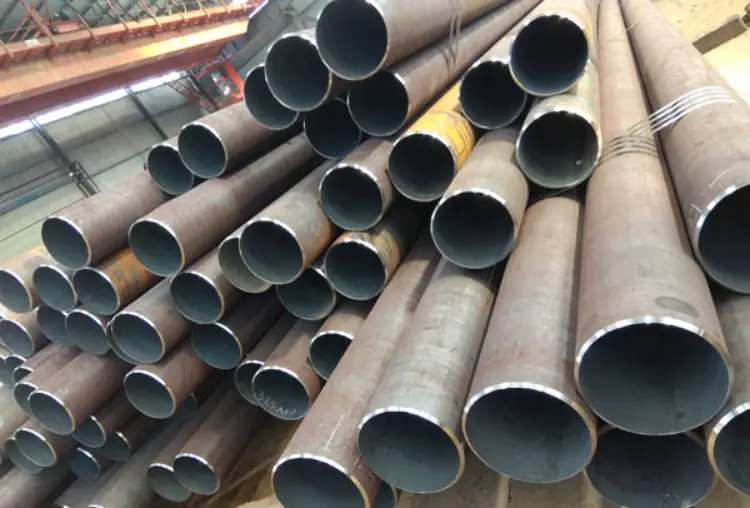
Q460C High-Strength Steel Material for SSAW Pipes
Q460C High-Strength Steel for SSAW Pipes - GB/T 1591
In-depth material analysis of Q460C steel grade specified in GB/T 1591, widely used for spiral submerged arc welded (SSAW) pipes. Includes chemical composition, mechanical properties for various thicknesses, thermal and electrical physical properties, and full international equivalent grades.
Hot rolling, thermomechanical rolling, normalizing; suitable for cold forming, welding (SAW, SMAW, GMAW), flame cutting; machinability comparable to mild steel when appropriate tooling is used
- Phone : +8618037372205
- Email : [email protected]
- WhatsApp: Contact via Whtsapp
- WeChat: +8618037372205
Q460C High-Strength Steel for SSAW Pipes Introduction
Q460C is a high-strength low-alloy structural steel according to Chinese standard GB/T 1591. It provides a minimum yield strength of 460 MPa for thin gauges and is supplied in a quality class C, requiring guaranteed impact energy at 0 °C.
- Good weldability and formability for spiral pipe manufacturing
- Used in thick-walled SSAW pipes for oil & gas transmission, structural piling, and offshore applications
- Chemical composition includes microalloying elements such as Nb, V, Ti for grain refinement and precipitation strengthening
- Available in a variety of delivery conditions: hot-rolled, normalized, or thermomechanical rolled depending on thickness and customer requirements
Q460C High-Strength Steel for SSAW Pipes Chemical Composition per GB/T 1591-2018
Cast analysis limits for Q460C steel.
- Microalloying elements Nb, V, Ti may be added individually or in combination for grain refinement and strengthening.
- Total content of Nb+V+Ti normally not exceeding 0.22%.
- Aluminum is required as a grain refiner (acid-soluble Al).
- Cu, Cr, Ni, Mo are residual elements and may be present from scrap.
- For specific thicknesses and delivery conditions, some elements may be finer tuned.
| Element | Standard Value (%) | Remarks |
|---|---|---|
| Carbon (C) | ≤ 0.20 | Ladle analysis; affects weldability and strength |
| Silicon (Si) | ≤ 0.60 | Deoxidizer; contributes to strength |
| Manganese (Mn) | ≤ 1.80 | Main strength-enhancing element; improves toughness |
| Phosphorus (P) | ≤ 0.030 | Quality C requirement; low P for toughness |
| Sulfur (S) | ≤ 0.030 | Quality C requirement; low S for formability |
| Niobium (Nb) | ≤ 0.11 | Grain refining and precipitation hardening |
| Vanadium (V) | ≤ 0.20 | Grain refining and precipitation hardening |
| Titanium (Ti) | ≤ 0.20 | Grain refining; also fixes nitrogen |
| Chromium (Cr) | ≤ 0.30 | Residual element; may increase hardenability |
| Nickel (Ni) | ≤ 0.80 | Residual element; improves low-temperature toughness |
| Copper (Cu) | ≤ 0.55 | Residual element; can cause hot shortness if high |
| Molybdenum (Mo) | ≤ 0.20 | Residual element; may increase strength |
| Nitrogen (N) | ≤ 0.015 | Controlled for ageing and toughness |
| Aluminum (Al_ sol.) | ≥ 0.015 | Acid soluble Al, mandatory for fine grain practice |
Q460C High-Strength Steel for SSAW Pipes Thermal and Electrical Physical Properties
These physical properties are typical for Q460C low-alloy steel at room temperature, unless otherwise noted. They are not mandatory requirements but serve as engineering reference.
- Density and modulus values are similar to those of other carbon-manganese structural steels.
- Thermal conductivity and specific heat capacity vary slightly with temperature; values given are for 20–100 °C range.
- Electrical resistivity applies to the as-rolled condition.
| Property | Typical Value | Unit | Test Condition |
|---|---|---|---|
| Density (ρ) | 7.85 | g/cm³ | Ambient temperature |
| Modulus of Elasticity (E) | 200 – 210 | GPa | Room temperature |
| Shear Modulus (G) | 80 – 84 | GPa | Calculated from E and Poisson's ratio |
| Poisson's Ratio (ν) | 0.27 – 0.30 | – | Room temperature |
| Thermal Expansion Coefficient (α) | 11.5 – 12.5 | 10⁻⁶/K | 20 – 100 °C |
| Thermal Conductivity (λ) | 40 – 50 | W/(m·K) | At 20 °C |
| Specific Heat Capacity | 450 – 500 | J/(kg·K) | At 20 – 100 °C |
| Electrical Resistivity (ρ_e) | 0.15 – 0.25 | µΩ·m | At 20 °C |
Q460C High-Strength Steel for SSAW Pipes Mechanical Properties for Q460C
Minimum values for tensile and impact properties as a function of product thickness, determined on transverse or longitudinal specimens per GB/T 1591-2018.
- Test pieces taken in accordance with the standard; yield strength is the upper yield point (ReH) or 0.2% proof stress if no yield phenomenon.
- Impact energy (KV₂) measured on Charpy V-notch specimens at 0 °C.
- Bend test performed with specified mandrel diameter; no cracks allowed after bending 180°.
| Property | Required Value | Unit | Test Condition / Thickness Range |
|---|---|---|---|
| Yield Strength (ReH) | ≥ 460 | MPa | Thickness ≤ 16 mm |
| Yield Strength (ReH) | ≥ 440 | MPa | Thickness > 16 mm to 40 mm |
| Yield Strength (ReH) | ≥ 430 | MPa | Thickness > 40 mm to 63 mm |
| Yield Strength (ReH) | ≥ 410 | MPa | Thickness > 63 mm to 80 mm |
| Yield Strength (ReH) | ≥ 400 | MPa | Thickness > 80 mm to 100 mm |
| Yield Strength (ReH) | ≥ 380 | MPa | Thickness > 100 mm to 150 mm |
| Tensile Strength (Rm) | 550 – 720 | MPa | Thickness ≤ 40 mm |
| Tensile Strength (Rm) | 550 – 720 | MPa | Thickness > 40 mm to 63 mm |
| Tensile Strength (Rm) | 530 – 700 | MPa | Thickness > 63 mm to 100 mm |
| Tensile Strength (Rm) | 530 – 680 | MPa | Thickness > 100 mm to 150 mm |
| Elongation (A) | ≥ 17 | % | Thickness ≤ 16 mm (L₀=5.65√S₀) |
| Elongation (A) | ≥ 16 | % | Thickness > 16 mm to 40 mm |
| Elongation (A) | ≥ 15 | % | Thickness > 40 mm to 63 mm |
| Elongation (A) | ≥ 14 | % | Thickness > 63 mm to 100 mm |
| Elongation (A) | ≥ 13 | % | Thickness > 100 mm to 150 mm |
| Bend Test (180°) | d = 2a | – | Thickness ≤ 16 mm |
| Bend Test (180°) | d = 3a | – | Thickness > 16 mm to 40 mm |
| Bend Test (180°) | d = 4a | – | Thickness > 40 mm to 63 mm |
| Bend Test (180°) | d = 5a | – | Thickness > 63 mm to 125 mm |
| Impact Energy (KV₂) | ≥ 34 | J | Longitudinal, 0 °C |
| Impact Energy (KV₂) | ≥ 27 | J | Transverse, 0 °C |
Q460C High-Strength Steel for SSAW Pipes Exact International Equivalent Grades for Q460C
| Country/Region | Standard | Grade | Remarks |
|---|---|---|---|
| Europe | EN 10025-2 | S460J0 (1.????) | Hot-rolled non-alloy structural steel, Charpy impact 0 °C ≥27 J; equivalent thickness ranges and properties align with Q460C. |
| International (ISO) | ISO 630-3 | E460C | Hot-rolled fine grain structural steel, 0 °C impact energy 27 J (transverse), equivalent for most applications. |
| Japan | JIS G3106 | SM570C | Welded structural steel with min yield 460 MPa, Charpy impact 0 °C ≥27 J; commonly used for pipes and structures. |
Q460C High-Strength Steel for SSAW Pipes Application Introduction
Q460C is specifically favoured for the production of spiral submerged arc welded (SSAW) pipes due to its balanced combination of strength, toughness, and weldability.
- Its 0 °C impact guarantee ensures reliable performance in moderate climates and during installation.
- The steel can be formed into large-diameter pipes (up to 3000 mm and above) with wall thicknesses up to 25 mm and beyond, depending on the mill capability.
- Typical processing: coils or heavy plates are uncoiled/levelled, edge milled, fed into spiral forming mill, tack welded, inside and outside SAW welded, then tested hydrostatically and by NDT.
- Post-weld heat treatment (PWHT) may be applied for stress relief if required by service conditions.
- Commonly coated with 3LPE, FBE, or other anti-corrosion layers for buried or submerged service.
Product Applications: SSAW (spiral welded) pipes for long-distance crude oil or natural gas pipelines, Structural pipes for piling and foundation cages, High-pressure water pipelines and penstock pipes in hydroelectric projects, Casing pipes and conductor tubes in oil well construction, Chimneys, stacks, and large-diameter ventilation ducts
Processed into products: Pipe body (spiral welded pipe segments, typically 12 m lengths), Pipe fittings: welded elbows, tees, reducers, flanges fabricated from Q460C plates, Custom-shaped structural elements (e.g., arch ribs, truss members) cut and formed from base plates, End connections: flange adapters, pup pieces, and weld-on connectors machined from plate or forged bar stock
Application industries: Oil and gas transmission pipelines (onshore and offshore), Water supply and sewage systems (large-diameter mains), Civil engineering and construction (bridge piers, building columns, tunnel linings), Marine and offshore engineering (jacket legs, conductor pipes, subsea structural supports), Wind energy (foundation monopile and transition pieces)
Q460C High-Strength Steel for SSAW Pipes Similar or Related Steel Grades
| Country/Region | Standard | Grade | Remarks |
|---|---|---|---|
| Europe | EN 10025-4 | S460M (1.8827) | Thermomechanical rolled, higher strength (min 460 MPa) with impact at -20 °C. Excellent weldability; used in heavy structures and pipes, slightly better toughness than Q460C. |
| China | GB/T 1591 | Q460D | Similar chemistry, but quality class D with impact test at -20 °C (≥34 J). Suitable for lower service temperatures. |
| USA | ASTM A572/A572M | Grade 65 | Min yield 450 MPa, not an exact match and no mandatory impact requirement. Often supplemented with impact testing per ASTM A709 for structural applications. |
| Europe | EN 10025-6 | S460Q (1.8927) | Quenched and tempered, yield 460 MPa, impact at -20 °C. Used in welded structures, but delivery condition (Q&T) differs from Q460C (typically hot rolled). |
Notes:
Welding recommendations: Q460C has good weldability, but preheating (usually 100–150 °C) may be required for thick sections or when hydrogen control is needed. Low-hydrogen consumables are recommended for SMAW and SAW. Post-weld heat treatment: Generally not required for wall thicknesses up to 25 mm, but for thicker pipes or high restraint, stress relieving at 550–600 °C may be applied. Supplementary testing: For SSAW pipes to API 5L (e.g., X65), the base material Q460C may be re-certified with additional impact, DWTT, or hardness tests per project specification. Corrosion protection: External coating systems (3LPE, FBE) and internal linings (liquid epoxy) are routinely applied to Q460C spiral pipes for long-term service.
- Share



