
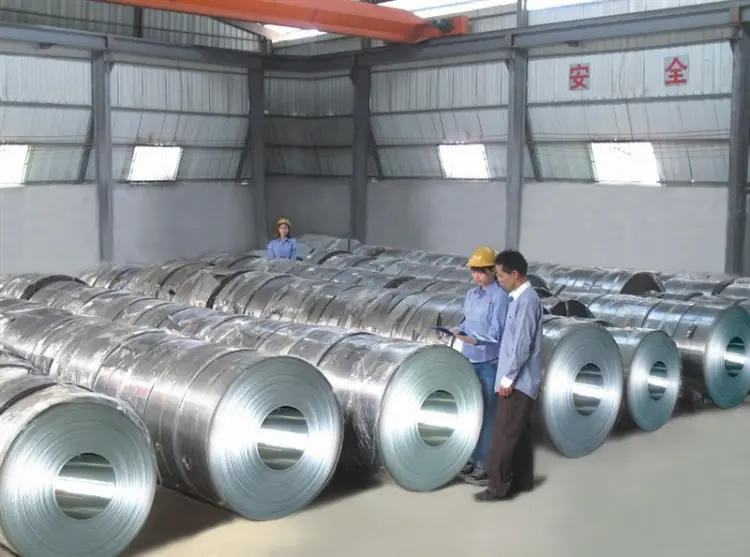
NK Grade A Shipbuilding Steel Coil
NK Grade A Shipbuilding Steel Coil - ClassNK Certified Marine Steel
Comprehensive data on NK Grade A shipbuilding steel: chemical composition, mechanical and physical properties, equivalent grades and application guidance.
Hot rolling, controlled rolling, normalizing, TMCP; suitable for cutting, welding, bending, forming
- Phone : +8618037372205
- Email : [email protected]
- WhatsApp: Contact via Whtsapp
- WeChat: +8618037372205
NK Grade A Shipbuilding Steel Coil Introduction
NK Grade A is a common-strength hull structural steel certified by Nippon Kaiji Kyokai (ClassNK) in accordance with the Rules for the Survey and Construction of Steel Ships. It is one of the most widely used grades for ship hulls and offshore structures, offering a reliable combination of moderate strength, good weldability, and adequate notch toughness at 0°C.
Typical yield strength is 235 MPa (for thicknesses ≤50 mm), with a tensile strength range of 400–520 MPa. The steel is usually supplied as hot-rolled coils or plates, and can be delivered in as-rolled, normalized or thermo-mechanically controlled processed (TMCP) condition. Excellent formability and weldability make it suitable for general shipbuilding applications such as hull plates, decks and stiffeners.
NK Grade A Shipbuilding Steel Coil Chemical Composition
The chemical composition is in accordance with ClassNK Rules. Typical ladle analysis for NK Grade A ensures good weldability and sufficient strength. As a fully killed steel, it often contains aluminium for grain refinement, although Al is not a mandatory requirement in the standard.
| Element | Standard Value (max, unless range) | Remarks |
|---|---|---|
| C | ≤ 0.21 | Carbon; key strength element |
| Si | ≤ 0.50 | Silicon; deoxidizer |
| Mn | ≥ 2.5 × C (commonly 0.50 - 1.00) | Manganese; improves strength and toughness |
| P | ≤ 0.035 | Phosphorus; impurity |
| S | ≤ 0.035 | Sulphur; impurity |
| Al (acid soluble) | ≥ 0.015 (typical, for grain refinement) | Optional but commonly added in fully killed practice |
| Others (Cr, Ni, Mo, Cu) | Residual sum ≤ 0.70 | Trace residuals from scrap |
NK Grade A Shipbuilding Steel Coil Thermal and Electrical Physical Properties
The following values are typical for carbon-manganese structural steels similar to NK Grade A. They are not mandatory requirements of the classification rule but serve as practical engineering data.
| Property | Standard Value | Unit | Test Conditions |
|---|---|---|---|
| Density (ρ) | 7.85 | g/cm³ | Room temperature |
| Modulus of elasticity (E) | 210 | GPa | Room temperature |
| Shear modulus (G) | 81 | GPa | Room temperature |
| Poisson's ratio (ν) | 0.3 | – | Room temperature |
| Thermal expansion coefficient (α) | 12 × 10⁻⁰ | K⁻¹ | 20 – 100 °C |
| Thermal conductivity (λ) | 50 | W/(m·K) | 20 °C |
| Specific heat capacity (c) | 460 | J/(kg·K) | 20 °C |
| Electrical resistivity (ρe) | 0.18 – 0.20 | μΩ·m | 20 °C |
NK Grade A Shipbuilding Steel Coil Mechanical Properties
Mechanical properties are specified according to ClassNK Rules. Values depend on product thickness. The steel is tested in the delivery condition (usually as-rolled or normalized). Impact test temperature is 0°C with longitudinal Charpy V-notch specimens.
| Property | Standard Requirement | Unit | Test Conditions / Remarks |
|---|---|---|---|
| Yield strength (ReH) | ≥ 235 | MPa | Thickness ≤ 50 mm |
| Yield strength (ReH) | ≥ 225 | MPa | Thickness 50 mm < t ≤ 70 mm |
| Yield strength (ReH) | ≥ 215 | MPa | Thickness 70 mm < t ≤ 100 mm |
| Tensile strength (Rm) | 400 – 520 | MPa | All thicknesses |
| Elongation (A5) | ≥ 22 | % | L0 = 5.65√S0, t ≤ 50 mm |
| Elongation (A5) | ≥ 21 | % | L0 = 5.65√S0, 50 < t ≤ 70 mm |
| Elongation (A5) | ≥ 20 | % | L0 = 5.65√S0, 70 < t ≤ 100 mm |
| Elongation (A200) | ≥ 24 | % | L0 = 200 mm, t ≤ 50 mm |
| Elongation (A200) | ≥ 23 | % | L0 = 200 mm, 50 < t ≤ 70 mm |
| Elongation (A200) | ≥ 22 | % | L0 = 200 mm, 70 < t ≤ 100 mm |
| Charpy impact energy (KV) | ≥ 27 (average of 3 specimens) | J | Test temperature 0°C, longitudinal V-notch, all thicknesses |
NK Grade A Shipbuilding Steel Coil Fully Equivalent Standards and Substitutable Grades
| Country / Region | Standard | Grade | Remarks |
|---|---|---|---|
| Japan | NK Rules | NK Grade A | Original classification society standard |
| United Kingdom | LR Rules | LR Grade A | Lloyd's Register common-strength hull steel |
| USA | ASTM A131 / A131M | ASTM A131 Grade A | American Bureau of Shipping (ABS) equivalent - ABS Grade A |
| Norway / Germany | DNV Rules | DNV Grade A | DNV GL class notation |
| France | BV Rules | BV Grade A | Bureau Veritas approved material |
| China | CCS Rules | CCS A | China Classification Society grade |
| Korea | KR Rules | KR Grade A | Korean Register of Shipping |
| Italy | RINA Rules | RINA Grade A | Registro Italiano Navale |
| Russia | RMRS Rules | RS A | Russian Maritime Register of Shipping |
NK Grade A Shipbuilding Steel Coil Application Introduction
NK Grade A is primarily employed in the marine and offshore industry where moderate strength and good toughness are required. Its excellent weldability and formability make it suitable for a wide range of structural parts in shipbuilding and ocean engineering. When replacement or substitution is considered, equivalent classification society grades (ABS, LR, DNV, BV, CCS) are recommended to maintain the required certification.
Product Applications: Hull plates for oil tankers, bulk carriers, container ships, Decks and bottom structures, Transverse and longitudinal bulkheads, Offshore platform decks and modules, Barges and floating docks, General marine steel structures
Processed into products: Outer hull shell plates, Stringers and stiffeners, Transverse webs and frames, Floor plates and girders, Deck plates and hatch coamings, Superstructure components, Bulkhead panels and stiffeners, Bracket plates
Application industries: Shipbuilding, Offshore engineering, Marine construction, Port and harbour structures
NK Grade A Shipbuilding Steel Coil Near-Equivalent or Similar Substitute Materials
| Country / Region | Standard | Grade | Remarks |
|---|---|---|---|
| International | ASTM A131 | ASTM A131 Grade A | Shipbuilding steel; equivalent mechanical properties but separate class certification required |
| European Union | EN 10025-2 | S235JR | General structural steel; similar yield strength but lacks mandatory classification society impact testing and certification |
| International | ISO 630-2 | S235B | Structural steel with comparable strength; not specifically for shipbuilding, impact test at 20°C instead of 0°C |
Notes:
- NK Grade A steel can be delivered in various conditions: as-rolled for thin gauges, normalized for improved toughness, or thermo-mechanically controlled processed (TMCP) for thicker products.
- When ordering, the thickness, width and length should be specified together with the required class certification.
- The steel exhibits good weldability with all conventional welding processes; preheating is generally not required for moderate thickness under normal ambient conditions.
- Carbon equivalent (CE) is usually controlled to ≤0.38% to ensure weldability, though it is not a mandatory requirement in the basic standard.
- Share



