
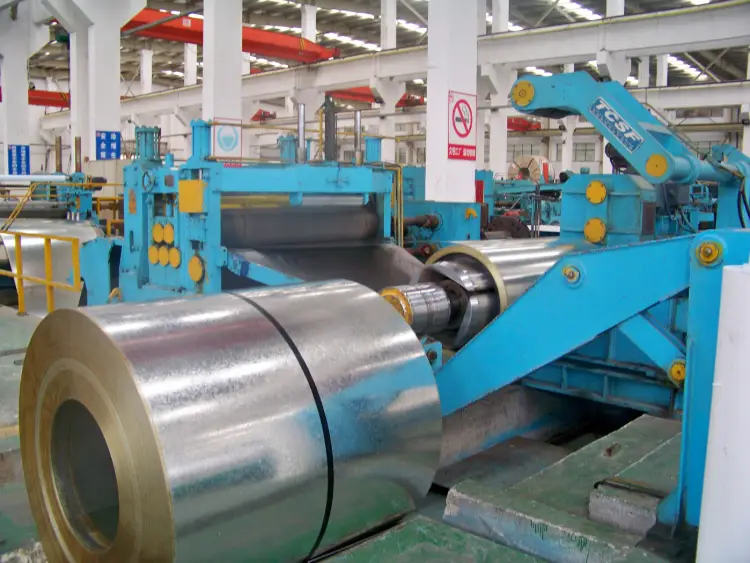
NK F36 Shipbuilding Steel Coil
NK F36 Shipbuilding Steel Coil: High Strength Arctic-Grade Hull Structural Steel for Marine Engineering
NK F36 is a high strength shipbuilding structural steel coil certified by ClassNK, designed for low-temperature service in ship and offshore construction, offering excellent weldability and impact toughness at -60°C.
Normalizing, Thermo-Mechanical Controlled Process (TMCP), as-rolled (depending on thickness and delivery condition)
- Phone : +8618037372205
- Email : [email protected]
- WhatsApp: Contact via Whtsapp
- WeChat: +8618037372205
NK F36 Shipbuilding Steel Coil Introduction
NK F36 is a high-strength hull structural steel grade under the Nippon Kaiji Kyokai (ClassNK) rules, equivalent to IACS UR W11 Grade EH36. It is supplied primarily in coil form and is intended for critical shipbuilding components such as shell plates, decks, and stiffeners operating in Arctic or sub-Arctic environments. Key characteristics include:
- Minimum yield strength of 355 MPa with tensile strength ranging 490–620 MPa
- Guaranteed Charpy V-notch impact energy of 27 J longitudinal at -60°C (F-grade toughness)
- Controlled chemical composition with low carbon equivalent (Ceq ≤ 0.38%) to ensure excellent weldability
- Available in normalizing, TMCP, or as-rolled conditions depending on thickness
The material meets the stringent requirements of the NK Rules for the Survey and Construction of Steel Ships and is globally recognized in maritime classification societies.
NK F36 Shipbuilding Steel Coil Chemical Composition
The following table presents the chemical composition requirements for NK F36 (EH36) according to ClassNK Rules Part K, Chapter 3. All values are maximum unless otherwise specified. The steel is fully killed and grain-refined. Fine grain elements may be added singly or in combination; if combined, the total of Nb+V+Ti shall not exceed 0.12%. The carbon equivalent (Ceq) is restricted to ensure good weldability.
| Element | Specified Value (max unless range given) | Remarks |
|---|---|---|
| Carbon (C) | ≤ 0.18% | Ladle analysis |
| Manganese (Mn) | 0.90 – 1.60% | Range acceptable |
| Silicon (Si) | 0.10 – 0.50% | Range acceptable |
| Phosphorus (P) | ≤ 0.035% | For product analysis: max 0.040% |
| Sulfur (S) | ≤ 0.035% | For product analysis: max 0.040% |
| Aluminum (Al) (acid soluble) | ≥ 0.015% | Total Al minimum 0.020% |
| Niobium (Nb) | 0.02 – 0.05% | Optional grain refiner |
| Vanadium (V) | 0.05 – 0.10% | Optional grain refiner |
| Titanium (Ti) | ≤ 0.02% | Optional grain refiner |
| Copper (Cu) | ≤ 0.35% | Residual element |
| Chromium (Cr) | ≤ 0.20% | Residual element |
| Nickel (Ni) | ≤ 0.40% | Residual element |
| Molybdenum (Mo) | ≤ 0.08% | Residual element |
| Residual sum (Cu+Cr+Ni+Mo) | ≤ 0.70% | If not intentionally added |
| Ceq (Carbon Equivalent) | ≤ 0.38% | Ceq = C + Mn/6 + (Cr+Mo+V)/5 + (Ni+Cu)/15 |
NK F36 Shipbuilding Steel Coil Physical, Thermal and Electrical Properties
The physical properties listed below are typical values for high-strength shipbuilding steel and are not part of the delivery requirements. Actual values may vary slightly depending on processing. They are provided for design calculations such as heat transfer, stress analysis, and electrical engineering.
- Density is standard for low alloy steels.
- Elastic and shear moduli are typical at room temperature.
- Thermal expansion and conductivity are averaged over the indicated temperature ranges.
- Electrical resistivity is representative of structural steels.
| Property | Typical Value | Unit | Test Condition / Remarks |
|---|---|---|---|
| Density (ρ) | 7850 | kg/m³ | at 20°C |
| Elastic Modulus (E) | 205 | GPa | at 20°C, longitudinal |
| Shear Modulus (G) | 80 | GPa | at 20°C, estimated |
| Poisson's Ratio (ν) | 0.3 | — | at 20°C, typical for steel |
| Thermal Expansion Coefficient (α) | 11.7 × 10⁻⁶ | m/(m·°C) | average 20–100°C |
| Thermal Expansion Coefficient (α) | 12.5 × 10⁻⁶ | m/(m·°C) | average 20–200°C |
| Thermal Expansion Coefficient (α) | 13.0 × 10⁻⁶ | m/(m·°C) | average 20–300°C |
| Thermal Conductivity (λ) | 52 | W/(m·K) | at 20°C |
| Thermal Conductivity (λ) | 48 | W/(m·K) | at 100°C |
| Specific Heat Capacity | 460 – 500 | J/(kg·K) | at 20–100°C range |
| Electrical Resistivity (ρ_e) | 0.15 – 0.22 | µΩ·m | at 20°C |
NK F36 Shipbuilding Steel Coil Mechanical Properties
Mechanical properties for NK F36 are extracted from ClassNK Rules for Higher Strength Hull Structural Steels. Yield strength and tensile values apply to transverse specimens unless otherwise agreed. Impact test is mandatory for F-grade at -60°C. Test conditions: tensile test according to ISO 6892-1 or equivalent; Charpy V-notch test per ISO 148-1 on longitudinal samples. Bend test requires no cracks or defects upon 180° bending.
| Property | Required Value | Unit | Test Condition / Remarks |
|---|---|---|---|
| Yield Strength (ReH) | ≥ 355 | MPa | thickness ≤ 50 mm |
| Yield Strength (ReH) | ≥ 355 | MPa | thickness 50 < t ≤ 70 mm |
| Yield Strength (ReH) | ≥ 355 | MPa | thickness 70 < t ≤ 100 mm |
| Tensile Strength (Rm) | 490 – 620 | MPa | all thicknesses up to 100 mm |
| Elongation (A5) | ≥ 21 | % | thickness ≤ 50 mm |
| Elongation (A5) | ≥ 19 | % | thickness 50 < t ≤ 70 mm |
| Elongation (A5) | ≥ 19 | % | thickness 70 < t ≤ 100 mm |
| Charpy V-notch Impact Energy (KV2) | ≥ 27 (longitudinal) | J | at -60°C, thickness ≤ 50 mm |
| Charpy V-notch Impact Energy (KV2) | ≥ 27 (longitudinal) | J | at -60°C, thickness 50 < t ≤ 70 mm |
| Charpy V-notch Impact Energy (KV2) | ≥ 27 (longitudinal) | J | at -60°C, thickness 70 < t ≤ 100 mm |
| Charpy V-notch Impact Energy (KV2) | ≥ 20 (transverse) | J | at -60°C, thickness ≤ 50 mm, if agreed |
| Charpy V-notch Impact Energy (KV2) | ≥ 20 (transverse) | J | at -60°C, thickness 50 < t ≤ 70 mm, if agreed |
| Charpy V-notch Impact Energy (KV2) | ≥ 16 (transverse) | J | at -60°C, thickness 70 < t ≤ 100 mm, if agreed |
| Bend Test (d = bend diameter, a = specimen thickness) | 180° bending, d = 3a | – | Applicable for Rm 490-620 MPa; no cracks |
NK F36 Shipbuilding Steel Coil Fully Equivalent Material Standards and Substitutable Grades
| Country / Society | Standard / Rule | Grade | Remarks |
|---|---|---|---|
| International | IACS UR W11 | EH36 | International Association of Classification Societies Unified Requirement |
| USA | ASTM A131 / A131M | EH36 | American Bureau of Shipping (ABS) equivalent EH36 |
| Norway/Germany | DNV Rules | EH36 | Det Norske Veritas (DNV) EH36 – now DNV GL |
| UK | Lloyd's Register Rules | EH36 | LR EH36, identical property requirements |
| France | Bureau Veritas Rules | EH36 | BV EH36 |
| Korea | Korean Register Rules | EH36 | KR EH36 |
| China | China Classification Society Rules | EH36 | CCS EH36 |
| Italy | RINA Rules | EH36 | RINA EH36 |
| Europe | EN 10025-4 | S355ML | Thermomechanically rolled weldable fine grain structural steel, -50°C impact option (ML) matches EH36 toughness |
| Japan | JIS G 3106 | SM490YA | Not a direct shipbuilding grade but comparable in strength; requires supplementary impact testing for F36 compliance |
NK F36 Shipbuilding Steel Coil Application Introduction
NK F36 steel coil is engineered for demanding marine environments. Its F-grade toughness certification makes it particularly suitable for Arctic and sub-Arctic shipping routes. The coil form allows efficient production of long continuous sections and is ideal for automated welding and cutting processes. Key application areas include:
- Structural hull members: shell plates, deck plates, bulkheads, longitudinal frames, and stiffeners
- Ice-strengthened structures: ice belts, stem, stern frame in icebreakers and ice-class vessels
- Offshore modules: jacket legs, deck beams, flare booms, helideck supports
- Piling and mooring components: anchor racks, bollards, winch foundations
Typical products manufactured from coils: cut-to-length plates, welded beams, bent sections, pipe spools, and prefabricated panels using robotic welding.
Product Applications: Hull plates for ice-class tankers, Deck stringers and sheer strakes, Watertight bulkheads and doors, Strengthened longitudinal and transverse frames, Offshore topside stiffened panels, Crane pedestal and heavy lifting structures, Ice belt and rubbing strake reinforcements
Processed into products: Ship hull shell expansion panels, Transverse web frames and brackets, Stiffeners (flat bars, angle bulbs, bulb flats), Rudder plates and stock support castings (welded assembly), Anchor chain bulkhead reinforcement, Offshore flare boom lattice members, Helideck support beams and columns
Application industries: Shipbuilding and ship repair (Arctic tankers, LNG carriers, naval vessels, icebreakers), Offshore oil & gas (fixed platforms, FPSO modules, subsea templates), Marine equipment manufacturing (cranes, winch bases, rudder horns), Port and harbor engineering (sheet piling, fender panels, mooring dolphins), Renewable energy – offshore wind (transition pieces, tower internals, J-tubes)
NK F36 Shipbuilding Steel Coil Similar / Alternative Materials with Comparable Properties
| Country / Region | Standard | Grade | Remarks |
|---|---|---|---|
| Europe | EN 10025-4 | S355ML | Fine grain structural steel for offshore structures; requires verification for -60°C impact unless specially ordered |
| Europe | EN 10025-6 | S500QL | Higher strength level but similar low-temperature toughness; suitable when weight reduction is priority |
| USA | API 2H | Grade 42 | Offshore structural steel plate with min YS 290 MPa (42 ksi); lower strength, not a direct substitute |
| Worldwide | EN 10225 | S355G8+N | Fixed offshore structure steel, normalized, with guaranteed toughness at -40°C; close but not identical to F36 at -60°C |
| China | GB/T 712 | EH36 | Chinese shipbuilding steel, equivalent chemistry but must confirm ClassNK acceptance if used under NK class |
| Japan | JIS G 3106 | SM490B | Rolled steel for welded structure, min YS 325 MPa; can be used for non-classed marine parts after additional testing |
Notes:
Certification and testing: All coils supplied under NK F36 must be accompanied by a ClassNK material certificate (NKK or NK inspection certificate). Additional tests such as ultrasonic examination, through-thickness tensile (Z-quality) can be agreed upon. For thickness above 40 mm, supplementary conditions may apply per NK rules. Welding: Suitable for all conventional shipbuilding welding processes (SMAW, SAW, FCAW, GMAW) with low-hydrogen consumables; preheat may be required for thicknesses above 50 mm or low ambient temperatures. CEV ≤0.38% ensures good cold cracking resistance. Surface condition: Coils are pickled and oiled, or delivered as hot-rolled; specific surface quality can be specified following NK Part K, Chapter 1. Processing: Can be processed with conventional cold forming, bending, punching, and laser/plasma cutting, though post-processing stress relief may be necessary for severe forming operations.
- Share



