
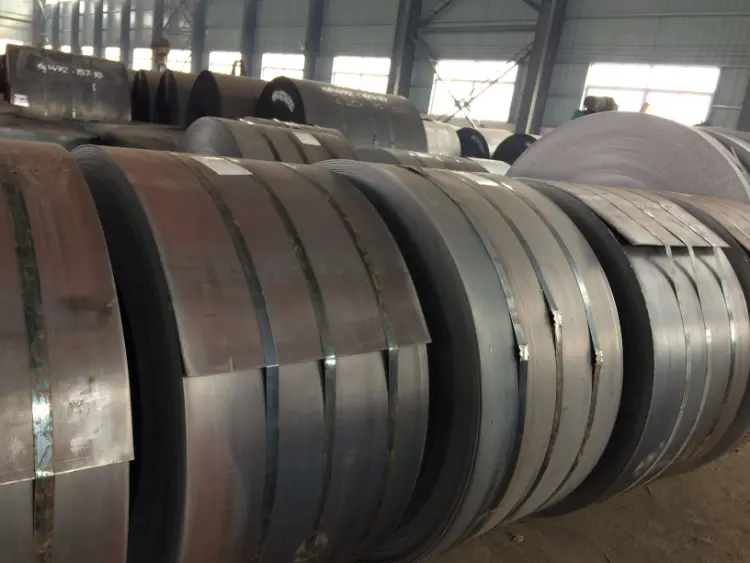
NK F32 Shipbuilding Steel Coil
NK F32 Shipbuilding Steel Coil: Ultimate Data Sheet & Material Guide
Explore authentic NK F32 (FH32) shipbuilding steel coil data: chemical composition, mechanical & thermal properties, full international equivalents, and expert application insights.
Thermo-Mechanically Controlled Process (TMCP); can be normalized or quenched & tempered upon agreement. Suitable for welding, bending, cutting, and forming.
- Phone : +8618037372205
- Email : [email protected]
- WhatsApp: Contact via Whtsapp
- WeChat: +8618037372205
NK F32 Shipbuilding Steel Coil Introduction
NK F32 (FH32) is a high-strength structural steel coil for shipbuilding, certified by Nippon Kaiji Kyokai (ClassNK) under the IACS Unified Requirements. It offers a minimum yield strength of 315 MPa and excellent toughness down to -60 °C, ensuring reliable performance in Arctic and harsh marine environments. The steel is produced via thermo-mechanically controlled processing (TMCP) and is typically supplied in coil form, ready for cutting and forming into hull components. Its balanced chemistry (C ≤ 0.18%, Mn 0.90–1.60%, microalloyed with Nb, V, Ti) provides good weldability and resistance to brittle fracture. The material meets stringent notch toughness requirements (Charpy V-notch ≥ 34 J at -60 °C). Ideal for critical ship structures such as decks, side shells, and bulkheads, NK F32 combines high strength with weight savings and long-term durability.
NK F32 Shipbuilding Steel Coil Chemical Composition
Chemical limits according to IACS UR W11 for Grade FH32 (adopted by ClassNK). All values are maximums unless a range is given. Additional microalloying elements (Nb, V, Ti) may be added singly or in combination to refine grain size and improve toughness. Carbon Equivalent (CEV) is typically limited to ≤0.38% for good weldability.
| Element | Standard Value (%) | Remarks |
|---|---|---|
| Carbon (C) | ≤0.18 | Ladle analysis |
| Silicon (Si) | 0.10–0.50 | For deoxidation and strength |
| Manganese (Mn) | 0.90–1.60 | Enhances strength and toughness |
| Phosphorus (P) | ≤0.025 | Strict limit for low-temperature toughness |
| Sulfur (S) | ≤0.025 | Low sulfur to avoid hot cracking |
| Aluminium (Al) total | ≥0.015 | Grain refining, killed steel practice |
| Niobium (Nb) | ≤0.05 | Optional microalloy; grain refiner |
| Vanadium (V) | ≤0.10 | Optional microalloy; precipitation strengthening |
| Titanium (Ti) | ≤0.02 | Optional microalloy; grain refinement |
| Copper (Cu) | ≤0.35 | Residual element, may improve corrosion resistance |
| Chromium (Cr) | ≤0.20 | Residual, limited for HAZ toughness |
| Nickel (Ni) | ≤0.40 | Residual, improves toughness |
| Molybdenum (Mo) | ≤0.08 | Residual, limited |
| Nitrogen (N) | ≤0.012 (if Al present) | Bound by Al, otherwise 0.009% max |
NK F32 Shipbuilding Steel Coil Thermal and Electrical Physical Properties
The following physical properties are representative for low-carbon microalloyed shipbuilding steels like NK F32. Exact values may vary slightly with chemistry and processing. These data are not part of the class rules but are used for design purposes. Thermal expansion and thermal conductivity are critical for distortion control during welding.
| Property | Typical Value | Unit | Test Condition |
|---|---|---|---|
| Density (ρ) | 7.85 | g/cm³ | Room temperature |
| Elastic Modulus (E) | 205–210 | GPa | Tensile test, longitudinal |
| Shear Modulus (G) | 80–81 | GPa | Calculated from E and ν |
| Poisson's Ratio (ν) | 0.28–0.30 | — | Elastic range |
| Thermal Expansion Coefficient (α) | 11.5 × 10⁻⁶ | K⁻¹ | 20–100 °C |
| Thermal Expansion Coefficient (α) | 12.0 × 10⁻⁶ | K⁻¹ | 20–200 °C |
| Thermal Expansion Coefficient (α) | 12.5 × 10⁻⁶ | K⁻¹ | 20–300 °C |
| Thermal Conductivity (λ) | ≈ 50 | W/(m·K) | at 20 °C |
| Thermal Conductivity (λ) | ≈ 45 | W/(m·K) | at 200 °C |
| Specific Heat Capacity (cp) | ≈ 0.46 | J/(g·K) | Room temperature |
| Electrical Resistivity (ρe) | 0.22–0.25 | µΩ·m | at 20 °C |
NK F32 Shipbuilding Steel Coil Mechanical Properties
Data based on IACS UR W11 for FH32 with thickness ≤50 mm, transverse direction unless noted. For thicker sections (50–100 mm), values are slightly adjusted. Impact tests are performed on longitudinal specimens at -60 °C with a minimum average energy of 34 J. Bend test requirement: no cracks on outer surface after 180° bending.
| Property | Standard Requirement Value | Unit | Test Condition |
|---|---|---|---|
| Yield Strength (ReH) | ≥315 | MPa | Transverse, thickness ≤50 mm |
| Yield Strength (ReH) | ≥315 | MPa | Transverse, 50 < t ≤ 70 mm |
| Yield Strength (ReH) | ≥315 | MPa | Transverse, 70 < t ≤ 100 mm |
| Tensile Strength (Rm) | 440–590 | MPa | Transverse, all thicknesses |
| Elongation (A) | ≥22 | % | Gauge length 5.65√So, thickness ≤50 mm |
| Elongation (A) | ≥22 | % | 50 < t ≤ 70 mm, same gauge |
| Elongation (A) | ≥22 | % | 70 < t ≤ 100 mm, same gauge |
| Charpy V-Notch Impact (KV) | ≥34 (average) | J | Longitudinal, -60 °C, thickness ≤50 mm |
| Charpy V-Notch Impact (KV) | ≥24 (average) | J | Transverse, -60 °C, thickness ≤50 mm |
| Charpy V-Notch Impact (KV) | ≥34 (average) | J | Longitudinal, -60 °C, 50 < t ≤ 70 mm |
| Charpy V-Notch Impact (KV) | ≥34 (average) | J | Longitudinal, -60 °C, 70 < t ≤ 100 mm |
| Bend Test | 180°; no cracks | — | Bend diameter = 3a (a = specimen thickness), thickness ≤50 mm |
NK F32 Shipbuilding Steel Coil Fully Equivalent Material Standards & Replaceable Grades
| Country/Region | Standard | Grade | Remarks |
|---|---|---|---|
| International (IACS) | IACS UR W11 | FH32 | Unified Requirement; identical to NK F32 |
| Japan | Nippon Kaiji Kyokai (NK) | NK F32 (FH32) | Original specification |
| Norway / Germany | DNV GL | FH32 | Det Norske Veritas & Germanischer Lloyd rules |
| UK | Lloyd's Register (LR) | FH32 | Grade FH32, equivalent toughness level |
| France | Bureau Veritas (BV) | FH32 | Identical grade |
| USA | American Bureau of Shipping (ABS) | FH32 | Grade FH32, for low-temperature service |
| China | China Classification Society (CCS) | FH32 | Same mechanical and chemical requirements |
| South Korea | Korean Register (KR) | FH32 | Fully equivalent |
| Italy | RINA | FH32 | Identical classification society grade |
| Russia | Russian Maritime Register (RS) | FH32 | Same designation |
NK F32 Shipbuilding Steel Coil Application Introduction
NK F32 steel coil is primarily used in the construction of sea-going vessels and offshore structures. Its high strength and superior low-temperature toughness make it the material of choice for critical hull members operating in cold climates. The coil form facilitates efficient fabrication of large structural elements via cutting, forming, and welding. It is suitable for parts that must resist brittle fracture under dynamic loads and severe weather. Typical delivery thickness ranges from 6 mm to 25 mm in coil, though heavier gauges are often supplied as plates.
Product Applications: Coil for continuous production of hull plates (uncoiling and cutting), Hull structural components (decks, side shells, bottom shells, bulkheads), Stiffeners, girders, stringers, and frames, Deckhouses and superstructures (cold regions), Piles, sheet piles, and box girders for marine terminals
Processed into products: Transverse and longitudinal stiffeners in hull plating, Bracket plates and connection plates, Hatch coamings and hatch covers (partially), Web frames and floor plates, Ice belt plates (in ice-strengthened vessels), Support structures for thrust blocks and machinery foundations
Application industries: Commercial shipbuilding (container ships, bulk carriers, tankers, LNG carriers), Naval and defence vessels (frigates, icebreakers, patrol boats), Offshore & marine engineering (jack-up rigs, semi-submersibles, FPSOs), Arctic and ice-class ships, Heavy steel fabrication for port equipment and harbour structures
NK F32 Shipbuilding Steel Coil Similar/Comparable Substitute Materials
| Country/Region | Standard | Grade | Remarks |
|---|---|---|---|
| International | IACS UR W11 | EH32 | Lower toughness (impact test at -40 °C instead of -60 °C), otherwise similar strength; suitable for less severe conditions |
| International | IACS UR W11 | FH36 | Higher strength (min yield 355 MPa), similar toughness; can be used with design adjustments |
| Europe | EN 10025-4 | S355ML/S355MLH | Thermomechanical rolled structural steel with yield 355 MPa, not specifically ship class, but comparable chemistry and toughness |
| Europe | EN 10025-3 | S315N/NL | Normalized steel with yield 315 MPa, lower impact toughness; alternative for non-marine applications |
| USA | ASTM A131 / A131M | FH32 | Same grade under ASTM shipbuilding specification, identical requirements |
Notes:
Delivery condition for coil: Typically TMCP (thermo-mechanically controlled process), hot-rolled, pickled and oiled (or dry). The steel is fully killed and fine-grained. Welding: All common welding processes (SMAW, SAW, GMAW, FCAW) can be used with low-hydrogen consumables. Pre-heating is not normally required for thicknesses ≤50 mm at room temperature, but low-hydrogen practice is essential. Certification: Each coil is marked and supplied with a ClassNK certificate (3.2) attesting conformity to the rules. Additional tests: Ultrasonic testing (UT) to EN 10160 Class S2/E2 may be agreed. The steel meets IMO resolution MSC.87(72) for shipbuilding materials.
- Share



