
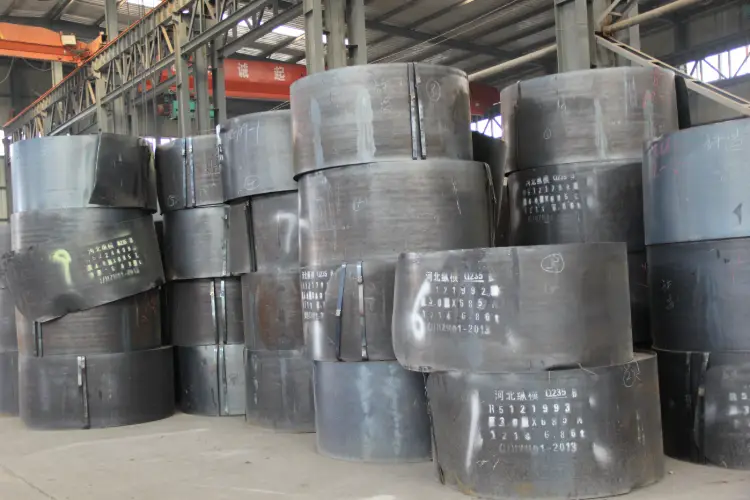
NK D70 Shipbuilding Steel Coil
NK D70 Shipbuilding Steel Coil: Ultra-High Strength Quenched & Tempered Marine Plate
NK D70 is a ClassNK-registered high-strength shipbuilding steel with minimum yield strength 690 MPa, designed for critical marine structures.
Cutting, welding, bending, forming, machining, surface preparation
- Phone : +8618037372205
- Email : [email protected]
- WhatsApp: Contact via Whtsapp
- WeChat: +8618037372205
NK D70 Shipbuilding Steel Coil Introduction
NK D70 (DH70) is a quenched and tempered ultra-high-strength steel grade certified by ClassNK (Nippon Kaiji Kyokai) for ship and offshore constructions. It belongs to the 700 MPa yield strength class, offering exceptional combination of strength, toughness, and weldability. Typical applications include hull plates, decks, and structural members subjected to high loads and low-temperature environments. The steel is supplied in plate or coil form with fine-grain practice and controlled inclusion shape for enhanced crack arrest properties. Its chemical composition is carefully balanced to achieve the required mechanical properties after quenching and tempering, while still allowing conventional welding processes. The material complies with ClassNK Rules Part K, ensuring consistent quality and traceability for marine class society approvals.
NK D70 Shipbuilding Steel Coil Chemical Composition
Chemical composition according to ClassNK Rules Part K, Chapter 3 for high-strength quenched and tempered steels (grade D70). Values represent maximum limits unless a range is indicated. Actual mill certificates may show tighter control for improved weldability and toughness.
- Fine grain elements (Al, Nb, V, Ti) are added singly or in combination.
- Carbon equivalent (CEV) is usually controlled for good weldability.
| Chemical Element | Nominal Value (%) | Remarks |
|---|---|---|
| Carbon (C) | 0.21 max | Typical 0.16-0.20 |
| Silicon (Si) | 0.55 max | Commonly 0.20-0.50 |
| Manganese (Mn) | 1.70 max | Often 1.00-1.60 |
| Phosphorus (P) | 0.025 max | Stringent control for marine service |
| Sulfur (S) | 0.025 max | Low sulfur for toughness |
| Chromium (Cr) | 1.50 max | Optional; enhances hardenability |
| Nickel (Ni) | 2.00 max | Optional; improves low-temperature toughness |
| Molybdenum (Mo) | 0.50 max | Optional; retards temper embrittlement |
| Copper (Cu) | 0.50 max | Optional; may be present from scrap |
| Vanadium (V) | 0.10 max | Grain refinement and precipitation strengthening |
| Niobium (Nb) | 0.05 max | Grain refinement |
| Titanium (Ti) | 0.05 max | Deoxidation and grain refinement |
| Aluminium (Al, total) | 0.015 min | For fine grain practice; acid-soluble Al ≥ 0.015% |
| Boron (B) | 0.005 max | Optional; only if other microalloying elements are absent |
NK D70 Shipbuilding Steel Coil Thermal and Electrical Physical Properties
Typical physical property data for quenched and tempered high-strength low-alloy steel similar to NK D70. These values are not mandatory by ClassNK but are representative for engineering calculations. Density, elastic moduli, and thermal conductivity are near those of structural alloy steels. Actual values may vary slightly depending on exact composition and heat treatment.
| Property | Typical Value | Unit | Condition / Temperature |
|---|---|---|---|
| Density (ρ) | 7.85 | g/cm³ | At 20°C |
| Elastic Modulus (E) | 210 | GPa | At 20°C |
| Shear Modulus (G) | 81 | GPa | Calculated (E, ν) |
| Poisson's Ratio (ν) | 0.30 | - | Elastic range |
| Thermal Expansion Coefficient (α) | 11.7 × 10⁻⁶ | /K | 20 - 100°C |
| Thermal Expansion Coefficient (α) | 12.5 × 10⁻⁶ | /K | 20 - 200°C |
| Thermal Expansion Coefficient (α) | 13.2 × 10⁻⁶ | /K | 20 - 300°C |
| Thermal Expansion Coefficient (α) | 13.8 × 10⁻⁶ | /K | 20 - 400°C |
| Thermal Conductivity (λ) | 33 | W/(m·K) | At 20°C |
| Thermal Conductivity (λ) | 35 | W/(m·K) | At 100°C |
| Thermal Conductivity (λ) | 36 | W/(m·K) | At 200°C |
| Thermal Conductivity (λ) | 34 | W/(m·K) | At 300°C |
| Thermal Conductivity (λ) | 32 | W/(m·K) | At 400°C |
| Specific Heat Capacity (cₚ) | 460 | J/(kg·K) | At 20°C |
| Specific Heat Capacity (cₚ) | 480 | J/(kg·K) | At 100°C |
| Specific Heat Capacity (cₚ) | 510 | J/(kg·K) | At 200°C |
| Specific Heat Capacity (cₚ) | 550 | J/(kg·K) | At 300°C |
| Specific Heat Capacity (cₚ) | 600 | J/(kg·K) | At 400°C |
| Electrical Resistivity (ρₑ) | 0.23 × 10⁻⁶ | Ω·m | At 20°C |
NK D70 Shipbuilding Steel Coil Mechanical Properties
Mechanical properties for NK D70 (DH70) plates/coils in quenched and tempered condition, based on ClassNK Rules Part K. Thickness ranges and testing orientation are specified. Impact test temperature is -20°C for D-grade. Elongation requirement depends on thickness; values shown are for plate thickness ≤ 50 mm. For thickness 50-100 mm, min elongation is 16%. Bend test mandrel diameter increases with plate thickness.
| Property | Required Value | Unit | Test Condition |
|---|---|---|---|
| Yield Strength (ReH) | 690 min. | MPa | Transverse test, t ≤ 50 mm |
| Tensile Strength (Rm) | 770 - 940 | MPa | Transverse test, t ≤ 50 mm |
| Elongation (A5) | 14 min. | % | Transverse test, gauge length 5.65√S₀, t ≤ 50 mm |
| Elongation (A5) | 16 min. | % | Transverse test, 50 < t ≤ 100 mm |
| Charpy V-notch Impact (KV₂) | 46 min. (avg), 31 min. (single) | J | Longitudinal, -20°C |
| Bend Test (180°) | d = 4a (t ≤ 25 mm) | - | No cracks, a = specimen thickness |
| Bend Test (180°) | d = 5a (25 < t ≤ 50 mm) | - | No cracks, a = specimen thickness |
NK D70 Shipbuilding Steel Coil Fully Equivalent Grades from Other International Standards
| Country / Region | Standard / Class Society | Equivalent Grade | Remarks |
|---|---|---|---|
| International | American Bureau of Shipping (ABS) | ABS DH70 / EQ70 | Same strength level, -20°C impact test |
| International | DNV GL (now DNV) | DNV E690 | Typically requires -40°C for E-grade; verify impact temperature |
| International | Lloyd's Register (LR) | LR DH70 | D-grade corresponds to -20°C |
| International | Bureau Veritas (BV) | BV D690 | Equivalent mechanical and toughness requirements |
| International | China Classification Society (CCS) | CCS D690 | Chinese equivalent for high-strength ship plate |
| International | Korean Register (KR) | KR D70 | Similar designation system |
| International | RINA | RINA D690 | Italian class society equivalent |
NK D70 Shipbuilding Steel Coil Application Introduction
NK D70 shipbuilding steel is specifically designed for critical structural components in modern shipbuilding and offshore engineering where weight saving and high payload capability are essential. Its combination of ultra-high strength, excellent low-temperature toughness, and good weldability makes it suitable for the most demanding marine environments. Typical applications include:
Product Applications: Hull structural plates (main deck, bottom, side shell), Longitudinal and transverse frames, Bulkhead stiffeners, Deck beams and girders, Jack-up rig legs and spudcans, Submarine pressure hulls, Heavy-lift crane booms, Icebreaker belt plates
Processed into products: Tensile-loaded stiffeners and brackets, High-stress chock plates and foundation structures, Welded T-joints and cruciform joints, Penetration pieces and reinforcements, Crane pedestal flanges, Deck tie-down points, Module support beams on offshore platforms, Fatigue-critical nodes in jack-up legs
Application industries: Shipbuilding (military and commercial vessels), Offshore oil & gas platforms (jack-ups, semi-submersibles, TLPs), Heavy lift and crane vessels, Marine renewable energy structures (offshore wind turbine foundations), Heavy machinery and pressure vessels, Bridge engineering (moveable bridges, trusses)
NK D70 Shipbuilding Steel Coil Similar / Alternative Materials
| Country / Region | Standard | Grade | Remarks |
|---|---|---|---|
| Europe | EN 10025-6 | S690QL / S690Q | Quenched and tempered structural steel; similar strength, but not class-approved for marine use without additional certification |
| USA | ASTM A514 / A517 | Grade Q / Grade F | High-strength quenched and tempered plate; 690 MPa min yield, used in pressure vessels and structural applications |
| Japan | JIS G3106 | SM570 | Rolled steel for welded structures; lower strength (570 MPa class), good weldability |
| Germany | DIN EN 10028-6 | P690QH | Pressure vessel steel; similar base chemistry but may have stricter toughness requirements |
| International | API 2Y / 2W | Grade 65 / 70 | Steel for offshore structures; 690 MPa class, often used in tension leg platforms and jackets |
Notes:
Welding considerations: NK D70 steel requires careful control of welding procedures, including preheating (typically 100-150°C) and low-hydrogen electrodes/processes to avoid hydrogen-induced cracking. Post-weld heat treatment (PWHT) is usually not required for thicknesses below 50 mm, but may be considered for heavily restrained joints. The steel exhibits good formability but must be bent with adequate radii to avoid strain ageing. Corrosion protection: As with carbon-manganese steels, a coating system (paint, cathodic protection) is necessary for marine service. The material can be supplied with primer or in bare condition. Certification: All plates/coils are delivered with ClassNK surveyor's certificate (3.1 or 3.2 according to EN 10204).
- Share



