
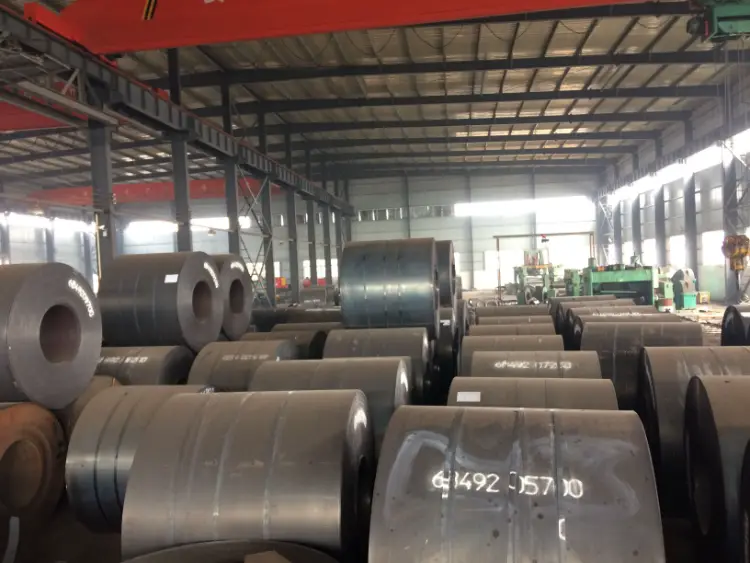
NK D36 Shipbuilding Steel Coil
NK D36 Shipbuilding Steel Coil: High-Strength Marine Structural Steel for Shipbuilding
Explore the properties and applications of NK D36 shipbuilding steel coil, a high-strength structural steel conforming to Nippon Kaiji Kyokai rules. Get chemical composition, mechanical properties, and international equivalents.
Hot rolling, controlled rolling, normalizing, thermo-mechanical control process (TMCP)
- Phone : +8618037372205
- Email : [email protected]
- WhatsApp: Contact via Whtsapp
- WeChat: +8618037372205
NK D36 Shipbuilding Steel Coil Introduction
NK D36 is a high-strength hull structural steel grade certified by Nippon Kaiji Kyokai (ClassNK). It is widely used in the construction of ships and offshore structures. The steel offers a minimum yield strength of 355 MPa and tensile strength in the range of 490–620 MPa, ensuring excellent load-bearing capacity and weldability. Key characteristics:
- Good toughness at low temperatures (impact test at -20°C)
- Excellent weldability with controlled carbon equivalent
- High strength-to-weight ratio
- Conforms to international ship classification society standards
NK D36 Shipbuilding Steel Coil Chemical Composition
The chemical composition of NK D36 steel is controlled to ensure good weldability, strength, and toughness. The carbon equivalent (CEV) is typically limited to 0.38–0.43 depending on thickness. Key elements:
- Manganese provides solid solution strengthening
- Microalloying elements like Nb and V refine grain structure and improve strength
- Aluminum is added for deoxidation and grain refinement
| Element | Standard Value | Remarks |
|---|---|---|
| Carbon (C) | ≤ 0.18% | Max for weldability |
| Silicon (Si) | 0.10–0.50% | Deoxidizer |
| Manganese (Mn) | 0.90–1.60% | Strength and toughness |
| Phosphorus (P) | ≤ 0.035% | Max impurity |
| Sulfur (S) | ≤ 0.035% | Max impurity |
| Aluminum (acid soluble) (Als) | ≥ 0.015% | Grain refinement |
| Niobium (Nb) | 0.02–0.05% | Microalloying |
| Vanadium (V) | 0.05–0.10% | Optional; microalloying |
| Titanium (Ti) | ≤ 0.02% | Max; grain refinement |
| Copper (Cu) | ≤ 0.35% | Max |
| Chromium (Cr) | ≤ 0.20% | Max |
| Nickel (Ni) | ≤ 0.40% | Max |
| Molybdenum (Mo) | ≤ 0.08% | Max |
NK D36 Shipbuilding Steel Coil Thermal and Electrical Physical Properties
These values are representative for carbon-manganese structural steel and are not part of the NK specification requirement. They are provided for design calculation purposes. Note:
- Physical properties may vary slightly with heat treatment and processing route
- Thermal conductivity decreases with increasing temperature
| Property | Standard Required Value | Unit | Test Condition |
|---|---|---|---|
| Density (ρ) | 7.85 | g/cm³ | At 20°C |
| Modulus of Elasticity (E) | 205 | GPa | At 20°C |
| Shear Modulus (G) | 80 | GPa | Approximate, at 20°C |
| Poisson's Ratio (ν) | 0.3 | — | At 20°C |
| Thermal Expansion Coefficient (α) | 11.5 × 10⁻⁶ | /K | 20–100°C |
| Thermal Expansion Coefficient (α) | 12.1 × 10⁻⁶ | /K | 20–200°C |
| Thermal Expansion Coefficient (α) | 12.9 × 10⁻⁶ | /K | 20–400°C |
| Thermal Conductivity (λ) | 52 | W/(m·K) | At 20°C |
| Specific Heat Capacity | 470 | J/(kg·K) | At 20°C |
| Electrical Resistivity (ρ_e) | 0.18 × 10⁻⁶ | Ω·m | At 20°C |
NK D36 Shipbuilding Steel Coil Mechanical Properties
Mechanical properties are tested in the normalized, controlled rolled, or TMCP condition. Impact toughness is evaluated at -20°C. Bend tests are performed with specified former diameters depending on thickness. Important:
- Yield and tensile values depend on thickness range
- Elongation is measured on a gauge length of 5.65√S0
| Property | Standard Required Value | Unit | Test Condition |
|---|---|---|---|
| Yield Strength (ReH) | ≥ 355 | MPa | Thickness ≤ 50 mm |
| Yield Strength (ReH) | ≥ 355 | MPa | Thickness 50–70 mm |
| Yield Strength (ReH) | ≥ 355 | MPa | Thickness 70–100 mm |
| Tensile Strength (Rm) | 490–620 | MPa | All thicknesses |
| Elongation (A) | ≥ 21 | % | Thickness ≤ 50 mm, L0 = 5.65√S0 |
| Elongation (A) | ≥ 20 | % | Thickness 50–70 mm |
| Elongation (A) | ≥ 19 | % | Thickness 70–100 mm |
| Impact Energy (KV) | ≥ 34 (longitudinal) | J | At -20°C, V-notch |
| Impact Energy (KV) | ≥ 24 (transverse) | J | At -20°C, V-notch |
| Bend Test (Former Diameter) | 3a (a = thickness) | — | Thickness ≤ 25 mm, 180° bend |
| Bend Test (Former Diameter) | 4a | — | Thickness > 25 mm |
NK D36 Shipbuilding Steel Coil Exact Equivalent Material Standards and Substitutable Grades
| Country/Region | Standard | Grade | Remarks |
|---|---|---|---|
| International | IACS UR W11 | D36 | Unified requirement for hull structural steel |
| USA / International | ABS Rules | ABS D36 | American Bureau of Shipping |
| Norway / International | DNV Rules | DNV D36 | DNV (now DNV GL) |
| UK / International | LR Rules | LR D36 | Lloyd's Register |
| France / International | BV Rules | BV D36 | Bureau Veritas |
| China | CCS Rules | CCS D36 | China Classification Society |
| South Korea | KR Rules | KR D36 | Korean Register |
| Italy | RINA Rules | RINA D36 | Registro Italiano Navale |
| Germany | GL Rules | GL D36 | Germanischer Lloyd (historical, now DNV) |
NK D36 Shipbuilding Steel Coil Application Introduction
NK D36 steel is primarily used in the shipbuilding and offshore industries where a combination of high strength, good toughness, and excellent weldability is required. It is suitable for critical structural components exposed to moderate low-temperature environments. Typical applications include:
- Main hull structure: bottom shells, side shells, decks, bulkheads
- Reinforcement members: longitudinal stiffeners, web frames, brackets
- Offshore platform decks, jack-up rig legs, and modules
- Manufacture of coiled tubing and pipes for marine systems
Product Applications: Ship hull plates and sections, Deck and bulkhead panels, Transverse and longitudinal girders, Offshore module structural frames, Coil-form strip for spiral welded pipe
Processed into products: Shell plating, Stringers and stiffeners, Watertight bulkheads, Reinforced floor plates, Bracket plates, Padeyes and lifting lugs, Cold-formed structural profiles from coil
Application industries: Shipbuilding (commercial vessels, naval ships), Offshore Oil & Gas (fixed platforms, FPSOs), Marine Engineering (port structures, floating docks), Bridge Building (for components requiring notch toughness)
NK D36 Shipbuilding Steel Coil Similar/Comparable Substitute Materials and Analysis
| Country/Region | Standard | Grade | Remarks |
|---|---|---|---|
| Japan | JIS G 3106 | SM490A/B/C | Welding structural steel with similar strength; D36 has better low-temperature toughness and is certified by ship classification societies |
| China | GB/T 712 | A36, D36, E36 | GB D36 is essentially identical to NK D36 |
| Japan | NK Rules | NK DH36 | Same strength level but impact test at -20°C (same as D36; DH36 is often considered equivalent) |
| European | EN 10025-4 | S355ML | Thermomechanical rolled fine grain structural steel with minimum 355 MPa yield; thickness limits and impact conditions may differ |
| USA | ASTM A131 / A131M | Grade D36 | ASTM shipbuilding steel with same designation |
| Russia | GOST 5521 | D36 | Russian shipbuilding steel similar but check exact composition and impact requirements |
Notes:
NK D36 is subject to stringent inspection by ClassNK surveyors. Mill certificates must include chemical analysis, tensile, impact, and bend test results. For welded structures, preheating may be required based on carbon equivalent and plate thickness. NK D36 can be delivered with additional through-thickness property (Z-grade) requirements, designated as NK D36 Z25/Z35.
- Share



