
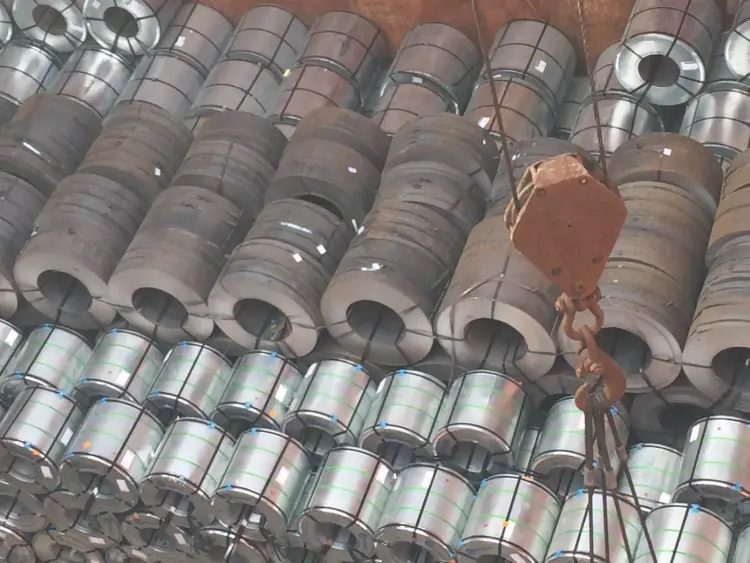
LR Grade A Shipbuilding Steel Coil
LR Grade A Shipbuilding Steel Coil - Technical Data and Equivalent Grades
Comprehensive material properties, international equivalents, and application guide for LR Grade A normal strength hull structural steel.
Hot rolling, cold forming, gas cutting, arc welding, submerged arc welding, normalizing (if required)
- Phone : +8618037372205
- Email : [email protected]
- WhatsApp: Contact via Whtsapp
- WeChat: +8618037372205
LR Grade A Shipbuilding Steel Coil Introduction
LR Grade A is a normal strength hull structural steel certified by Lloyd's Register (LR). It is widely used in shipbuilding and marine engineering for its
- Good combination of strength and ductility
- Excellent weldability
- Reliable notch toughness at ambient temperature (impact test at 20°C typically)
- Cost-effectiveness for general structural components
The steel is produced in accordance with LR Rules and IACS UR W11. It is typically supplied as hot-rolled coils, plates, and sections, and can be used in as-rolled or normalized condition. Minimum yield strength is 235 MPa, ensuring adequate structural integrity for various hull members.
LR Grade A Shipbuilding Steel Coil Chemical Composition
The chemical composition conforms to LR Rules and IACS UR W11 for ordinary strength hull structural steel Grade A. The following table shows the typical limits. Elements not listed are controlled as residual elements with maximum limits: Cu ≤ 0.30%, Cr ≤ 0.25%, Ni ≤ 0.30%, Mo ≤ 0.08%, and the sum of Cu+Cr+Ni+Mo ≤ 0.70%. Aluminum may be added to achieve fine grain practice, but is not mandatory for Grade A.
| Element | Standard Value (max or range) | Remarks |
|---|---|---|
| Carbon (C) | 0.21% max | Also Min Mn ≥ 2.5×C, commonly Mn 0.60 - 1.20% |
| Manganese (Mn) | Min 2.5×C; typical range 0.80 - 1.20% | When C ≤ 0.18%, Mn may be as low as 0.60% |
| Silicon (Si) | 0.50% max | Typical 0.10 - 0.35% |
| Phosphorus (P) | 0.035% max | |
| Sulfur (S) | 0.035% max | |
| Aluminum (Al) (acid soluble) | 0.015% min (if fine grain practice) | Optional; not required for Grade A |
| Copper (Cu) | 0.30% max | Residual element |
| Chromium (Cr) | 0.25% max | Residual element |
| Nickel (Ni) | 0.30% max | Residual element |
| Molybdenum (Mo) | 0.08% max | Residual element |
LR Grade A Shipbuilding Steel Coil Physical Properties
The following physical properties are typical for carbon-manganese steel similar to LR Grade A. These values are not specified in the LR material rules but are representative for design calculations and are based on standard steel data at room temperature unless otherwise noted. Density, elastic moduli, and thermal/electrical properties may vary slightly with chemical composition and processing.
| Property | Typical Value | Unit | Test Condition / Remarks |
|---|---|---|---|
| Density (ρ) | 7.85 | g/cm³ | 20°C |
| Modulus of Elasticity (E) | 205 | GPa | 20°C |
| Shear Modulus (G) | 80 | GPa | 20°C (calculated from E and Poisson's ratio) |
| Poisson's Ratio (ν) | 0.3 | - | 20°C |
| Thermal Expansion Coefficient (α) | 11.5 - 13.0 | 10⁻⁶/K | Range from 20°C to 300°C; 12.0 typical at 100°C |
| Thermal Conductivity (λ) | 50 - 55 | W/(m·K) | At 20°C; decreases with temperature |
| Specific Heat Capacity (c_p) | 460 | J/(kg·K) | At 20°C |
| Electrical Resistivity (ρ_e) | 0.14 - 0.20 | μΩ·m | At 20°C |
LR Grade A Shipbuilding Steel Coil Mechanical Properties
Properties are based on tensile and impact tests in accordance with LR Rules and IACS UR W11. Yield strength (ReH), tensile strength (Rm), elongation (A), and Charpy V-notch impact energy (KV) depend on product thickness. Impact test temperature is 20°C for Grade A. Bending test is carried out over a former of diameter 'd', with test piece width = 2a (a = thickness). The table shows requirements for different thickness ranges.
| Property | Standard Requirement | Unit | Test Condition / Remarks |
|---|---|---|---|
| Yield Strength (ReH) | min 235 | MPa | All thicknesses t ≤ 100 mm, transverse |
| Tensile Strength (Rm) | 400 - 520 | MPa | All thicknesses, transverse |
| Elongation (A) | min 22 | % | Gauge length 5.65√S₀; thickness t ≤ 50 mm, longitudinal |
| Elongation (A) | min 22 | % | 50 < t ≤ 70 mm |
| Elongation (A) | min 21 | % | 70 < t ≤ 100 mm |
| Charpy V-notch Impact (KV) | min 27 (average) / 20 (individual) | J | Test temperature 20°C, longitudinal, standard 10x10 mm specimen; for sub-size specimens see rules |
| Bend Test (180°) | d = 2a | - | Thickness ≤ 25 mm, Rm 400 - 460 MPa |
| Bend Test (180°) | d = 3a | - | Thickness > 25 - 50 mm, or t ≤ 25 mm when Rm > 460 - 520 MPa |
| Bend Test (180°) | d = 4a | - | Thickness > 50 - 100 mm |
LR Grade A Shipbuilding Steel Coil Exactly Equivalent Material Standards and Substitutable Grades
| Country / Region | Standard | Grade | Remarks |
|---|---|---|---|
| USA | ABS Rules (American Bureau of Shipping) | Grade A | Identical requirements per IACS UR W11 |
| Germany / Norway | DNV Rules (Det Norske Veritas) | Grade A | Now DNV GL (formerly Germanischer Lloyd integrated); Grade A same |
| France | BV Rules (Bureau Veritas) | Grade A | Equivalent ordinary strength hull steel |
| China | CCS Rules (China Classification Society) | Grade A | Same specification |
| Japan | NK Rules (Nippon Kaiji Kyokai) | Grade A | Equivalent |
| Italy | RINA Rules (Registro Italiano Navale) | Grade A | Equivalent |
| Korea | KR Rules (Korean Register of Shipping) | Grade A | Equivalent |
| Russia | RS Rules (Russian Maritime Register of Shipping) | Grade A | Equivalent |
| India | IRS Rules (Indian Register of Shipping) | Grade A | Equivalent |
LR Grade A Shipbuilding Steel Coil Application Introduction
LR Grade A steel is designed for the construction of seagoing vessels and marine structures. It is suitable for moderately stressed structural components with a service temperature generally above 0°C (design temperature not lower than 20°C impact test). Excellent weldability makes it ideal for all conventional shipyard welding processes. Typical applications include:
- Hull shell plating (side and bottom)
- Main deck and stringer plates
- Bulkheads and inner bottom
- Transverse frames and web frames
- Stiffeners, brackets, and girder webs
- Offshore platform topside structures (with proper design code)
Product Applications: Ship hull plates (flat and curved), Deck panels, Bulkhead sections, Fabricated beams and girders, Stiffening ribs (longitudinals, frames)
Processed into products: Shell plating (strakes), Deck plating, Transverse web frames, Floor plates, Bracket toes, Stiffeners (angle bars, bulb flats), Girder webs and flanges, Hatch coaming plates, Watertight bulkhead panels
Application industries: Shipbuilding (commercial vessels, naval auxiliaries), Offshore oil and gas platforms (topside secondary structures), Barge and floating production storage and offloading (FPSO) construction, Dredgers, tugs, and workboats, Marine infrastructure (lock gates, floating docks)
LR Grade A Shipbuilding Steel Coil Similar / Nearby Alternative Materials
| Country / Region | Standard | Grade | Remarks |
|---|---|---|---|
| International (IACS) | LR, ABS, DNV, etc. | Grade B | Higher impact test temperature (0°C) than Grade A; otherwise similar chemical and mechanical properties. |
| International (IACS) | LR, ABS, DNV, etc. | AH32 | Higher strength hull structural steel (ReH min 315 MPa) with impact test at 0°C; can be used if higher strength needed. |
| Europe | EN 10025-2 | S235JR | Similar minimum yield strength 235 MPa; not classed for shipbuilding but comparable structural steel; check notch toughness requirements. |
| China | GB/T 712 | Grade A (CCS) | Same as LR Grade A through CCS equivalence; domestic Chinese ship steel standard. |
Notes:
LR Grade A steel is not intended for thick sections where fracture toughness at low temperature is critical; for such applications consider LR Grade D or E. For thicknesses over 40-50 mm, normalizing may be required or recommended depending on design conditions and classification rules. When welding, low-hydrogen electrodes and appropriate preheat procedures should be applied for thicker sections to avoid cold cracking. Surface condition and tolerances comply with EN 10029 or equivalent for plates. Always refer to the latest edition of the LR Rules and project-specific class notations for exact compliance.
- Share



