
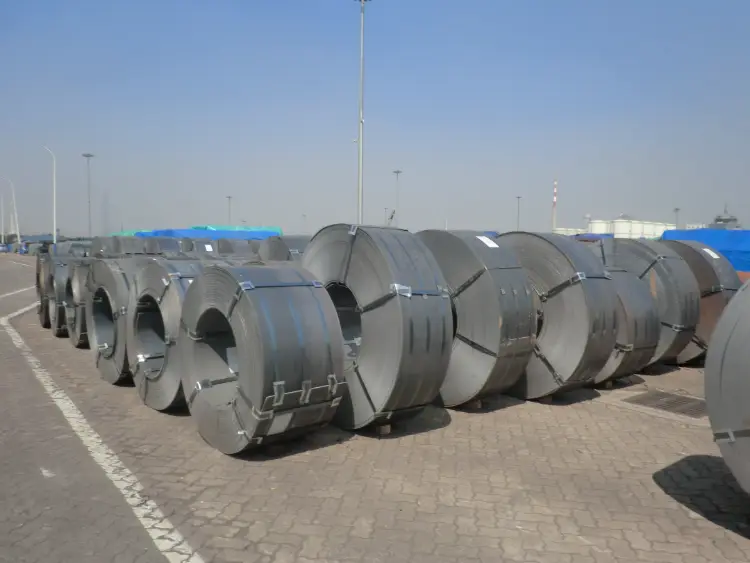
LR FH42 Shipbuilding Steel Coil
LR FH42 Shipbuilding Steel Coil - High-Strength Low-Temperature Structural Steel
LR FH42 is a high-strength structural steel for shipbuilding with minimum yield strength of 420 MPa and guaranteed impact toughness down to -60°C. Certified by Lloyd's Register, it is used in critical marine structures requiring excellent weldability and low-temperature performance.
Hot rolling, cold forming, welding, cutting, machining
- Phone : +8618037372205
- Email : [email protected]
- WhatsApp: Contact via Whtsapp
- WeChat: +8618037372205
LR FH42 Shipbuilding Steel Coil Introduction
LR FH42 is a high-strength, low-temperature shipbuilding steel grade certified by Lloyd's Register (LR) under the Rules for the Manufacture, Testing and Certification of Materials. It belongs to the category of fine-grained, fully killed structural steels with a minimum yield strength of 420 MPa. The 'F' designation indicates that the steel is suitable for service at temperatures as low as -60°C, with guaranteed Charpy V-notch impact values. Typical applications include critical structural members of ships, offshore platforms, and other marine structures operating in harsh, cold environments. The steel is supplied in the form of coils or plates and is characterized by excellent weldability, good formability, and high resistance to brittle fracture.
LR FH42 Shipbuilding Steel Coil Chemical Composition
The chemical composition of LR FH42 conforms to Lloyd's Register rules for high-strength shipbuilding steels. The steel is fine-grained, fully killed and may contain aluminum, niobium, vanadium, titanium or combinations thereof for grain refinement and strength. Maximum limits for phosphorus and sulfur ensure excellent weldability and toughness. The addition of alloying elements is specified to achieve the required mechanical properties.
- Carbon Equivalent (CE) may be limited depending on thickness to ensure weldability.
- Grain-refining elements such as Al, Nb, V, Ti are added as necessary.
| Element | Standard Value (max unless range) | Remarks |
|---|---|---|
| Carbon (C) | 0.18 % | Maximum; typical range 0.10-0.18% |
| Silicon (Si) | 0.10 - 0.50 % | Killed steel; typical range |
| Manganese (Mn) | 1.00 - 1.60 % | Required for strength and toughness |
| Phosphorus (P) | 0.025 % | Maximum; lower for better weldability |
| Sulfur (S) | 0.025 % | Maximum; low for lamellar tearing resistance |
| Aluminum (Al, total) | ≥ 0.015 % | Grain refinement; acid-soluble Al may be specified |
| Niobium (Nb) | 0.02 - 0.05 % | Optional, alone or in combination with V/Ti |
| Vanadium (V) | 0.05 - 0.10 % | Optional, alone or in combination with Nb/Ti |
| Titanium (Ti) | 0.007 - 0.05 % | Optional, grain refinement; may be specified |
| Nitrogen (N) | ≤ 0.012 % | Maximum; typical for killed steel |
| Copper (Cu) | ≤ 0.35 % | Residual element; may be present |
| Chromium (Cr) | ≤ 0.20 % | Residual element; may be present |
| Nickel (Ni) | ≤ 0.40 % | Residual element; may be present |
| Molybdenum (Mo) | ≤ 0.08 % | Residual element; may be present |
LR FH42 Shipbuilding Steel Coil Thermal and Electrical Physical Properties
Physical properties are typical for microalloyed, fine-grained structural steels. These values are not mandatory per LR rules but are provided for design purposes. Density is assumed at room temperature; thermal and electrical properties vary with temperature. Data are average values for similar carbon-manganese high-strength steels.
- Elastic modulus decreases with increasing temperature.
- Thermal conductivity and resistivity are sensitive to composition and microstructure.
| Property | Typical Value | Unit | Test Condition |
|---|---|---|---|
| Density (ρ) | 7.85 | g/cm³ | 20°C |
| Elastic Modulus (E) | 210 | GPa | 20°C, static tensile |
| Shear Modulus (G) | 81 | GPa | 20°C, calculated from E and ν |
| Poisson's Ratio (ν) | 0.3 | — | room temperature |
| Thermal Expansion Coefficient (α) | 12.0 × 10⁻⁶ | 1/K | 20-100°C, average |
| Thermal Expansion Coefficient (α) | 12.5 × 10⁻⁶ | 1/K | 20-200°C, average |
| Thermal Expansion Coefficient (α) | 13.0 × 10⁻⁶ | 1/K | 20-300°C, average |
| Thermal Conductivity (λ) | 50 | W/(m·K) | 20°C |
| Thermal Conductivity (λ) | 47 | W/(m·K) | 200°C |
| Specific Heat Capacity (cp) | 460 | J/(kg·K) | 20°C |
| Electrical Resistivity (ρ_e) | 0.25 - 0.30 | Ω·mm²/m | 20°C |
LR FH42 Shipbuilding Steel Coil Mechanical Properties
Mechanical properties of LR FH42 are determined according to LR testing procedures. Minimum yield strength and tensile strength values are specified for thickness ranges typical of shipbuilding plates. Elongation is measured on a gauge length of 5.65√S₀ (proportional test piece). Charpy impact tests are performed at -60°C, with minimum absorbed energy values specified for both longitudinal and transverse specimens. Bend tests are conducted with a mandrel diameter related to the specimen thickness.
- Properties may vary slightly with thickness; typical data below are for plates up to 50 mm.
- Normalized or thermomechanically rolled condition is standard.
| Property | Standard Requirement Value | Unit | Test Condition |
|---|---|---|---|
| Yield Strength (ReH) | ≥ 420 | MPa | Room temperature, thickness ≤ 50 mm |
| Yield Strength (ReH) | ≥ 420 - (thickness factor) | MPa | Thickness > 50 mm; may be slightly reduced per LR rules |
| Tensile Strength (Rm) | 530 - 680 | MPa | Room temperature, all thicknesses |
| Elongation (A) | ≥ 19 | % | Gauge length 5.65√S₀; longitudinal, thickness ≤ 50 mm |
| Charpy Impact (KV, longitudinal) | ≥ 41 (average) | J | -60°C; min single value 28 J |
| Charpy Impact (KV, transverse) | ≥ 27 (average) | J | -60°C; min single value 20 J |
| Bend Test (180°) | d = 3a (for t ≤ 50 mm) | — | a = specimen thickness; no cracks |
| Bend Test (180°) | d = 4a (for t > 50 mm) | — | a = specimen thickness; no cracks |
LR FH42 Shipbuilding Steel Coil Exact Equivalent Material Standards & Substitute Grades
| Country/Region | Standard | Grade | Remarks |
|---|---|---|---|
| United Kingdom | LR (Lloyd's Register) | FH42 | Identical – LR certified material |
| USA | ABS (American Bureau of Shipping) | FH42 | Same grade under ABS rules |
| Norway/Germany | DNV (Det Norske Veritas) | FH42 | Equivalent in DNV classification |
| France | BV (Bureau Veritas) | FH42 | Equivalent BV grade |
| China | CCS (China Classification Society) | FH42 | Equivalent CCS grade |
| South Korea | KR (Korean Register) | FH42 | Equivalent KR grade |
| Japan | NK (Nippon Kaiji Kyokai) | FH42 | Equivalent NK grade |
| Italy | RINA (Registro Italiano Navale) | FH42 | Equivalent RINA grade |
| Russia | RS (Russian Maritime Register) | FH42 | Equivalent RS grade |
| International | IMO IACS unified requirements | FH42 | All IACS members accept equivalent FH42 |
LR FH42 Shipbuilding Steel Coil Application Introduction
LR FH42 steel is primarily designed for the shipbuilding and offshore industries, where high strength and excellent notch toughness at sub-zero temperatures are critical. The steel's weldability and formability make it suitable for complex structural fabrications. Typical applications involve components subjected to dynamic loading and harsh environmental conditions.
- Advanced steelmaking practices (low sulfur, inclusion shape control) provide superior resistance to lamellar tearing.
- Thermomechanical rolling is often used to achieve the required properties with lean alloy design.
Product Applications: Hull plates and stiffeners, Deck plating and stringers, Bulkheads and bottom plating, Structural members of offshore topsides, Modules for FPSO and FLNG units, Ice belt regions of ice-class vessels
Processed into products: Longitudinal and transverse frames, Webs and flanges of built-up girders, Weather deck panels and hatch coamings, Bracket plates and beam knees, Helideck supporting structures, Transition pieces in offshore wind turbines (if marine certified)
Application industries: Shipbuilding (merchant vessels, naval ships, icebreakers), Offshore oil & gas platforms (jack-up rigs, semi-submersibles, modules), Marine engineering (port facilities, caissons, dock gates), Arctic and cold-region structures, Heavy structural engineering (when certified to marine standards)
LR FH42 Shipbuilding Steel Coil Similar / Alternative Materials for Substitution
| Country/Region | Standard | Grade | Remarks |
|---|---|---|---|
| Multi-Region | IACS UR W11 | EH36 | Lower strength level (min YS 355 MPa), but similar low-temperature toughness (-40°C vs -60°C for FH42). May be considered for less demanding applications. |
| Multi-Region | IACS UR W11 | FH36 | Similar low-temperature toughness (-60°C) but lower strength (min YS 355 MPa). Suitable where FH42 strength is not required. |
| Multi-Region | IACS UR W11 | EH42 | Same strength (420 MPa) but higher minimum service temperature (-40°C) compared to FH42 (-60°C). Use where extreme cold toughness is not mandatory. |
| Multi-Region | IACS UR W11 | FH47 | Higher strength (min YS 460 MPa) with similar -60°C toughness. Can replace FH42 in weight-critical applications if design allows. |
| Europe | EN 10025-4 | S420ML or S420MLO | Thermomechanically rolled fine-grain structural steel with min YS 420 MPa, impact test at -50°C (-20°C slower). Not identical but close for non-marine use. |
Notes:
LR FH42 steel must be supplied with LR survey and certification. Material marking includes the LR stamp, grade, heat number, and manufacturer's identification. Supplementary requirements such as through-thickness properties (Z-quality) or higher Charpy energy than minimum can be agreed upon. For coils, decoiling and leveling may cause some reduction in yield strength due to the Bauschinger effect; this should be considered in design. Consult the latest LR Rules or the specific material supplier for detailed product dimensions and tolerances.
- Share



