
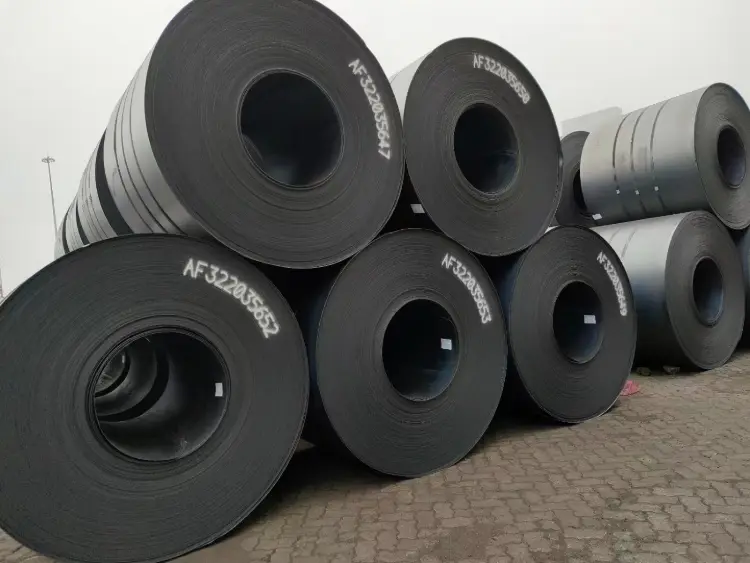
LR FH32 Shipbuilding Steel Coil
LR FH32 Shipbuilding Steel Coil - High-Strength Low-Temperature Structural Plate
Comprehensive material data sheet for LR FH32 shipbuilding steel coil: chemical composition, mechanical properties, physical performance, international equivalents, and application guidance.
Suitable for TMCP, normalising rolling, welding, cold forming, machining, and blasting/painting
- Phone : +8618037372205
- Email : [email protected]
- WhatsApp: Contact via Whtsapp
- WeChat: +8618037372205
LR FH32 Shipbuilding Steel Coil Introduction
LR FH32 is a high-strength, fine-grain structural steel for shipbuilding, certified to Lloyd's Register rules and complying with IACS UR W11. It is designed for critical hull structures requiring a minimum yield strength of 315 MPa and reliable notch toughness at temperatures as low as -60°C (longitudinal Charpy V‑notch ≥ 34 J). The grade is supplied as thermomechanically rolled (TMCP) or normalised coil/plate with excellent weldability, cold formability, and uniform mechanical properties across thicknesses up to 100 mm.
- Base composition of C‑Mn with controlled microalloying (Nb, V, Al) for grain refinement
- Delivered in normalising rolling or TMCP condition
- Meets ultra‑low‑temperature impact requirements (F‑class at –60°C)
LR FH32 Shipbuilding Steel Coil Chemical Composition
The chemical composition meets LR Rules for Grade FH32, consistent with IACS UR W11 for fine‑grain low‑temperature structural steel. Restriction on carbon equivalent (CEV) applies for weldability. Typical microalloying elements (Nb, V, Ti) are used singly or in combination to ensure grain refinement and notch toughness at −60°C. Maximum CEV ≤ 0.38% for thickness ≤ 50 mm, ≤ 0.40% for 50–100 mm (CEV = C+Mn/6+(Cr+Mo+V)/5+(Ni+Cu)/15).
| Element | Standard Value (wt%) | Remarks |
|---|---|---|
| Carbon (C) | ≤ 0.18 | Ladle analysis |
| Manganese (Mn) | 0.90 – 1.60 | Ladle analysis |
| Silicon (Si) | ≤ 0.50 | Ladle analysis |
| Phosphorus (P) | ≤ 0.035 | Ladle analysis |
| Sulfur (S) | ≤ 0.035 | Ladle analysis |
| Aluminium (Al, total) | ≥ 0.015 | Fine grain practice |
| Niobium (Nb) | 0.02 – 0.05 | Optional, singly or combined |
| Vanadium (V) | 0.05 – 0.10 | Optional, singly or combined |
| Titanium (Ti) | ≤ 0.02 | Optional; can be used for grain refinement |
| Nitrogen (N) | ≤ 0.009 | If Al present, free N limited |
LR FH32 Shipbuilding Steel Coil Thermal and Electrical Physical Properties
Physical properties are not part of the LR certification; the values below represent typical data for fine‑grained C‑Mn structural steels of similar composition and density (~7.85 g/cm³). They are suitable for design calculations under ambient and moderately elevated temperatures (<400°C). Actual values may vary slightly depending on the exact production route and thickness.
| Property | Standard Requirement Value | Unit | Test Conditions / Remarks |
|---|---|---|---|
| Density (ρ) | 7.85 | g/cm³ | At 20°C, typical |
| Elastic Modulus (E) | 210 | GPa | At 20°C, typical |
| Shear Modulus (G) | 81 | GPa | Calculated from E and ν |
| Poisson's Ratio (ν) | 0.3 | – | At 20°C, typical |
| Thermal Expansion Coefficient (α) | 11.5 – 12.5 | 10⁻⁶/K | Between 20°C and 100°C |
| Thermal Conductivity (λ) | 48 – 54 | W/(m·K) | At 20°C, typical |
| Specific Heat Capacity (cp) | 460 – 480 | J/(kg·K) | At 20°C, typical |
| Electrical Resistivity (ρe) | 0.20 – 0.25 | µΩ·m | At 20°C, typical |
LR FH32 Shipbuilding Steel Coil Mechanical Properties
Mechanical properties are determined in accordance with LR Rules and IACS UR W11 on test pieces taken from the finished coil/plate in the transverse or longitudinal direction, as applicable. For thickness ≤ 100 mm, the values below are minimum requirements except where a range is indicated. Impact testing at −60°C is mandatory for FH grade.
| Property | Specified Value (min, unless range) | Unit | Test Conditions |
|---|---|---|---|
| Yield Strength (ReH) | ≥ 315 | MPa | Transverse direction; applicable for t ≤ 100 mm |
| Tensile Strength (Rm) | 440 – 590 | MPa | Transverse direction; t ≤ 100 mm |
| Elongation (A5.65√So) | ≥ 22 | % | Longitudinal, gauge length 200 mm; t ≤ 100 mm |
| Charpy Impact Energy (KV) | ≥ 34 | J | Longitudinal, −60°C; specimen 10×10 mm |
LR FH32 Shipbuilding Steel Coil Fully Equivalent Material Standards and Replaceable Grades
| Country/Region | Standard | Grade | Remarks |
|---|---|---|---|
| International (IACS) | IACS UR W11 | FH32 | Common IACS standard for high‑strength hull structural steel |
| USA | ABS Rules | FH32 | Identical to LR FH32; interchangeable |
| France | BV Rules | FH32 | Identical; certified by Bureau Veritas |
| China | CCS Rules | FH32 | Identical; Chinese classification society |
| Norway/Germany | DNV Rules | FH32 | Identical; certified by DNV |
| South Korea | KR Rules | FH32 | Identical; Korean Register |
| Japan | NK Rules | FH32 | Identical; Nippon Kaiji Kyokai |
| Italy | RINA Rules | FH32 | Identical; Registro Italiano Navale |
LR FH32 Shipbuilding Steel Coil Application Introduction
LR FH32 steel coil is engineered for the most demanding shipbuilding and offshore structural applications where both high strength and guaranteed low‑temperature toughness are required. It is widely employed in the fabrication of primary hull members, deck plating, shell plating, stiffeners, and structural frameworks of vessels operating in cold‑climate or ice‑class conditions. Its excellent weldability (low CEV) and cold formability allow efficient assembly in shipyards.
- Industries: Shipbuilding, offshore engineering, marine construction, naval architecture
- Typical products: Merchant ships (container, bulk, tanker), ice‑strengthened vessels, offshore platforms (jackets, decks), floating production units, and heavy‑lift crane barges
- Common components: Hull plates (bottom, side, sheer strake), longitudinal stiffeners, transverse frames, bulkhead plates, deck girders, hatch coaming plates, and structural nodes
Product Applications: Ocean-going bulk carriers, tankers, container ships and LNG/LPG carriers, Ice-strengthened patrol vessels and icebreakers, Offshore oil & gas production platforms (jackets, decks, and flare booms), Floating production, storage and offloading (FPSO) units, Heavy-duty crane barges and pipelay vessels
Processed into products: Bottom, bilge and side shell plating, Longitudinal stiffeners, stringers and girders, Transverse web frames and floor plates, Watertight bulkheads and tank boundary bulkheads, Hatch coaming upper plates and reinforcement rings, Deck plating and deck longitudinal members, Structural nodes (e.g., bracket plates, insert plates) requiring high toughness at low temperature
Application industries: Shipbuilding (merchant, naval, ice-class vessels), Offshore engineering (platform topsides, jackets, modules), Marine construction (port structures, floating docks), Fabrication of pressure hulls and structural elements for subsea applications
LR FH32 Shipbuilding Steel Coil Similar or Comparable Substitute Material Recommendations
| Country/Region | Standard | Grade | Remarks |
|---|---|---|---|
| Europe | EN 10025‑4 | S355ML | Thermomechanically rolled weldable fine‑grain structural steel; Min yield 355 MPa, impact at −50°C (27 J); not fully equivalent due to higher strength and higher impact temperature |
| Europe | EN 10025‑3 | S355NL | Normalised fine‑grain structural steel; Min yield 355 MPa, impact at −50°C (27 J); suitable for low‑temperature service but not identical to FH32 |
| USA (ASTM) | ASTM A131 / A131M | FH32 | Actually identical to ABS FH32; could be considered equivalent but listed here as it follows ASTM/IACS cross‑reference |
| Japan | JIS G 3106 | SM490B/C/YA/YB | Welding structural steels with typical min yield 325–365 MPa, but impact temperatures only −10°C to −20°C; not suitable for −60°C unless special agreement |
Notes:
Note: LR FH32 coils are usually delivered with mill test certificates (EN 10204 3.1 or 3.2) stating chemical analysis, tensile test, and impact test at −60°C. Surface quality and dimensional tolerances follow EN 10029 or LR Rules. For welding, preheating is generally unnecessary for moderate thicknesses due to the low carbon equivalent, but a qualified welding procedure is required. When ordering, the specification should include delivery condition (N or TMCP), thickness, width, and length/coil weight. This data sheet represents the minimum requirements of the Lloyd's Register standard; supplementary requirements (e.g., through‑thickness Z‑grade, ultrasonic testing) may be agreed upon between the purchaser and manufacturer.
- Share



