
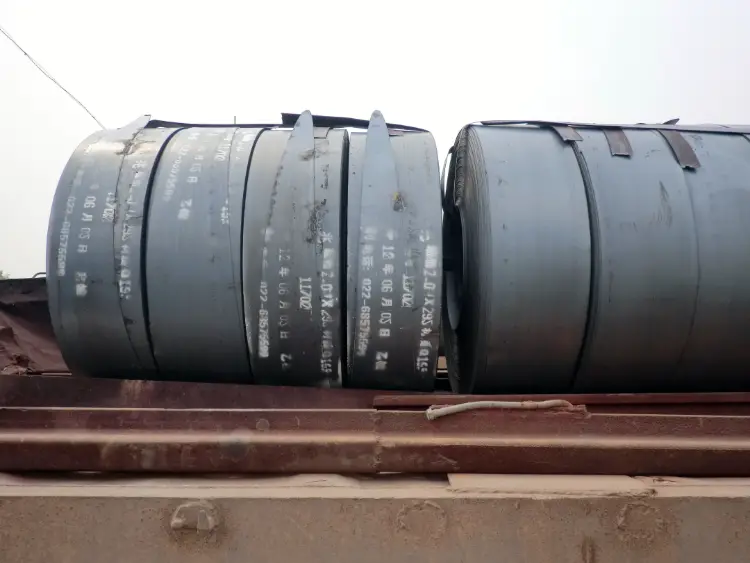
LR EH42 Shipbuilding Steel Coil
LR EH42 Shipbuilding Steel Coil - High-Strength Structural Material for Marine Applications
LR EH42 is a high-strength shipbuilding steel coil certified by Lloyd's Register, offering minimum yield strength of 420 MPa for critical marine structures.
Welding, cutting, forming, bending, machining, shot blasting
- Phone : +8618037372205
- Email : [email protected]
- WhatsApp: Contact via Whtsapp
- WeChat: +8618037372205
LR EH42 Shipbuilding Steel Coil Introduction
LR EH42 is a high-strength structural steel specifically designed for shipbuilding and offshore engineering, certified under the Lloyd's Register Rules for Materials. It belongs to the EH (extra high-strength) series, with a minimum yield strength of 420 MPa, excellent weldability, and good toughness at low temperatures down to -40 °C. The steel is typically supplied in coil form and processed into plates for hulls, decks, and stiffeners. Main features:
- High strength-to-weight ratio suitable for modern vessel design
- Low-temperature impact toughness ensures reliability in cold environments
- Good formability and weldability, compatible with automated welding processes
- Available in thermo-mechanically controlled (TMCP) or normalized condition
LR EH42 Shipbuilding Steel Coil Chemical Composition
The chemical composition of LR EH42 steel is strictly controlled to ensure high strength, weldability, and low-temperature toughness. Typical limits as per LR rules (ladle analysis) are listed below. Micro-alloying elements like Nb, V, Ti are added to refine grain size and improve strength without significantly impairing weldability. Key notes:
- Carbon equivalent (CEV) is usually limited to ≤0.38% for weldability.
- Al is required as a grain refiner and deoxidizer.
- Residual elements Cu, Cr, Ni, Mo are kept low to avoid temper embrittlement.
| Element | Standard Value (max %) | Remarks |
|---|---|---|
| Carbon (C) | 0.12 | Max |
| Silicon (Si) | 0.10 - 0.50 | As per thickness |
| Manganese (Mn) | 1.60 | Max |
| Phosphorus (P) | 0.025 | Max |
| Sulfur (S) | 0.025 | Max |
| Aluminum (Al) | 0.015 min (acid soluble) | Min |
| Niobium (Nb) | 0.05 | Max |
| Vanadium (V) | 0.10 | Max |
| Titanium (Ti) | 0.02 | Max |
| Copper (Cu) | 0.35 | Max |
| Chromium (Cr) | 0.20 | Max |
| Nickel (Ni) | 0.40 | Max |
| Molybdenum (Mo) | 0.08 | Max |
| Nitrogen (N) | 0.009 | If applicable, max |
LR EH42 Shipbuilding Steel Coil Thermal & Electrical Physical Properties
Typical physical properties for EH42 steel at room temperature and elevated temperatures, as commonly used for engineering calculations. These values are representative for low-alloy structural steels and may vary slightly with composition and processing. Notes:
- Thermal conductivity and specific heat are key inputs for welding preheat calculations.
- Thermal expansion coefficient matches that of common shipbuilding steels to minimize thermal stress.
- Electrical resistivity is low, typical for iron-based alloys.
| Property | Standard Value | Unit | Test Condition |
|---|---|---|---|
| Density (ρ) | 7.85 | g/cm³ | Room temperature |
| Elastic modulus (E) | 210 | GPa | Room temperature |
| Shear modulus (G) | 81 | GPa | Calculated from E and ν |
| Poisson's ratio (ν) | 0.3 | - | Elastic range |
| Thermal expansion coefficient (α) | 1.15 × 10⁻⁵ | /°C | 20–100 °C |
| Thermal expansion coefficient (α) | 1.24 × 10⁻⁵ | /°C | 20–200 °C |
| Thermal expansion coefficient (α) | 1.30 × 10⁻⁵ | /°C | 20–300 °C |
| Thermal conductivity (λ) | 52 | W/(m·K) | 20 °C |
| Thermal conductivity (λ) | 48 | W/(m·K) | 200 °C |
| Thermal conductivity (λ) | 44 | W/(m·K) | 400 °C |
| Specific heat capacity | 470 | J/(kg·K) | 20 °C |
| Specific heat capacity | 530 | J/(kg·K) | 200 °C |
| Specific heat capacity | 610 | J/(kg·K) | 400 °C |
| Electrical resistivity (ρ_e) | 0.20 | µΩ·m | At 20 °C |
LR EH42 Shipbuilding Steel Coil Mechanical Properties
Mechanical properties are determined according to LR rules using transverse or longitudinal test pieces. For coil material up to 50 mm thickness, the following minimum values apply. The steel exhibits excellent ductility and low-temperature impact toughness, making it suitable for welded structures in harsh marine environments. Test conditions:
- Test specimens are taken perpendicular to rolling direction unless otherwise agreed.
- Charpy V-notch tests are performed at -40 °C for EH grade.
- Bend tests are carried out on a diameter 3 times the specimen thickness (d=3a) for thickness up to 25 mm.
| Property | Standard Required Value | Unit | Test Condition |
|---|---|---|---|
| Yield strength (ReH) | 420 (min) | MPa | Thickness ≤ 50 mm, transverse |
| Yield strength (ReH) | 390 (min) | MPa | Thickness >50 – ≤70 mm, transverse |
| Yield strength (ReH) | 370 (min) | MPa | Thickness >70 – ≤100 mm, transverse |
| Tensile strength (Rm) | 530 - 680 | MPa | All thicknesses, transverse |
| Elongation (A5) | 18 (min) | % | Gauge length 5.65√S₀, thickness ≤50 mm |
| Elongation (A5) | 18 (min) | % | Thickness >50 mm |
| Charpy impact (KV) longitudinal | 41 (min) | J | At -40 °C, 10x10 mm specimen |
| Charpy impact (KV) transverse | 27 (min) | J | At -40 °C, 10x10 mm specimen |
| Bend test | d = 3a (180°) | - | Thickness ≤ 25 mm, no cracks or defects |
LR EH42 Shipbuilding Steel Coil Fully Equivalent Materials and Replaceable Grades
| Country/Region | Standard | Grade | Remarks |
|---|---|---|---|
| International | Lloyd's Register Rules | EH42 | Original specification |
| USA / International | ABS Rules | EH42 | Fully equivalent, same yield class |
| Norway / International | DNVGL Rules (now DNV) | E420 | Direct grade correspondence |
| France / International | Bureau Veritas Rules | EH42 | Equivalent mechanical requirements |
| China / International | China Classification Society (CCS) | EH42 | Equivalent grade, accepted for newbuilding |
| Italy / International | RINA Rules | E420 | Same yield and impact class |
| Japan / International | ClassNK Rules | KE42 | Former NK grade, same strength level |
| Russia / International | Russian Maritime Register (RS) | EH42 | EH42 under RS rules |
LR EH42 Shipbuilding Steel Coil Application Introduction
LR EH42 coil is predominantly used in marine and offshore environments where high strength and low-temperature toughness are essential. Its TMCP delivery condition ensures a fine-grained microstructure that balances strength, ductility, and weldability, making it ideal for automated panel line production in shipyards. Typical applications include:
Product Applications: Hull plates and shell plating, Strength decks and weather decks, Transverse and longitudinal bulkheads, Bottom and side shell stiffeners, Hatch coamings and container cell guides, Offshore modules and living quarter structures
Processed into products: Main deck panels, Sheer strakes, Bilge keels, Stringer plates, Web frames and brackets, Foundation plates for heavy machinery, Weld-in attachments and pad-eyes
Application industries: Commercial shipbuilding (container ships, bulk carriers, tankers), Naval architecture and defense vessels, Offshore oil & gas (platforms, FPSO, jack-up rigs), Marine engineering and port equipment, Ice-going and polar-class vessels
LR EH42 Shipbuilding Steel Coil Similar / Alternative Steel Grades
| Country/Region | Standard | Grade | Remarks & Typical Differences |
|---|---|---|---|
| International | LR Rules | EH36 | Lower yield strength (355 MPa), similar toughness; used where less strength is sufficient |
| International | LR Rules | EH47 | Higher yield strength (460 MPa), more stringent welding controls; suitable for weight-critical structures |
| Europe | EN 10025 | S420ML/ S420NL | Structural steels with similar yield, but toughness may not meet LR requirements at -40°C; not class-approved for primary ship structures without additional certification |
| USA | ASTM A131 | EH42 | ASTM version of EH42, essentially equivalent but may have different P/S limits; verify with class society |
| Japan | JIS G 3106 | SM490YM | High-strength weldable steel, yield 365 MPa; lower than EH42, not directly substitutable |
Notes:
Welding recommendations: EH42 steel requires low-hydrogen welding consumables and careful preheat/interpass temperature control to avoid cold cracking, especially in thicker sections. Maximum carbon equivalent (CEV) often specified at 0.38–0.43% depending on classification society. Certification: All material supplied under Lloyd's Register approval must be accompanied by mill certificates with CEV, mechanical test results, and non-destructive testing if agreed. Coils may need further leveling and cut-to-length processing before use. Corrosion protection: In service, standard marine coating systems (epoxy-based) are applied; shot blasting before coating ensures adequate adhesion. No special corrosion resistance is inherent; additional allowances for corrosion are given in design.
- Share



