
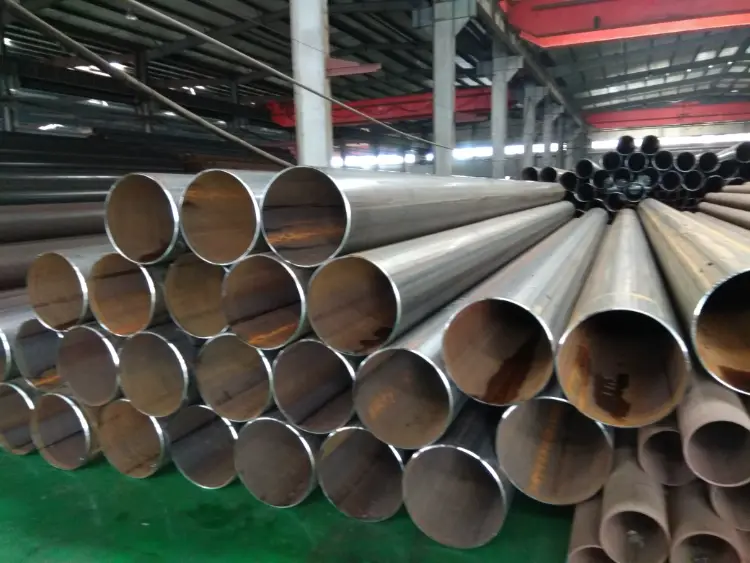
JIS G4305 SUS309S Stainless Steel Pipe
JIS G4305 SUS309S Stainless Steel Pipe: High-Temperature Oxidation Resistance & Strength
Comprehensive technical data for SUS309S stainless steel pipe under JIS G4305, including chemical composition, mechanical properties, thermal performance, international equivalents, and applications in high-temperature environments.
Welding, Bending, Cold Forming, Hot Forming, Machining
- Phone : +8618037372205
- Email : [email protected]
- WhatsApp: Contact via Whtsapp
- WeChat: +8618037372205
JIS G4305 SUS309S Stainless Steel Pipe Introduction
SUS309S, specified in JIS G4305 (Cold-Rolled Stainless Steel Plates, Sheets and Strip), is an austenitic chromium-nickel stainless steel engineered for elevated-temperature service. With a low carbon content (<0.08%) and high chromium (22–24%) and nickel (12–15%) levels, it exhibits excellent oxidation resistance up to approximately 1000°C in continuous service. The alloy maintains good strength and creep resistance at high temperatures, combined with good corrosion resistance in various atmospheres. The "S" designation indicates a reduced carbon variant of 309, minimizing carbide precipitation and improving weldability. Typical applications include
- Furnace components
- Heat exchangers
- Combustion chambers
- Petrochemical equipment
The material is supplied in solution-annealed condition, ensuring optimal formability and corrosion resistance.
JIS G4305 SUS309S Stainless Steel Pipe Chemical Composition
The chemical composition of SUS309S is defined by JIS G4305. The alloy features high chromium and nickel to provide superior oxidation resistance and stability at high temperatures. Carbon is restricted to ≤0.08% to suppress sensitization and enhance weldability. Manganese and silicon are controlled to maintain austenite stability and deoxidation. Phosphorus and sulfur are kept low for good hot workability and corrosion resistance. This composition balance delivers a combination of mechanical integrity and long-term thermal performance.
| Element | Standard Value (%) | Remarks |
|---|---|---|
| Carbon (C) | ≤ 0.08 | Low carbon to reduce carbide precipitation |
| Silicon (Si) | ≤ 1.00 | Deoxidizer; slight improvement in oxidation resistance |
| Manganese (Mn) | ≤ 2.00 | Austenite stabilizer and deoxidizer |
| Phosphorus (P) | ≤ 0.045 | Controlled for hot workability |
| Sulfur (S) | ≤ 0.030 | Controlled for weldability and toughness |
| Nickel (Ni) | 12.00 – 15.00 | Austenite former for high-temperature strength |
| Chromium (Cr) | 22.00 – 24.00 | Primary element for oxidation and corrosion resistance |
JIS G4305 SUS309S Stainless Steel Pipe Thermal and Electrical Physical Properties
The physical properties shown are typical for SUS309S in the solution-annealed condition. They are essential for design calculations in high-temperature service. Density is comparable to other austenitic grades. Thermal conductivity is relatively low, which may lead to heat retention. The coefficient of thermal expansion is higher than ferritic steels, requiring thermal expansion joints in design. The electrical resistivity is moderate, relevant for heating elements or electrical applications.
| Property | Typical Value | Unit | Test Condition / Remarks |
|---|---|---|---|
| Density (ρ) | 7.9 | g/cm³ | Room temperature |
| Elastic Modulus (E) | 200 | GPa | Room temperature |
| Shear Modulus (G) | 77 | GPa | Room temperature (calculated) |
| Poisson's Ratio (ν) | 0.3 | – | Room temperature |
| Thermal Expansion Coefficient (α) | 16.0 | 10⁻⁶/°C | 20–100°C |
| Thermal Expansion Coefficient (α) | 17.5 | 10⁻⁶/°C | 20–400°C |
| Thermal Conductivity (λ) | 15.0 | W/(m·K) | 100°C |
| Thermal Conductivity (λ) | 19.0 | W/(m·K) | 500°C |
| Specific Heat Capacity | 500 | J/(kg·K) | 0–100°C |
| Electrical Resistivity (ρ_e) | 0.78 | µΩ·m | 20°C |
JIS G4305 SUS309S Stainless Steel Pipe Mechanical Properties
The mechanical properties are determined on solution-annealed specimens in accordance with JIS G4305. For both plate and pipe applications, the minimum requirements ensure adequate ductility and strength. The elongation is measured with a gauge length of 50 mm for thickness ≤ 8 mm. Hardness values are provided as supplementary information. The bend test confirms formability without cracking. These properties make SUS309S suitable for structural components exposed to thermal cycling and moderate loads.
Note: For pipe products, the property requirements may be governed by JIS G3459 or ASTM A312; however, equivalent values generally apply.
| Property | Standard Required Value | Unit | Test Condition / Remarks |
|---|---|---|---|
| Tensile Strength (Rm) | ≥ 520 | MPa | Solution annealed, room temperature |
| Yield Strength (ReH, 0.2% offset) | ≥ 205 | MPa | Solution annealed, room temperature |
| Elongation (A) | ≥ 40 | % | Gauge length 50 mm, thickness ≤ 8 mm |
| Bend Test | 180° | – | Bend diameter = 2 × thickness (≤ 8 mm), no cracks |
| Hardness (HBW) | ≤ 187 | – | Optional; typical maximum |
| Hardness (HRB) | ≤ 90 | – | Optional; typical maximum |
| Hardness (HV) | ≤ 200 | – | Optional; typical maximum |
JIS G4305 SUS309S Stainless Steel Pipe Fully Equivalent Material Standards and Substitutable Grades
| Country/Region | Standard | Grade | Remarks |
|---|---|---|---|
| Japan | JIS G4305 / G3459 | SUS309S | Base specification; also for pipe under G3459 |
| USA | ASTM A240/A240M / A312 | 309S | Plates, sheets, and pipe; UNS S30908 |
| EU | EN 10088-2 / EN 10217-7 | 1.4833 (X12CrNi23-13) | Austenitic stainless steel for high temperature |
| China | GB/T 3280 / GB/T 14976 | 06Cr23Ni13 | Equivalent to SUS309S; 06Cr23Ni13 pipe available |
| Japan | JIS G4304 | SUS309S | Hot-rolled plates; same chemistry and mechanicals |
| International | ISO 15510 | X12CrNi23-13 | International designation matching 1.4833 |
JIS G4305 SUS309S Stainless Steel Pipe Application Introduction
SUS309S is engineered for applications demanding high-temperature oxidation resistance combined with moderate strength. It resists scaling up to 980°C in intermittent service and 1090°C in continuous service. The low carbon content avoids sensitization in as-welded thin sections, making it suitable for welded structures without post-weld heat treatment. Common uses span from industrial furnaces to power generation. It can be processed into pipes, tubes, fittings, plates, and custom fabrications.
Product Applications: Seamless and welded stainless steel pipes and tubes, Plates and sheets for furnace casings and ducting, Bar and rod for fasteners and support structures in hot areas, Fittings: flanges, elbows, reducers, Wire for resistance heating elements (in less demanding applications)
Processed into products: Radiant tubes for continuous carburizing furnaces, Superheater and reheater tubes in thermal power plants, Retorts and muffles for heat treatment processes, Combustion chamber liners, High-temperature piping in chemical reactors, Exhaust system components for high-performance engines
Application industries: Petrochemical and Refining: furnace tubes, reformer tubes, cracking units, Power Generation: superheater and reheater tubing, boiler parts, Heat Treatment and Metallurgy: radiant tubes, muffles, retorts, combustion chambers, Automotive: exhaust manifolds, catalytic converter shells (high-temperature zone), Industrial Furnaces: burners, kiln liners, conveyor rollers, Food Processing: high-temperature ovens and dryers (where oxidation resistance is needed)
JIS G4305 SUS309S Stainless Steel Pipe Near-Equivalent or Similar Substitute Materials
| Country/Region | Standard | Grade | Remarks |
|---|---|---|---|
| Japan | JIS G4305 | SUS309 | Higher carbon (≤0.20%), better strength but lower weldability |
| Japan | JIS G4305 | SUS310S | Higher Cr (24–26%) and Ni (19–22%) for more severe oxidation up to 1100°C |
| USA | ASTM A240 | 309H | Carbon content 0.04–0.10%, provides higher creep strength |
| EU | EN 10088-2 | 1.4828 (X15CrNiSi20-12) | Silicon alloyed for improved oxidation resistance |
| China | GB/T 3280 | 20Cr23Ni13 | Similar to 309, higher carbon than SUS309S |
Notes:
For pipe applications, the purchaser should confirm the governing standard (e.g., JIS G3459 or ASTM A312) as mechanical properties and tolerances may differ slightly from JIS G4305 sheets. Welding: Use filler metals ER309 or ER309L to match corrosion resistance. Post-weld heat treatment is generally not required for thin sections but may be needed for heavy wall components to relieve stress. SUS309S is not recommended for extensive exposure to sulfurous atmospheres above 600°C due to possible sulfidation. Always verify material specifications for critical components.
- Share



