
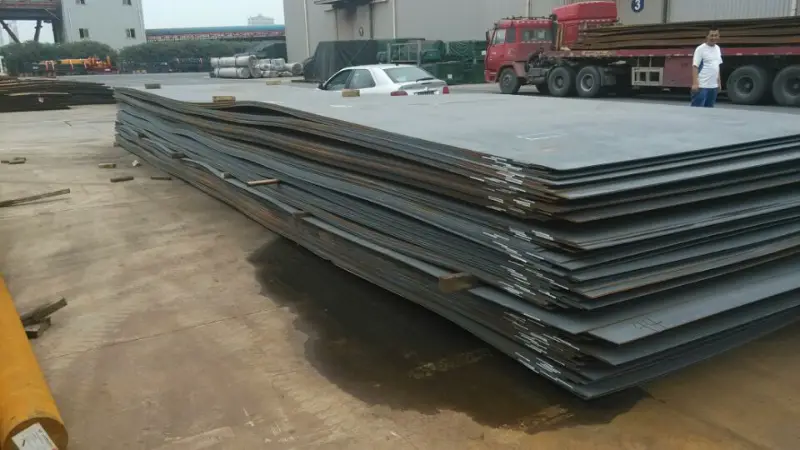
JIS G3106 SM490C High-Strength Weldable Structural Steel Plate
SM490C High-Strength Weldable Structural Steel Plate to JIS G3106
Detailed material data and international equivalents for SM490C carbon and low-alloy high-strength steel plate used in welded structures.
Hot rolling, normalizing, controlled rolling, quenching and tempering (upon agreement)
- Phone : +8618037372205
- Email : [email protected]
- WhatsApp: Contact via Whtsapp
- WeChat: +8618037372205
JIS G3106 SM490C High-Strength Weldable Structural Steel Plate Introduction
SM490C is a structural steel plate grade defined in Japanese Industrial Standard JIS G3106 for rolled steels used in welded structures. It belongs to the SM490 series, offering a minimum tensile strength of 490 MPa and guaranteed Charpy impact toughness at 0 °C with an average absorbed energy of at least 47 J. This grade is intended for applications where high reliability and resistance to brittle fracture are required, such as in bridges, ships, heavy machinery, and building frameworks.
- Excellent weldability due to controlled carbon equivalent.
- Good balance of strength and ductility.
- Available in plate, sheet, and strip forms, typically delivered in the as-rolled or normalized condition.
- Often supplied with optional through-thickness tensile or impact testing.
SM490C is differentiated from SM490A (no impact requirement) and SM490B (27 J at 0 °C) by its higher toughness, making it suitable for dynamic and low-temperature service environments.
JIS G3106 SM490C High-Strength Weldable Structural Steel Plate Chemical Composition
Chemical composition per JIS G3106 for SM490C. Values are maximum unless a range is indicated. Carbon equivalent (Ceq) is usually agreed upon to ensure weldability. Residual elements such as Cr, Ni, Cu may be present as part of the steelmaking process. For thicknesses > 100 mm, slightly higher limits may apply as noted.
| Chemical Element | Standard Value (wt.%) | Remarks |
|---|---|---|
| Carbon (C) | ≤0.18 | For thickness ≤50 mm. For 50 < t ≤ 100 mm: ≤0.20 |
| Silicon (Si) | ≤0.55 | |
| Manganese (Mn) | ≤1.60 | |
| Phosphorus (P) | ≤0.035 | |
| Sulfur (S) | ≤0.035 | |
| Carbon Equivalent (Ceq) | Usually ≤0.44 (t≤40 mm) agreed upon | Ceq = C + Mn/6 + (Cr+Mo+V)/5 + (Ni+Cu)/15 |
JIS G3106 SM490C High-Strength Weldable Structural Steel Plate Thermal and Electrical Physical Properties
The following physical properties are representative of SM490C steel at room temperature unless otherwise noted. These values are for general engineering guidance and are not mandatory per JIS G3106. Properties may vary slightly with exact chemistry and heat treatment condition.
| Property | Typical Value | Unit | Condition / Remarks |
|---|---|---|---|
| Density (ρ) | 7.85 | g/cm³ | 20 °C |
| Elastic Modulus (E) | 210 | GPa | 20 °C |
| Shear Modulus (G) | 80 | GPa | 20 °C, calculated from E and poisson ratio |
| Poisson's Ratio (ν) | 0.3 | - | |
| Thermal Expansion Coefficient (α) | 11.5–12.5 × 10⁻⁶ | /K | 20–100 °C |
| Thermal Conductivity (λ) | 53 | W/(m·K) | 20 °C |
| Specific Heat Capacity (cₚ) | 0.46 | J/(g·K) | 20 °C |
| Electrical Resistivity (ρₑ) | 0.22 | µΩ·m | 20 °C |
JIS G3106 SM490C High-Strength Weldable Structural Steel Plate Mechanical Properties
Mechanical properties according to JIS G3106 for SM490C steel plates. Yield strength depends on thickness and decreases in thicker sections. Tensile strength remains 490–610 MPa for all thicknesses up to 200 mm. Charpy V-notch impact test at 0 °C is mandatory, with an average requirement of ≥47 J and individual minimum ≥33 J. Bending test is 180° flat bend with different internal diameters based on thickness. Elongation values are for standard test pieces.
| Property | Standard Value | Unit | Test Condition |
|---|---|---|---|
| Yield Strength (ReH) | ≥325 | MPa | Thickness ≤16 mm |
| Yield Strength (ReH) | ≥315 | MPa | Thickness >16 to 40 mm |
| Yield Strength (ReH) | ≥295 | MPa | Thickness >40 to 75 mm |
| Yield Strength (ReH) | ≥295 | MPa | Thickness >75 to 100 mm |
| Yield Strength (ReH) | ≥285 | MPa | Thickness >100 to 160 mm |
| Yield Strength (ReH) | ≥275 | MPa | Thickness >160 to 200 mm |
| Tensile Strength (Rm) | 490–610 | MPa | All thicknesses |
| Elongation (A) | ≥17 (No.5 test piece) | % | Thickness ≤16 mm, gauge length 50 mm |
| Elongation (A) | ≥21 (No.1A test piece) | % | Thickness >16 mm, gauge length 200 mm |
| Elongation (A) | ≥23 (No.1A test piece) | % | Thickness >40 mm, gauge length 200 mm (depending on standard edition) |
| Bending Test (180°) | d = 1.5a | - | Thickness ≤16 mm, a = specimen thickness |
| Bending Test (180°) | d = 2.0a | - | Thickness >16 to 100 mm |
| Charpy Impact (KV₂) | ≥47 (average), ≥33 (single) | J | At 0 °C, V-notch test piece, longitudinal |
JIS G3106 SM490C High-Strength Weldable Structural Steel Plate Completely Equivalent Material Standards and Replaceable Grades
| Country/Region | Standard | Grade | Remarks |
|---|---|---|---|
| Japan | JIS G3106 | SM490C | Original specification; exactly matches the composition, mechanical properties, and impact requirements. |
| International | ISO 630 (historical) | Fe 510 D | Old ISO designation; similar tensile strength and impact at 0 °C, but exact limits may differ. |
| China | GB/T 1591 | Q345D | Minimum yield strength 345 MPa; tensile 470–630 MPa; 0 °C impact 34J. Verify equivalence for thickness ranges. |
| Europe | EN 10025-2 | S355J2+N / S355J2 | Yield 355 MPa, tensile 470–630 MPa, 0 °C impact 27J (J2) or 40J (J2+N). Closest European match; not fully identical. |
| USA | ASTM A572/A572M | Grade 50 [345] | Minimum yield 345 MPa, tensile 450 MPa; optional impact. Often used as alternative but lower tensile strength. |
JIS G3106 SM490C High-Strength Weldable Structural Steel Plate Application Introduction
SM490C steel is designed for demanding welded structures where reliability under dynamic loading and moderate service temperatures are crucial. Its guaranteed impact energy at 0 °C makes it suitable for outdoor and cold-climate applications. Typical usage includes:
Product Applications: Welded beams and columns for high-rise buildings, Bridge girders, trusses, and deck plates, Ship hulls, decks, and bulkheads, Offshore platform modules and legs, Wind turbine tubular towers, Industrial storage tanks and silos, Heavy-duty crane booms and excavator arms, Lifting and transport equipment frames
Processed into products: Flanges, web plates, and stiffeners in built-up sections, Base plates, end plates, and anchor plates, Gusset plates and node connections, Welded brackets and cleats, Penstock shells and ring stiffeners, Frame corners and mounting plates, Padeyes and lifting lugs
Application industries: Construction and civil engineering, Shipbuilding and marine structures, Bridge engineering, Offshore oil and gas platforms, Wind energy tower fabrication, Heavy machinery and mining equipment, Pressure vessel and penstock manufacturing, Railway rolling stock and automotive structural parts
JIS G3106 SM490C High-Strength Weldable Structural Steel Plate Similar or Alternative Material Recommendations
| Country/Region | Standard | Grade | Remarks |
|---|---|---|---|
| Japan | JIS G3106 | SM490B | Lower impact toughness requirement (27 J at 0 °C); may be used where 47 J is not mandatory. |
| Japan | JIS G3106 | SM520C | Higher tensile strength (520–640 MPa); similar impact toughness; for strength-critical designs. |
| Japan | JIS G3101 | SS490 | General structural rolled steel, no impact requirement; for non-critical applications. |
| South Korea | KS D 3515 | SM490C | Korean standard essentially identical to JIS G3106. |
| China | GB/T 1591 | Q420D | Higher strength (420 MPa yield); similar low-temperature toughness; for advanced designs. |
| Europe | EN 10025-3 | S355NL | Normalized fine-grain steel with improved low-temperature toughness ( –50 °C). |
Notes:
Additional Information:
- Thickness ranges up to 200 mm are covered; for thicker plates, the purchaser should agree on properties with the manufacturer.
- Optional tests such as through-thickness tensile (Z-direction) per JIS G 3199 may be specified.
- Ultrasonic testing as per JIS G 0801 is often required for critical applications.
- Welding consumables must be selected to match the base metal strength and toughness (e.g., JIS Z 3212 electrodes).
- Preheating may be required for thick sections or high restraint joints to prevent cold cracking.
- SM490C can be hot-dip galvanized; however, care must be taken with silicon content to minimize coating defects.
- The steel can be cold-formed provided bending radii follow standard guidelines (≥ 2t).
- Share



