
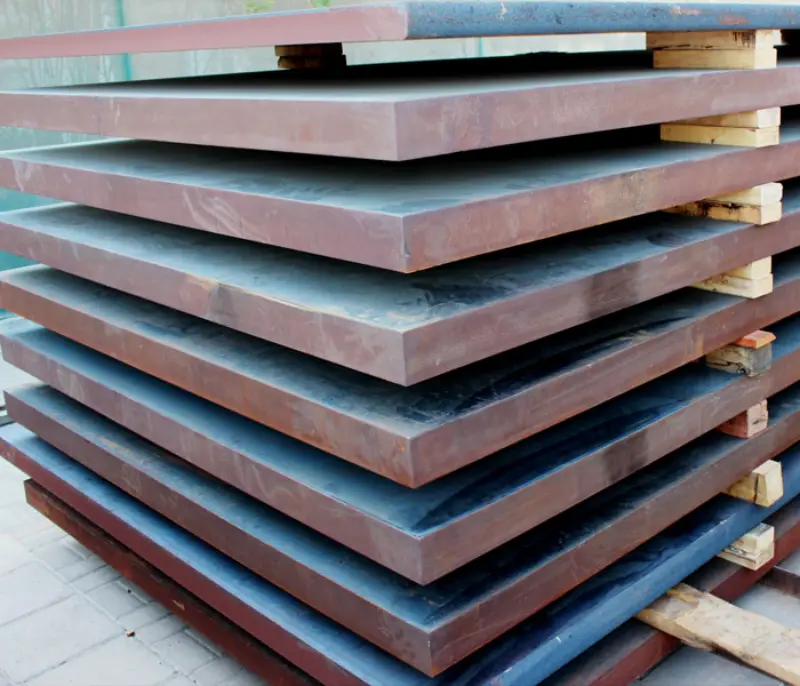
JIS G3106 SM400C Carbon Steel for Welded Structures
JIS G3106 SM400C Carbon Steel for Welded Structures (LSAW Pipe Base Metal)
Comprehensive material data for SM400C steel according to JIS G3106 standard, covering chemical composition, mechanical and physical properties, international equivalents, and application guidance for LSAW pipes.
Hot rolling, cold forming, hot forming, gas cutting, submerged arc welding (LSAW/SAW), machining, straightening
- Phone : +8618037372205
- Email : [email protected]
- WhatsApp: Contact via Whtsapp
- WeChat: +8618037372205
JIS G3106 SM400C Carbon Steel for Welded Structures Introduction
SM400C is a weldable structural carbon steel grade defined in JIS G3106, primarily used for rolled plates and strips in welded construction. It delivers a minimum yield strength of 245 MPa (for thickness ≤16 mm) and tensile strength in the range of 400–510 MPa. The 'C' suffix guarantees Charpy V‑notch impact energy of at least 47 J at 0 °C, ensuring reliable toughness for service in moderate‑low temperature environments. The material is commonly supplied in hot‑rolled condition and serves as the base metal for LSAW (Longitudinal Submerged Arc Welded) pipes, which are widely employed in liquid and gas transmission pipelines. SM400C combines excellent weldability, good formability, and cost‑effective strength, making it a preferred choice for general structures, bridges, shipbuilding, and industrial equipment.
JIS G3106 SM400C Carbon Steel for Welded Structures Chemical Composition
Chemical composition limits in accordance with JIS G3106 for SM400C. The carbon content is tightly controlled to maintain weldability, while manganese and silicon are added for deoxidation and to meet tensile strength requirements. Phosphorus and sulfur are kept low to avoid embrittlement and hot cracking.
| Element | Standard Value | Remarks |
|---|---|---|
| C | ≤ 0.18 (t ≤ 16 mm); ≤ 0.20 (16 < t ≤ 40 mm); ≤ 0.22 (40 < t ≤ 100 mm) | Thickness‑dependent maximum |
| Mn | ≤ 1.40 (t ≤ 40 mm); ≤ 1.50 (40 < t ≤ 100 mm) | Thickness‑dependent maximum |
| Si | ≤ 0.35 | — |
| P | ≤ 0.035 | — |
| S | ≤ 0.035 | — |
JIS G3106 SM400C Carbon Steel for Welded Structures Thermal & Electrical Physical Properties
Physical properties reported here are typical values for carbon steel (based on engineering references) since JIS G3106 does not specify them. They are suitable for design calculations involving heat treatment, thermal stress analysis, or welding simulation. Actual values may vary slightly depending on the exact composition and heat treatment condition.
| Property | Typical Value | Unit | Test Condition |
|---|---|---|---|
| Density (ρ) | 7850 | kg/m³ | Room temperature |
| Elastic modulus (E) | 200 – 210 | GPa | Room temperature |
| Shear modulus (G) | ~ 80 | GPa | Room temperature |
| Poisson's ratio (ν) | 0.29 – 0.30 | — | Room temperature |
| Thermal expansion coefficient (α) | 11.5 – 12.0 | ×10⁻⁶ /K | 20 – 100 °C |
| Thermal conductivity (λ) | 50 – 54 | W/(m·K) | Room temperature |
| Specific heat capacity (cₚ) | 460 – 490 | J/(kg·K) | Room temperature |
| Electrical resistivity (ρₑ) | 0.15 – 0.20 | μΩ·m | Room temperature |
JIS G3106 SM400C Carbon Steel for Welded Structures Mechanical Properties
Tensile test results apply to hot‑rolled plates and strips. Yield strength and tensile strength are influenced by product thickness. Elongation requirements depend on the gauge length of the test specimen (No. 5 or No. 4). The Charpy impact test is mandatory for SM400C at 0 °C, applicable only to thicknesses greater than 12 mm. Bending tests are performed with a 180° bend.
| Property | Standard Requirement | Unit | Test Condition / Thickness Range |
|---|---|---|---|
| Upper yield strength (ReH) | ≥ 245 | MPa | t ≤ 16 mm |
| Upper yield strength (ReH) | ≥ 235 | MPa | 16 < t ≤ 40 mm |
| Upper yield strength (ReH) | ≥ 215 | MPa | 40 < t ≤ 100 mm |
| Tensile strength (Rm) | 400 – 510 | MPa | t ≤ 100 mm (all thicknesses) |
| Elongation (A) – No. 5 specimen | ≥ 23 | % | t ≤ 5 mm |
| Elongation (A) – No. 5 specimen | ≥ 18 | % | 5 < t ≤ 16 mm |
| Elongation (A) – No. 4 specimen | ≥ 22 | % | 16 < t ≤ 50 mm |
| Elongation (A) – No. 4 specimen | ≥ 24 | % | 50 < t ≤ 100 mm |
| Bend test (180°) – inner radius | 0.5 a (a = sample thickness) | — | t ≤ 16 mm |
| Bend test (180°) – inner radius | 1.0 a | — | 16 < t ≤ 100 mm |
| Charpy impact energy – KV₂ (0 °C) | ≥ 47 (average of 3 tests); ≥ 34 (individual) | J | t > 12 mm; V‑notch specimen |
JIS G3106 SM400C Carbon Steel for Welded Structures Equivalent Material Standards & Replaceable Grades
| Country / Region | Standard | Grade | Remarks |
|---|---|---|---|
| Japan | JIS G3106 | SM400C | Original standard; base grade for this analysis |
| Korea | KS D 3515 | SM400C | Korean adaptation of JIS; identical technical requirements |
| Taiwan | CNS 2947 | SM400C | Taiwanese standard; same designation and requirements |
| China | GB/T 1591 | Q275C | Similar strength and 0 °C impact toughness; yield slightly higher (275 MPa at thin gauge) |
| EU | EN 10025-2 | S275J0 | Comparable tensile class and 0 °C impact; yield ~275 MPa, tensile 410‑560 MPa |
| USA | ASTM A572 / A572M | Grade 42 [290] | Min yield 290 MPa, tensile ≥415 MPa; toughness by supplementary requirements |
JIS G3106 SM400C Carbon Steel for Welded Structures Application Introduction
SM400C steel, especially in the form of hot‑rolled plates, is well‑suited for manufacturing LSAW (Longitudinal Submerged Arc Welded) pipes and large welded structures. Its controlled chemistry ensures good weldability without preheat in moderate thicknesses, while the guaranteed 0 °C impact toughness makes it reliable for outdoor installations and moderate‑climate pipelines. The material can be formed into tubular products (cold or hot), cut to shape, and connected by conventional welding processes (SAW, SMAW, GMAW).
Product Applications: LSAW steel pipes (API 5L PSL1 or custom specifications), Welded hollow sections (square, rectangular, circular), Fabricated bridge girders and arched steel frames, Steel pipe piles and retaining wall systems, Tubular towers and masts (for lighting, telecommunication), Pressure piping systems (low‑medium pressure)
Processed into products: Pipe spools and elbows for pipeline networks, Flanges (backing flanges, slip‑on flanges) welded to SM400C pipe ends, Sleeves and branch connections (weld‑on tees and olets), Pipe‑pile connectors and reinforcement collars, Stiffened plates and gusset plates in structural assemblies, Tube‑to‑tube sheet weldments in heat exchangers (non‑corrosive service), Support saddles and anchor blocks for piping
Application industries: Oil and gas transmission pipeline (LSAW pipes for onshore and offshore), Water supply and sewage systems, Civil and infrastructure engineering (bridges, viaducts, steel buildings), Shipbuilding (secondary structural members, deck plates), Port and harbour structures (steel pipe piles, dolphins), Power plants (cooling water pipes, structural modules), General machinery (frames, supports, non‑pressurised vessels)
JIS G3106 SM400C Carbon Steel for Welded Structures Similar / Substitute Materials
| Country / Region | Standard | Grade | Remarks |
|---|---|---|---|
| EU | EN 10025-2 | S235J2 | Lower strength (yield 235 MPa) but −20 °C toughness; suitable for less demanding structural applications |
| USA | ASTM A36 / A36M | A36 | Widely used structural carbon steel; yield ≥250 MPa, tensile 400‑550 MPa; impact often not required |
| China | GB/T 700 | Q235C | Yield 235 MPa, tensile 370‑500 MPa; 0 °C impact; commonly used for welded structures |
| Russia | GOST 380 / GOST 27772 | St3ps / S245 | Similar weldable structural steel; tensile 360‑460 MPa, impact varies with category |
Notes:
- In welded pipe production, the plate edge preparation and welding consumables must be compatible with the SM400C base metal to maintain joint toughness.
- For thicknesses over 40 mm, post‑weld heat treatment (PWHT) may be necessary to relieve residual stresses, depending on the service code.
- SM400C does not possess improved atmospheric corrosion resistance; for aggressive environments, consider JIS G3114 SMA400 series or painted/coated protection.
- When substituting SM400C with other standards, verify the minimum impact temperature and yield strength for the intended design code.
- Share



