
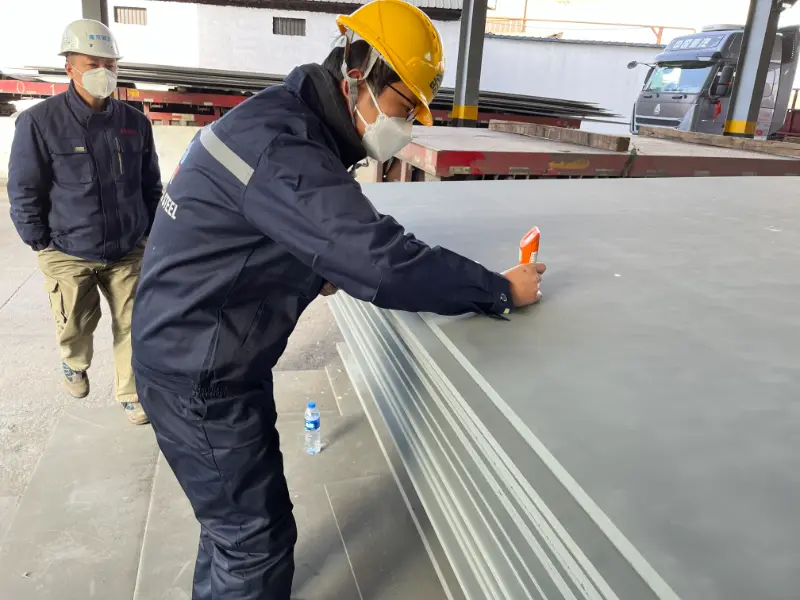
JIS G 3116 SG255 Steel Material for Welded Gas Cylinders
JIS G 3116 SG255 Steel for Welded Gas Cylinders - Properties & Equivalents
Comprehensive technical data for JIS G 3116 SG255 steel sheets, coils and plates used in welded gas cylinders. Includes chemical composition, mechanical properties, thermal and electrical properties, international equivalents, and application guide.
Hot rolling, cold forming, welding, deep drawing, bending
- Phone : +8618037372205
- Email : [email protected]
- WhatsApp: Contact via Whtsapp
- WeChat: +8618037372205
JIS G 3116 SG255 Steel for Welded Gas Cylinders Introduction
JIS G 3116 SG255 is a hot-rolled steel for welded gas cylinders, specified by the Japanese Industrial Standards. It is a low-carbon manganese steel designed for pressure vessels requiring good weldability and formability. SG255 offers a minimum yield strength of 255 MPa and tensile strength of at least 400 MPa, making it suitable for LPG cylinders, industrial gas containers and high-pressure vessels. The steel is typically supplied in sheets, coils or plates under normalized or hot-rolled condition, with excellent notch toughness at ambient temperature and reliable performance in cylindrical vessel fabrication involving welding and drawing operations.
JIS G 3116 SG255 Steel for Welded Gas Cylinders Chemical Composition – SG255
Chemical composition according to JIS G 3116. Values are ladle analysis maximums unless range is specified. The steel is rimmed or semi-killed/killed, with controlled carbon equivalent to ensure weldability.
| Element | Standard Value | Remarks |
|---|---|---|
| Carbon (C) | ≤ 0.20 | Max |
| Silicon (Si) | ≤ 0.35 | Max |
| Manganese (Mn) | ≥ 0.30 | Min |
| Phosphorus (P) | ≤ 0.030 | Max |
| Sulfur (S) | ≤ 0.030 | Max |
| Carbon equivalent (Ceq) | ≤ 0.40 | Typically; calculated: Ceq = C + Mn/6 |
JIS G 3116 SG255 Steel for Welded Gas Cylinders Physical and Thermal Properties – SG255
Thermal, electrical and other physical properties at room temperature unless otherwise noted. These values are typical for low-carbon manganese steels and may vary slightly with processing.
| Property | Typical Value | Unit | Test Condition |
|---|---|---|---|
| Density (ρ) | 7.85 | g/cm³ | 20°C |
| Elastic Modulus (E) | 210 | GPa | 20°C |
| Shear Modulus (G) | 81 | GPa | 20°C |
| Poisson's Ratio (ν) | 0.30 | - | 20°C |
| Thermal Expansion Coefficient (α) | 11.5 × 10⁻⁶ | /K | 20–100°C |
| Thermal Conductivity (λ) | 52 | W/(m·K) | 20°C |
| Specific Heat Capacity (Cp) | 460 | J/(kg·K) | 20°C |
| Electrical Resistivity (ρ_e) | 0.18 × 10⁻⁶ | Ω·m | 20°C |
JIS G 3116 SG255 Steel for Welded Gas Cylinders Mechanical Properties – SG255
Mechanical properties for SG255 plates, sheets and coils according to JIS G 3116. Tests are performed on transverse test pieces. Yield strength and tensile strength are room temperature values. Elongation depends on thickness.
| Property | Standard Requirement | Unit | Test Condition |
|---|---|---|---|
| Yield Strength (ReH) | ≥ 255 | MPa | Room temperature, as-rolled/normalized, t ≤ 25 mm |
| Tensile Strength (Rm) | ≥ 400 | MPa | Room temperature |
| Elongation (A) | ≥ 21 (t ≤ 5 mm) | % | Gauge length 50 mm, transverse |
| Elongation (A) | ≥ 24 (5 < t ≤ 10 mm) | % | Gauge length 50 mm, transverse |
| Elongation (A) | ≥ 27 (10 < t ≤ 15 mm) | % | Gauge length 50 mm, transverse |
| Elongation (A) | ≥ 29 (15 < t ≤ 20 mm) | % | Gauge length 50 mm, transverse |
| Elongation (A) | ≥ 30 (20 < t ≤ 25 mm) | % | Gauge length 50 mm, transverse |
| Bend Test (Bend Radius) | No cracks, r = 1.0t (t ≤ 12 mm) | - | 180° bend, test piece width ≥ 30 mm |
| Bend Test (Bend Radius) | No cracks, r = 1.5t (t > 12 mm) | - | 180° bend |
| Impact Energy (KV) | ≥ 27 J at 0°C (for Charpy) | J | V-notch, transverse, only if specified by purchaser |
JIS G 3116 SG255 Steel for Welded Gas Cylinders Fully Equivalent Materials – International Standards & Grades
| Country/Region | Standard | Grade | Remarks |
|---|---|---|---|
| Japan | JIS G 3116 | SG255 | Original specification |
| China | GB 6653 | HP265 | Closest match, yield ≥265 MPa, TS ≥410 MPa, for gas cylinders |
| Europe | EN 10120 | P245NB | Gas cylinder steel, comparable chemistry and mechanicals |
| International | ISO 4978 | SG255 | Identical designation, fully equivalent |
| India | IS 6240 | SG255 | Same designation as JIS |
JIS G 3116 SG255 Steel for Welded Gas Cylinders Application Introduction
SG255 steel is specifically designed for the manufacture of welded gas cylinders. Its balanced strength and formability allow deep drawing and welding operations required for two-piece and three-piece cylinder construction. The steel is suitable for a wide range of industrial and domestic gas storage applications.
Product Applications: LPG domestic cylinders (5–50 kg), Industrial oxygen, nitrogen, argon cylinders, Acetylene cylinders, CNG cylinders for vehicles, Fire extinguisher bodies, High-pressure seamless steel cylinders (welded type)
Processed into products: Cylinder shells (upper and lower halves), End domes and dished ends, Foot rings and neck rings, Boss attachments, Welded seams (longitudinal and circumferential), Valve protector collars
Application industries: Industrial Gas Manufacturing, LPG Cylinder Producers, Pressure Vessel Fabrication, Automotive (CNG & Hydrogen Cylinders), Medical Gas Equipment
JIS G 3116 SG255 Steel for Welded Gas Cylinders Similar / Substitution Materials – Performance Close to SG255
| Country/Region | Standard | Grade | Remarks |
|---|---|---|---|
| China | GB 6653 | HP235 | Lower strength (YS ≥235 MPa) but same application, can be alternative |
| Europe | EN 10120 | P265NB | Higher strength (YS ≥265 MPa), all other characteristics similar |
| USA | ASTM A414 | Grade G | Similar yield and tensile range, for pressure vessels, not identical for gas cylinders |
| Japan | JIS G 3116 | SG295 | Higher strength version (YS ≥295 MPa), often used for larger cylinders |
| Korea | KS D 3532 | SG255 | Korean standard same as JIS |
Notes:
Weldability: SG255 offers excellent weldability without preheating due to low carbon content and low carbon equivalent. Formability: Suitable for cold forming, deep drawing and bending. Surface condition: Usually supplied as hot-rolled and may be pickled and oiled to remove mill scale. Non-destructive testing: May be required per customer specification for laminations and surface defects. Test certificates: Typically supplied with EN 10204 3.1 or JIS G 0415 type inspection certificate.
- Share



